
Moses Lake chamber talks water, education with governor
JOEL MARTIN | Hagadone News Network | UPDATED 2 years, 10 months AGO
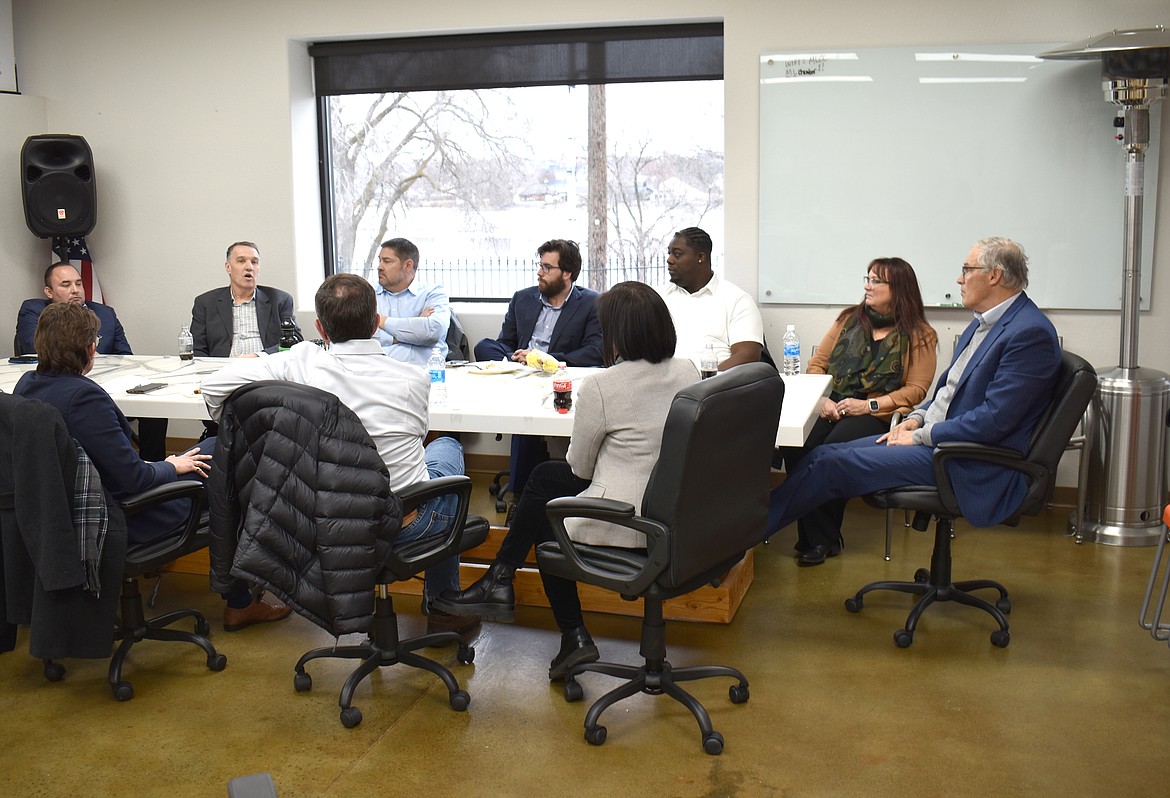
Washington Gov. Jay Inslee, right, listens to Moses Lake community leaders at the Moses Lake Chamber of Commerce Wednesday.
Joel Martin/Columbia Basin Herald
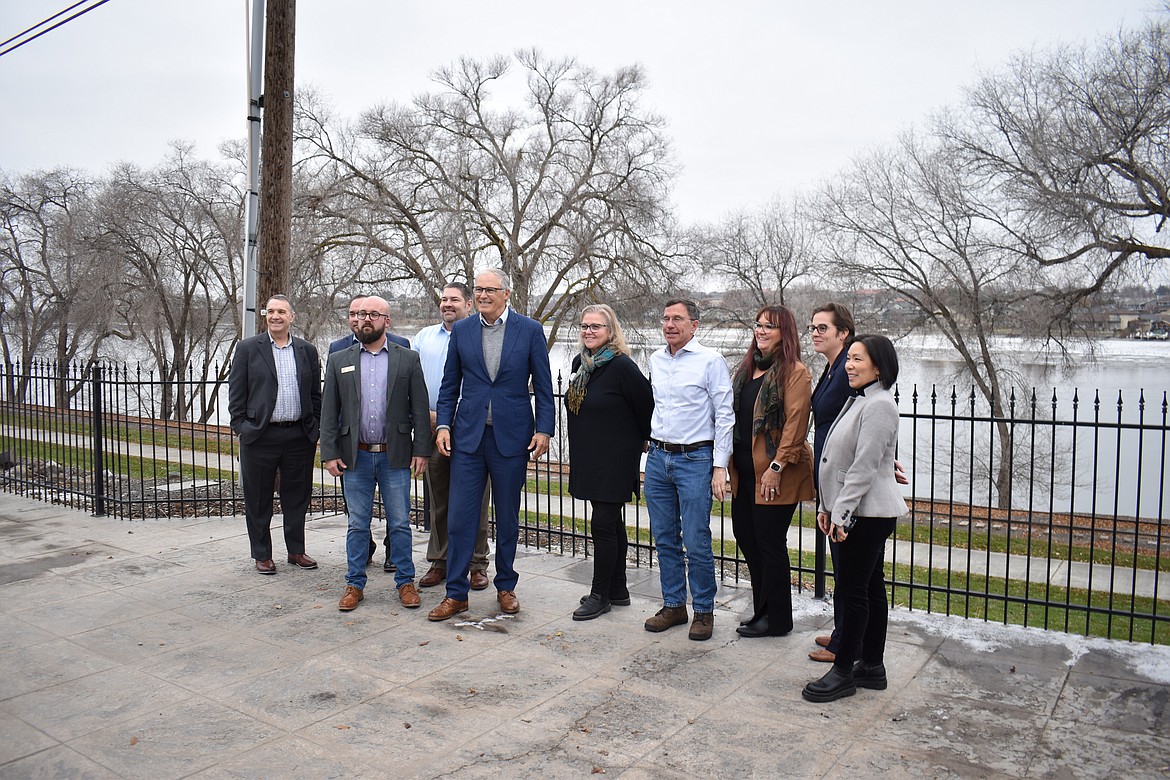
Washington Gov. Jay Inslee, poses for a photo with attendees at a round table meeting Wednesday at the Moses Lake Chamber of Commerce. From left: city Administrator Kevin Fuhr, Port of Moses Lake Director of Business Development Richard Hanover (partially obscured), Mayor Don Myers, Grant County Economic Development Council Executive Director Brant Mayo, Inslee, Chamber President Debbie Doran-Martinez, Group14 CEO Rick Luebbe, Chamber Marketing Director Lori Robins, Big Bend Community College President Sara Thompson Tweedy and Washington Department of Commerce Engagement and Outreach Speciali…
Joel Martin/Columbia Basin Herald
Joel Martin has been with the Columbia Basin Herald for more than 25 years in a variety of roles and is the most-tenured employee in the building. Martin is a married father of eight and enjoys spending time with his children and his wife, Christina. He is passionate about the paper’s mission of informing the people of the Columbia Basin because he knows it is important to record the history of the communities the publication serves. | November 30, 2023 4:27 PM
MOSES LAKE — Washington Gov. Jay Inslee had an opportunity to hear about the challenges facing Moses Lake at a round table discussion at the Moses Lake Chamber of Commerce on Wednesday.
Besides Chamber President Debbie Doran-Martinez and Marketing Director Lori Robins, the governor met with Moses Lake Mayor Don Myers, City Administrator Kevin Fuhr, Grant County Economic Development Council Executive Director Brant Mayo, Port of Moses Lake Director of Business Development Richard Hanover, Big Bend Community College President Sara Thompson Tweedy and Group14 CEO Rick Luebbe. Accompanying Inslee was Washington Department of Commerce Engagement and Outreach Specialist Soo Ing-Moody.
“First of all, Governor, we want to thank you for the $36 million that went into the budget to help us with water, more specifically getting surface water to do more irrigation,” Doran-Martinez told Inslee. “Also there was $4 million that was in the transportation budget that helped with bridges. So we were able to widen some bridges, put some bigger culverts in to deliver more water into the Columbia Basin Project. And then we've leveraged that and got more federal dollars as well for that project. We still don't have enough money to get it over the finish line, but every little bit helps.”
Water concerns
Fuhr said he saw water availability as crucial to Moses Lake’s economic growth.
“Our goal is to be a good partner, and to provide those services, those utilities, that these companies and our residents need to stay here. Our goal is for the Group14s and the Silas and the RECs to come here and be here for decades, not short-term, ‘We run out of water, may go somewhere else.’ Our goal is for them to be here for decades.”
The difficulty with that, Fuhr told Inslee, is that the city of Moses Lake has two wells that are shut down, which impedes the city’s ability to get water to businesses in the Port of Moses Lake area, as well as other users. The city has applied to the Bureau of Reclamation to take about 10 million gallons of surface water a day out of the local irrigation system, treat it and use it for the community and businesses. Unfortunately, Fuhr said. That's an expensive process, and until funding can be secured for that or another solution, the city is having difficulty meeting the needs even of residents inside the city limits, let alone the surrounding area.
“We got to figure something out,” Fuhr added. “Moses Lake’s growth right now is unprecedented. other than maybe back in the ’50s.”
Inslee said money raised through the Climate Commitment Act, which he signed into law in 2021, could possibly be used to fund water projects. The controversial law allows businesses to purchase allowances for greenhouse gas emissions at auction, the money from which is used to fund clean energy development. There is $1.5 million currently available for use from that fund, he said.
“That can help at least peripherally on water, to the extent we can tie it to mitigation of climate change,” Inslee said. “But you kind of usually can because the climate is changing and that's changing our hydrology … So that fund is a really sweet asset to address all of these issues. But it's at risk. There are those who want to eliminate that fund, by eliminating the Climate Commitment Act. If that happens, the ability to do these things goes poof, and it goes from $1.5 million to zero. It's not like a haircut. It's a total elimination.”
Expanding education
Thompson Tweedy spoke about the difficulty of providing educational opportunities to a service area as spread out as Big Bend’s. The college is located in Moses Lake and serves all of Grant and Adams counties as well as a portion of Lincoln County. Among other programs, Big Bend participates in Running Start, which allows students to earn post-secondary credit before they graduate high school. The college has also applied to become a Battery and Allied Technology Transformation Tech Hub, one of a handful across the country.
“What was in our BATT Tech Hub proposal was that we would build learning centers in Quincy, Mattawa and Othello, our next three largest population centers, so that we can start workforce development with high school students so that when they leave high school, they have the skills that they need to walk right into Group14, Sila, REC wherever else. And we're already working together to develop the curriculum for this.”
Big Bend’s service area has some of the lowest educational attainment rates and some of the highest poverty rates in the country, Thompson Tweedy said. In many communities, students have to start with English language acquisition, which makes the educational trajectory a long one indeed to prepare a student for a job at a high-tech company, she explained.
“We have been doing a lot of work with our high schools in those areas, to talk about what kind of collaborations we need,” she said. “But to be quite frank, the way (community and technical colleges) are funded doesn't allow for that to happen ... in an efficient and effective way. So I don't have the human power and I don't have the flexibility in my budget.”
Colleges also need better ways of coordinating so that credits earned through Running Start carry over to the college of the student’s choice, Thompson Tweedy said.
“Is there fruit to be gained by getting colleges to recognize other people's credits more effectively?” Inslee asked.
“What would also go a million miles is us having the resources so that we can put the learning centers in those communities,” Thompson Tweedy said. “Because here's the embedded inequity: If you live in Moses Lake, you have access to Big Bend. And you can see we're 10 minutes away from just about any place in Moses Lake, and there is public transportation. If you live in Mattawa, the opportunity window is open about (holding up two fingers close together) this much.”
Joel Martin may be reached via email at [email protected].
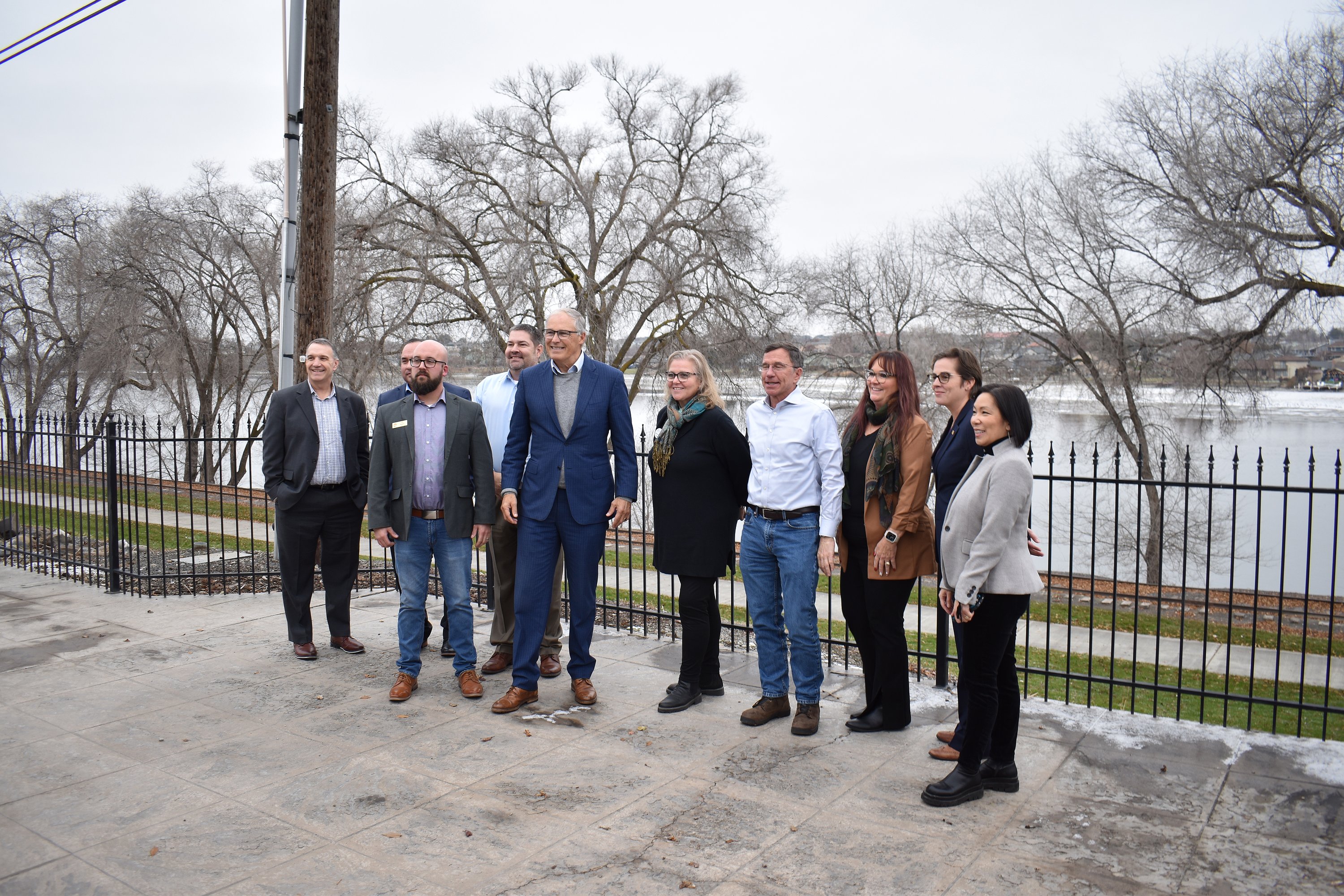 Washington Gov. Jay Inslee, poses for a photo with attendees at a round table meeting Wednesday at the Moses Lake Chamber of Commerce. From left: city Administrator Kevin Fuhr, Port of Moses Lake Director of Business Development Richard Hanover (partially obscured), Mayor Don Myers, Grant County Economic Development Council Executive Director Brant Mayo, Inslee, Chamber President Debbie Doran-Martinez, Group14 CEO Rick Luebbe, Chamber Marketing Director Lori Robins, Big Bend Community College President Sara Thompson Tweedy and Washington Department of Commerce Engagement and Outreach Specialist Soo Ing-Moody.
Joel Martin/Columbia Basin Herald
ARTICLES BY JOEL MARTIN
Endless battle
Noxious Weed Control Board works to keep invasive plants under control
MOSES LAKE — Some of the nastiest plants in Grant County were the topic of a class led by Jay Johnson, a consultant with the Grant County Noxious Weed Control Board, Tuesday. The Noxious Weed Control Board, as its name would suggest, is tasked with keeping weeds under control in Grant County. That’s not a small job; the board’s website lists 129 species of noxious weeds that are found around Grant County. A noxious weed is defined as an invasive, non-native plant that threatens agricultural crops, local ecosystems or fish and wildlife habitat, according to the Noxious Weed Control Board. Washington state law requires that these weeds be identified and their spread kept to a minimum, if not completely eradicated. “We’re one of those agencies a lot of people don’t really understand,” Johnson said. “We’re a county office and … our funding is tax-based assessment. When you get your tax bill and you look down at all the expenses that you pay for, there we are.”
BASIN EVENTS: Oct. 16-24
COLUMBIA BASIN — Whether you feel like shopping, crafting, learning or seeing a show, there’s something happening for you this week in the Basin. Oct. 16 ‘My Family (Mi Familia)’ screening Spanning three generations, “My Family (Mi Familia)” is a heartfelt drama that follows the Sánchez family as they build their lives in East Los Angeles. Through love, hardship, triumph, and sacrifice, the film explores the immigrant experience, the strength of family bonds, and the traditions that connect one generation to the next. Lowrider show and taco truck before the screening. Sponsored by Columbia Basin Allied Arts, EDUBS C/S and the Moses Lake Creative District. $12 per person. Doors open at 6 p.m., film begins at 7 p.m. at the Moses Lake Civic Center Auditorium, 401 S. Balsam St. Tickets and info: www.cba-arts.org.
Moses Lake author encourages women to look beyond church culture norms
MOSES LAKE — A Moses Lake author’s book, “A Christian Woman Striving to Live Her Faith in a Man-Controlled World,” takes aim at the role to which many churches relegate the female half of their congregations. “It’s to encourage women in the faith,” Linda Curran said. “A lot of churches say, ‘Teach Sunday school, do this, do that, but don’t (evangelize.)’" In her book, Curran recounts a time when she moved to a new community and joined a church there. She was surprised to learn that, as a new female member, she had been automatically assigned church cleaning duties. When she questioned it, she wrote, she was met with condescension and her objections were brushed aside. In other churches, she said, women who were capable of teaching were relegated to “women’s ministry.”