
Bee colonies down from last year in US
JOEL MARTIN | Hagadone News Network | UPDATED 3 years AGO
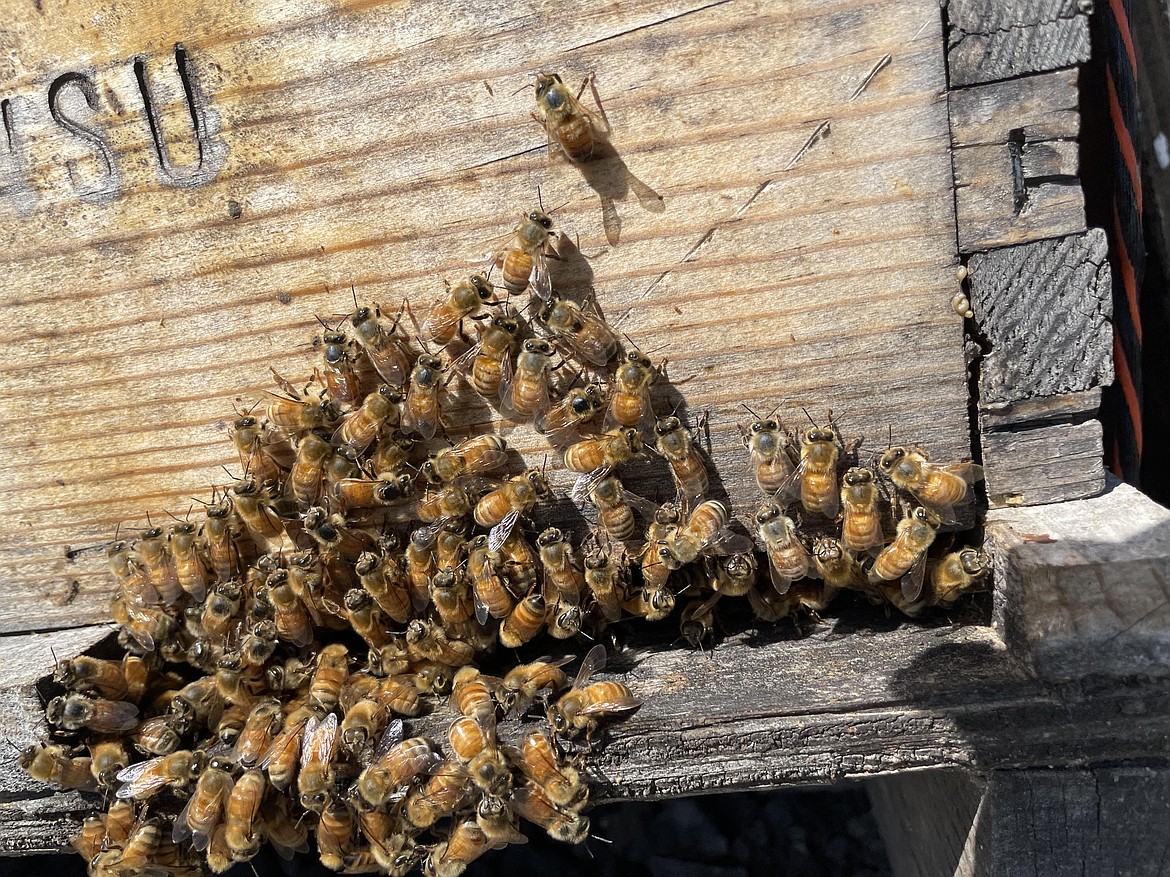
Honey bees gather on the porch of a WSU hive at WSU’s Honey Bee and Pollinator Research, Extension and Education Facility near Othello in 2021. Honey bee colonies are down 7% this year over last, but the fluctuations tend to even out, according to experts.
File photo
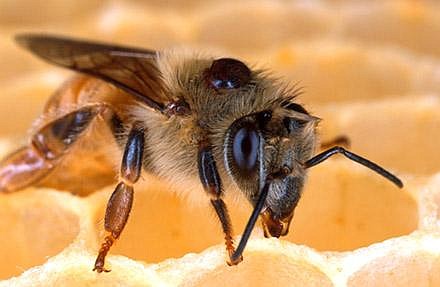
European honey bee with a Varroa mite on its back. The mites cause death and disease in bee colonies.
Joel Martin has been with the Columbia Basin Herald for more than 25 years in a variety of roles and is the most-tenured employee in the building. Martin is a married father of eight and enjoys spending time with his children and his wife, Christina. He is passionate about the paper’s mission of informing the people of the Columbia Basin because he knows it is important to record the history of the communities the publication serves. | October 1, 2023 1:00 AM
MOSES LAKE — Honey bee populations are down nationwide, but that’s not necessarily a reason to worry, agriculture statisticians say.
“Honey bees and other pollinators are critically important to securing the nation’s food supply and providing ecosystem services that insure plant diversity, soil stability, and species richness,” the U.S. Department of Agriculture wrote on its website.
According to statistics released in August by the National Agricultural Statistics Service, In January 2023 there were 2.68 million domesticated honey bee colonies for operations with five or more colonies in the U.S., down 7% from the 2.88 million colonies in January 2022. In April, the year-over-year change was even greater, from 2.71 million to 2.91 million colonies, a 9% change.
In Washington, the decrease was a little larger than the national decline, dropping 9% from 70,000 to 65,000 colonies from January 2022 to January 2023, and 9% again from 97,000 to 87,000 from April to April.
“The reality is that you’re going to have a seasonality to the number of colonies, because you’re gonna have more colonies in the summer than you’re gonna have in the winter,” said Seth Riggins, an economist with the U.S. Department of Agriculture. “Each colony is going to produce several queens, which can then be broken up to start more colonies in the spring. Producers can split colonies, they can buy more colonies, they can buy more queens, so they can offset that loss if they need to for the operation.”
This is not to say there are no threats to the honey bee population. The biggest stressor for honey bees, according to the NASS, is the varroa mite. This bloodsucking parasite arrived in the U.S. in 1987 from Asia, according to the USDA’s Agricultural Research Service. There its primary prey was the Asian honey bee, or Apis serana, which didn’t suffer a great deal from its predations because it only infested drone brood, less than 5% of a colony’s brood population. Additionally, adult Asian honey bees are able to remove and kill varroa mites on each other. The honey bees in the U.S. are Apis Mellifera, or European honey bees, and Varroa mites infect both their drones and workers, brood and adults.
“(European honey bees) came over with the colonists hundreds of years ago,” Riggins said. “They’ve spread rapidly over the entire North American continent because it was conducive to their lifestyle. So we had wild honey bees and bees in production. There’s virtually no wild population now, because of the varroa mite.”
Varroa mites appear to be on the increase, according to the NASS report. From April through June 2022, the percentage of colonies in the U.S. affected by the mites was 47.5, increasing for the same period in 2023 to 50.9. Washington colonies affected by Varroa mites decreased in the same period, from 50.8% in 2022 to 41.6% in 2023.
“Climate change is a significant factor contributing to the decline in pollinator populations,” the USDA wrote on its website. The warming of the planet and changes in weather patterns are altering the synchrony between flowering plants and their pollinators, causing nutritional stress … (T)he warmer fall and winter temperatures are extending the period when bees are foraging. This disrupts the colony age structure and resource utilization, enabling Varroa mites to migrate among colonies on foragers, spreading this parasite and the viruses it transmits throughout apiaries.”
In the long run, Riggins said, the changes really aren’t all that drastic and they tend to correct themselves.
“We were down 1% on Jan. 1 last year. The year before we were up 2%. The year before that we were up 8% and we were up 1% the year before that. So it’s something that fluctuates year in and year out. We seem to be fairly stable at the U.S. level.”
Joel Martin may be reached via email at [email protected].
ARTICLES BY JOEL MARTIN
Endless battle
Noxious Weed Control Board works to keep invasive plants under control
MOSES LAKE — Some of the nastiest plants in Grant County were the topic of a class led by Jay Johnson, a consultant with the Grant County Noxious Weed Control Board, Tuesday. The Noxious Weed Control Board, as its name would suggest, is tasked with keeping weeds under control in Grant County. That’s not a small job; the board’s website lists 129 species of noxious weeds that are found around Grant County. A noxious weed is defined as an invasive, non-native plant that threatens agricultural crops, local ecosystems or fish and wildlife habitat, according to the Noxious Weed Control Board. Washington state law requires that these weeds be identified and their spread kept to a minimum, if not completely eradicated. “We’re one of those agencies a lot of people don’t really understand,” Johnson said. “We’re a county office and … our funding is tax-based assessment. When you get your tax bill and you look down at all the expenses that you pay for, there we are.”
BASIN EVENTS: Oct. 16-24
COLUMBIA BASIN — Whether you feel like shopping, crafting, learning or seeing a show, there’s something happening for you this week in the Basin. Oct. 16 ‘My Family (Mi Familia)’ screening Spanning three generations, “My Family (Mi Familia)” is a heartfelt drama that follows the Sánchez family as they build their lives in East Los Angeles. Through love, hardship, triumph, and sacrifice, the film explores the immigrant experience, the strength of family bonds, and the traditions that connect one generation to the next. Lowrider show and taco truck before the screening. Sponsored by Columbia Basin Allied Arts, EDUBS C/S and the Moses Lake Creative District. $12 per person. Doors open at 6 p.m., film begins at 7 p.m. at the Moses Lake Civic Center Auditorium, 401 S. Balsam St. Tickets and info: www.cba-arts.org.

Moses Lake author encourages women to look beyond church culture norms
MOSES LAKE — A Moses Lake author’s book, “A Christian Woman Striving to Live Her Faith in a Man-Controlled World,” takes aim at the role to which many churches relegate the female half of their congregations. “It’s to encourage women in the faith,” Linda Curran said. “A lot of churches say, ‘Teach Sunday school, do this, do that, but don’t (evangelize.)’" In her book, Curran recounts a time when she moved to a new community and joined a church there. She was surprised to learn that, as a new female member, she had been automatically assigned church cleaning duties. When she questioned it, she wrote, she was met with condescension and her objections were brushed aside. In other churches, she said, women who were capable of teaching were relegated to “women’s ministry.”