
The sky’s the limit: Cle Elum drone pilot says improved battery tech key to opening up drones for ag use
JOEL MARTIN | Hagadone News Network | UPDATED 3 years AGO
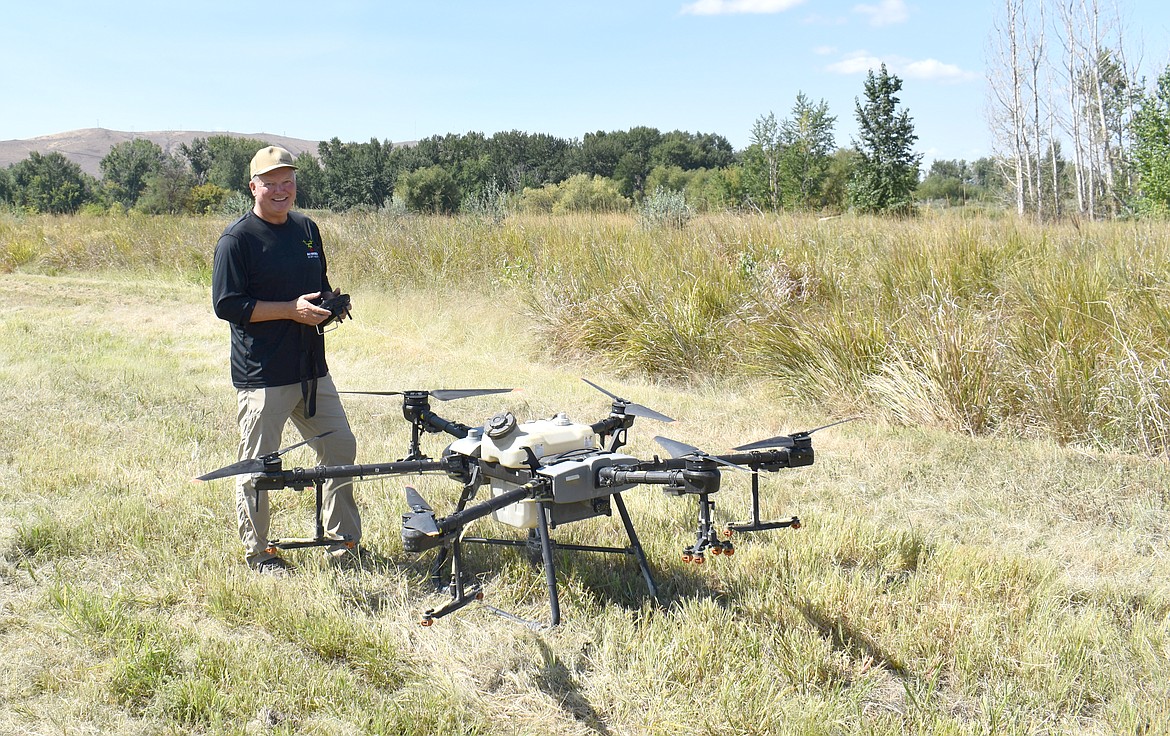
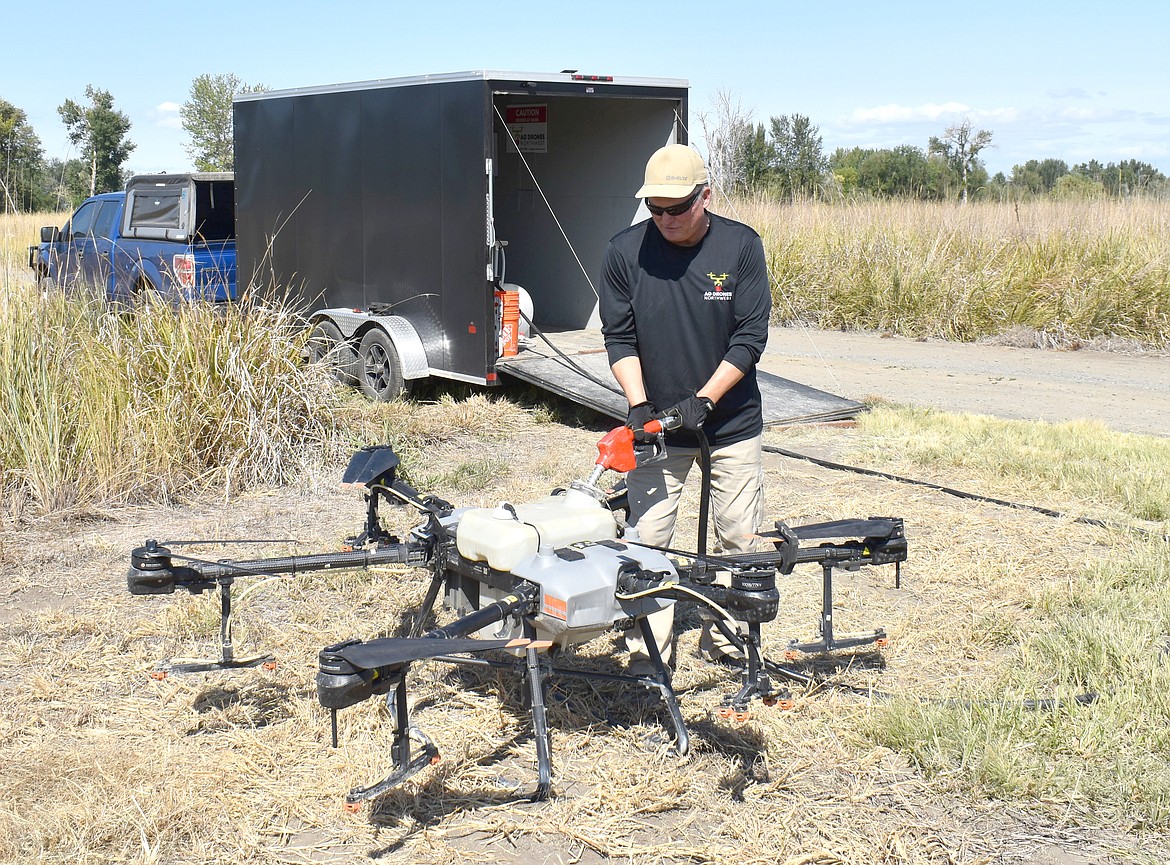
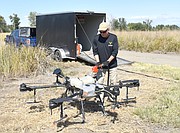
Bill Kuper, owner of Ag Drones Northwest, shows the T30 craft he calls Big Agnes.
Joel Martin/Basin Business Journal
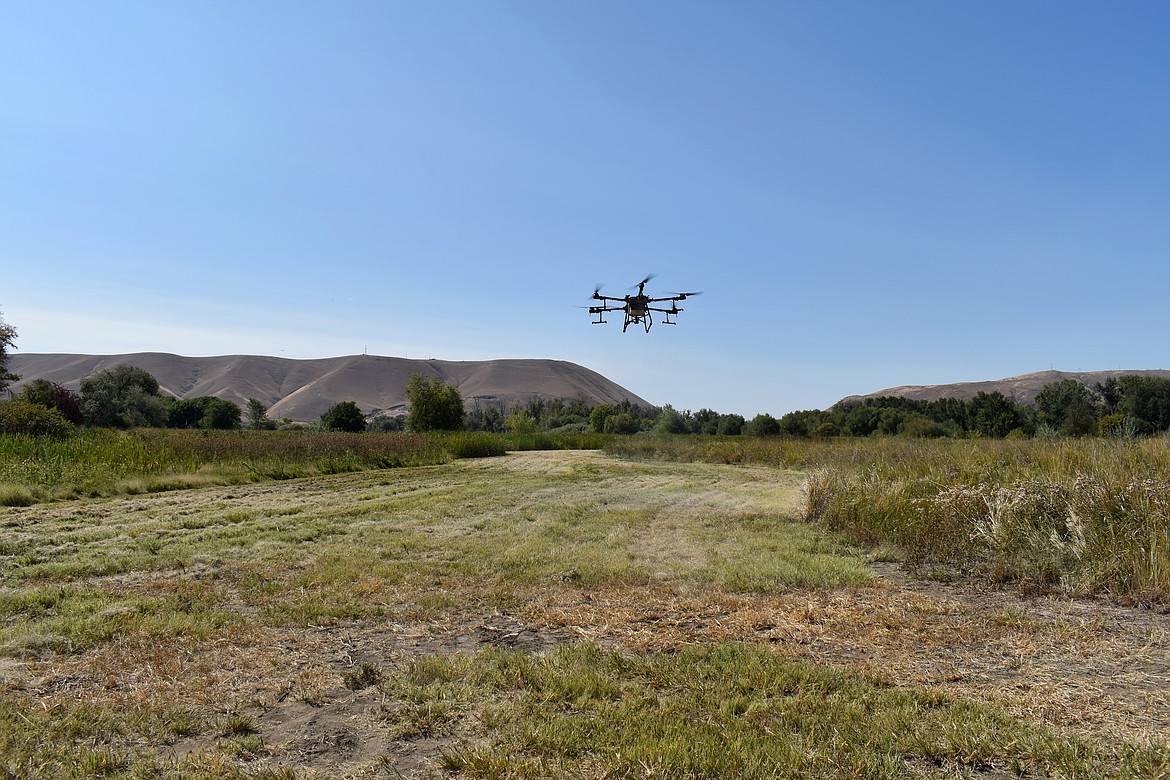
An Ag Drones Northwest drone flies over a wetland near Yakima Aug. 23.
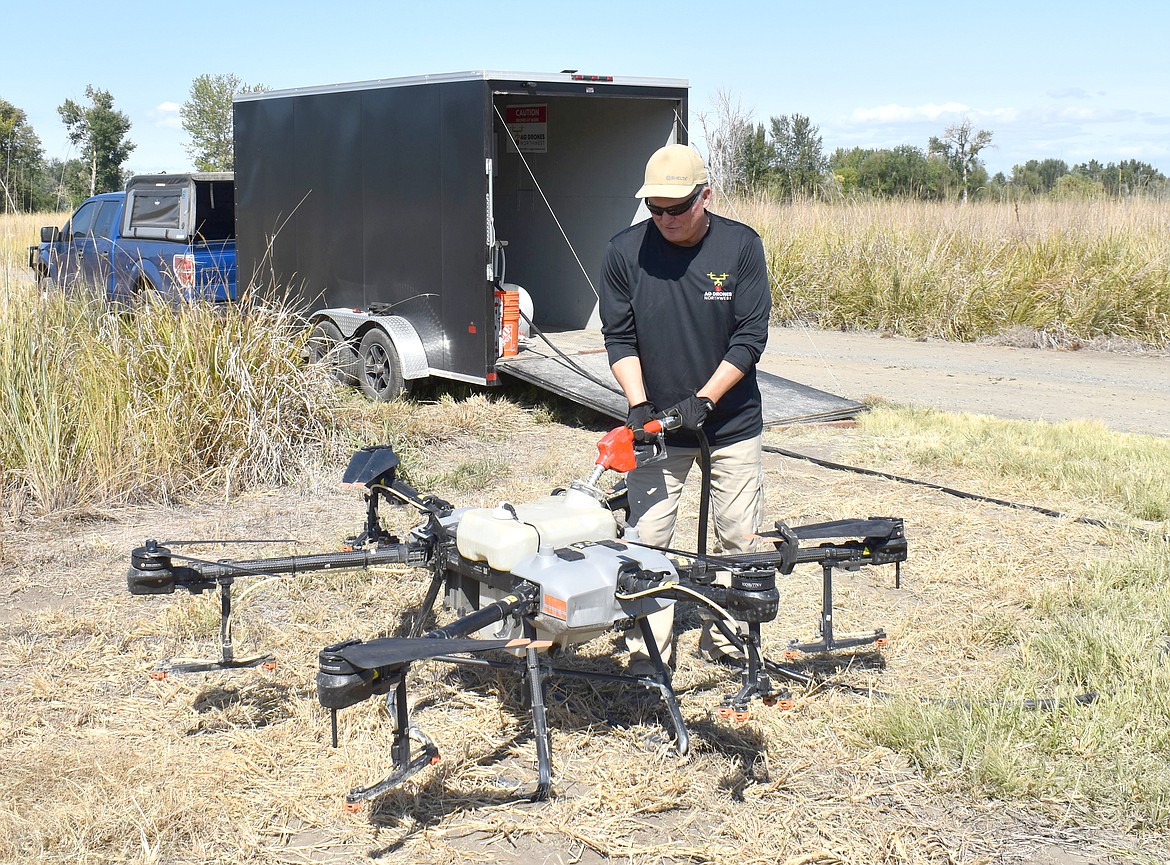
Bill Kuper fills the tank on his T30 drone. The tank can hold 30 liters of chemicals, as the name would suggest, which can spray an area nine meters wide and cover 40 acres in an hour on level ground.
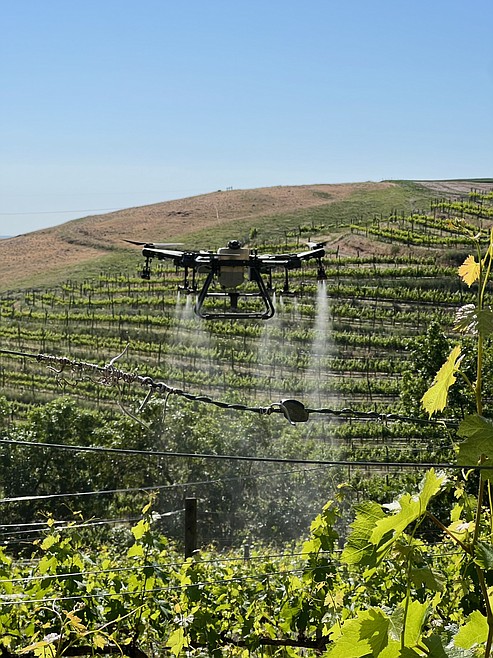
An Ag Drones Northwest drone sprays a vineyard in eastern Washington. Drones are especially suited to vineyards because the hillsides can be difficult for human sprayers to access.
Bill Kuper, owner of Ag Drones Northwest, demonstrates the nozzles on his sprayer drone. The device has 16 nozzles that can be programmed to turn on and off in flight, to make sure the liquid is as precisely placed as possible.
Joel Martin has been with the Columbia Basin Herald for more than 25 years in a variety of roles and is the most-tenured employee in the building. Martin is a married father of eight and enjoys spending time with his children and his wife, Christina. He is passionate about the paper’s mission of informing the people of the Columbia Basin because he knows it is important to record the history of the communities the publication serves. | October 13, 2023 1:00 AM
YAKIMA — Bill Kuper didn’t originally set out to spray crops.
“I flew my first drone over 10 years ago now for video and photo, because my background is actually technical, but in video and media,” he said. “And that’s when I first started flying.”
It was a hot August morning on a wetland alongside the Yakima River. Kuper, the owner of Ag Drones Northwest, was there to demonstrate how an uncrewed aerial vehicle – what most people call a drone – can revolutionize routine operations like pesticide application and spraying fertilizer. His mechanical companion was a drone he calls Big Agnes.
Originally from the Seattle area, Kuper has owned a little patch of land near Cle Elum for about 20 years, he said, which he used as a weekend place. Five years ago he decided to move there full time.
He said he’s grateful to be on the East Side of the state and that he doesn’t have to be one of the folks commuting back to the Seattle metro on Sunday afternoons. He credits the opportunities drone piloting has provided him.
“I’ve been an entrepreneur, my whole career, and I just saw this opportunity,” Kuper said. “The same company that makes the video drones makes these agricultural drones, and I get their newsletter.”
The company was DJI, a Chinese outfit Kuper described as the Apple of the drone world.
“They’re just leading the way,” he said. “Their (Research and Development) department must be huge, because they’re announcing a new product almost every two months.”
Not all of DJI’s products are agriculturally-oriented, he said. They produce drones that inspect bridges and that are used for building and surveying. They also produce a wide variety of video and media-oriented uncrewed aircraft.
“But it wasn’t until last year with this model, it’s called the T30, that it really like hit me like a big wave, ‘Oh, my God, now it’s finally feasible,’” Kuper said.
The breakthrough DJI had made was in battery technology, Kuper said. The problem with any electrical vehicle, whether it flies, rolls or sails, is the more power a battery can hold, the heavier it has to be, which in turn causes the vehicle to use more of the stored energy and thus the battery drains faster.
Big Agnes weighs about 58 pounds without batteries and with empty tanks, according to DJI’s website. When it’s full, it weighs closer to 150 pounds, Kuper said, which means the batteries need to generate a lot of thrust.
“In the past, the battery technology wasn’t great,” he said. “An outfit like this would have to have like a dozen batteries. Those get heavy, and the capacity wasn’t nearly as big.”
The new battery technology – the T30 uses a single 22-pound removable battery, according to the website – was the first key to making agriculturally applied drones feasible, he said.
“The second key to this was the charger that has these dual power supplies,” Kuper said, “so that with a high-power generator, I can recharge in 10 minutes, which allows me to only have three batteries and run all day long.”
The unit can fly for about 10 minutes on a single charge, he explained. This means the trips out and back aren’t long, but with three batteries there’s little downtime between them.
Big Agnes can hold 30 liters of fluid, as the name T30 suggests. That’s 30 liters of pesticide or fertilizer or, as Kuper was demonstrating with, just plain water. According to DJI, a T30 can spray 40 acres in an hour on level ground. But Kuper doesn’t usually work over level ground, he said; the fields he sprays tend to have a little more contour to them.
“I’m one of the first guys into do vineyards out here,” he said. “In fact, I think I’m the first. The flat row (crops are) pretty straightforward. But, what I was challenged with was a vineyard that is so steep and so curvy, there wasn’t a straight line in the whole thing. The company that manages it hired me because some of the blocks are so steep, that it would have been dangerous even for a guy with a backpack. Because if he or she were to fall over, that’d be very dangerous.”
Many people might think of piloting as actually steering the vehicle manually on the fly, but these drones are more sophisticated than that. The user pre-programs the route the speed, the rate and location of the spray, and the drone can carry out those instructions with amazing precision.
Kuper’s control device looked a little like a handheld video game, with a little map of the ground showing the unit’s location. The user can draw the route on a small touchscreen, adding waypoints and turns, as well as setting outputs, speed, height and course options numerically. When the power begins to run low or the tanks are going to need refilling, the unit returns automatically. It can even be set to spray from one side on the trip out and the other on the way back or to shut off the nozzles when passing over something that doesn’t need spraying. With a special tripod, the unit can triangulate with its GPS and increase the accuracy of its positioning from a meter to a centimeter, Kuper said.
A T30 can actually fly to altitudes greater than 14,000 feet, according to DJI’s website, but Kuper keeps his flights to less than 50 feet. Among other things, the higher the altitude, the greater the risk to airplanes and such, which is why the FAA keeps a very tight leash on drone pilots.
That caution actually delayed Ag Drones Northwest’s debut on the market, Kuper said.
“It’s pretty much like getting a crop duster certification,” he said. “It’s a lot of paperwork to apply, and then you just wait and wait and wait and wait and wait until they get to you.”
Because the drone business is growing so quickly, Kuper explained, the FAA staff has a backlog of certification applications. Both the pilot and the business itself need to be tested and certified, which makes the process even longer.
“So the FAA came out here last October, and I had a verbal test I had to do and then a flight test,” he said. “And then we were good to go.”
In the meantime, Kuper made arrangements with a business in Ellensburg, he said. They had the license but no pilot, and he could get his hours in as a pilot without having his business certification. Once that came through, he went out on his own. There aren’t a lot of businesses in the region doing what Ag Drones Northwest does right now, but he expects to see that change dramatically over the next year.
“There are so many growers who could use this just don’t know about it, and or don’t believe that it could actually help them or think it’s just a gimmick, you know?” Kuper said. “But it really can solve some problems. I strongly believe that these little flying robots are going to be the wave of the future.”
Joel Martin may be reached via email at [email protected].
ARTICLES BY JOEL MARTIN
Endless battle
Noxious Weed Control Board works to keep invasive plants under control
MOSES LAKE — Some of the nastiest plants in Grant County were the topic of a class led by Jay Johnson, a consultant with the Grant County Noxious Weed Control Board, Tuesday. The Noxious Weed Control Board, as its name would suggest, is tasked with keeping weeds under control in Grant County. That’s not a small job; the board’s website lists 129 species of noxious weeds that are found around Grant County. A noxious weed is defined as an invasive, non-native plant that threatens agricultural crops, local ecosystems or fish and wildlife habitat, according to the Noxious Weed Control Board. Washington state law requires that these weeds be identified and their spread kept to a minimum, if not completely eradicated. “We’re one of those agencies a lot of people don’t really understand,” Johnson said. “We’re a county office and … our funding is tax-based assessment. When you get your tax bill and you look down at all the expenses that you pay for, there we are.”

BASIN EVENTS: Oct. 16-24
COLUMBIA BASIN — Whether you feel like shopping, crafting, learning or seeing a show, there’s something happening for you this week in the Basin. Oct. 16 ‘My Family (Mi Familia)’ screening Spanning three generations, “My Family (Mi Familia)” is a heartfelt drama that follows the Sánchez family as they build their lives in East Los Angeles. Through love, hardship, triumph, and sacrifice, the film explores the immigrant experience, the strength of family bonds, and the traditions that connect one generation to the next. Lowrider show and taco truck before the screening. Sponsored by Columbia Basin Allied Arts, EDUBS C/S and the Moses Lake Creative District. $12 per person. Doors open at 6 p.m., film begins at 7 p.m. at the Moses Lake Civic Center Auditorium, 401 S. Balsam St. Tickets and info: www.cba-arts.org.

Moses Lake author encourages women to look beyond church culture norms
MOSES LAKE — A Moses Lake author’s book, “A Christian Woman Striving to Live Her Faith in a Man-Controlled World,” takes aim at the role to which many churches relegate the female half of their congregations. “It’s to encourage women in the faith,” Linda Curran said. “A lot of churches say, ‘Teach Sunday school, do this, do that, but don’t (evangelize.)’" In her book, Curran recounts a time when she moved to a new community and joined a church there. She was surprised to learn that, as a new female member, she had been automatically assigned church cleaning duties. When she questioned it, she wrote, she was met with condescension and her objections were brushed aside. In other churches, she said, women who were capable of teaching were relegated to “women’s ministry.”