
Quincy continues to be a draw for data centers
CHERYL SCHWEIZER | Hagadone News Network | UPDATED 2 years, 2 months AGO
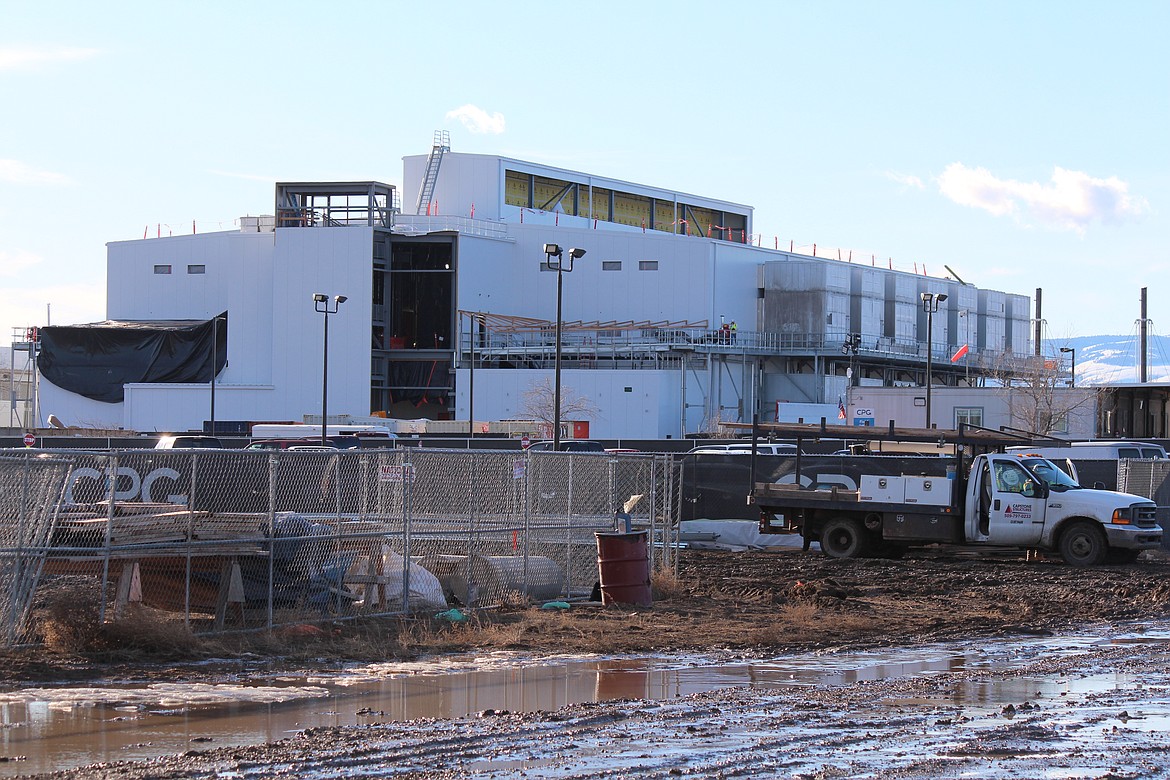
Construction crews work on the expansion of the Microsoft data center in Quincy in January 2023. Multiple data centers have not only been constructed in the small city, but have been expanded as well as information technology companies have noted its convenience.
FILE PHOTO
Senior Reporter Cheryl Schweizer is a journalist with more than 30 years of experience serving small communities in the Pacific Northwest. She began her post-high-school education at Treasure Valley Community College and enerned her journalism degree at Oregon State University. After working for multiple publications, she has settled down at the Columbia Basin Herald and has been a staple of the newsroom for more than a decade. Schweizer’s dedication to her communities and profession has earned her the nickname “The Baroness of Bylines.” She covers a variety of beats including health, business and various municipalities. | October 14, 2023 2:40 PM
QUINCY — Quincy is and has been a busy farm town, a center of production for tree fruit, potatoes and other crops. Now it’s also home to a host of data centers.
Microsoft is in Quincy and was the first one in town. Sabey Data Centers is there and expanded this year. Yahoo is in Quincy, and so are H5 Data Centers and Vantage Data Centers. CyrusOne is building its first data facility in town.
How Quincy became a data center hub is a tale of, among other things, good geography, affordable electricity and a decision made a while ago by the Grant County Public Utility District commissioners.
John Sabey, executive director of Sabey Data Centers, said Quincy and Grant County in general have some advantages. Affordable electricity and geographic and geologic factors all play a part.
Quincy City Administrator Pat Haley said he remembered asking Dave Sabey, founder of Sabey Data Centers, how Quincy became so attractive to data center builders. Dave Sabey cited Grant County’s affordable electricity and Quincy’s flat developable land. The area’s geological stability also mattered.
“That’s a big deal,” Haley said.
The PUD’s fiber buildout and the work it had done for its internal network meant Quincy was a good spot for such facilities.
Quincy is within driving distance of Pangborn Memorial Airport, which has daily passenger service, Haley said. That allows businesses using Quincy convenient access when they visit.
Once one data center discovered Quincy, others followed.
“Data centers like to be near other data centers, just from a networking perspective,” John Sabey said. “So once you’ve already got (a facility) in one spot, it kind of builds on itself.”
Haley called it a “clustering effect.” The demand has prompted businesses to and utilities to work to meet the need.
“(Electrical) substations and property and personnel, and vendors that do the electrical, HV/AC and plumbing and all of those components. They want to be near each other because it’s easy to get service and parts,” Haley said.
In addition, the Washington Legislature provided some incentives, waiving some sales taxes statewide. Server technology is advancing rapidly enough that the average life of a server is about three years, Haley said.
“Because the new technology is climbing that fast, that’s why the incentives were created by the legislature,” he said. “If you can recruit a company to locate here, and delete that cost component, they might come.”
The connectivity component is in part the work of Grant County PUD commissioners, back in the day. The Washington Legislature authorized local public utility districts to provide wholesale fiber services, and in 2000 the GCPUD decided to take advantage of that.
Tom Flint was there, back in 2000, when the PUD commissioners decided to invest in that new thing called fiber. Its final cost is projected to be about $70.2 million when the buildout is complete. There were starts and stops, and commission support waxed and waned, but in the end, there was a commitment to finish it.
“It’s brought a lot of business to Grant County,” Flint said. “It’s created a lot of jobs. To be able to have a world-class platform like a gigabyte to the home if you want it is almost unavailable anywhere else.”
David Parkhurst, network manager of engineering for GCPUD, said fiber is both quick and reliable.
“HIgh speed and low latency. Low latency means that your response is very fast,” he said.
He used the example of an overseas phone call, where there’s a delay between one person speaking and the other hearing them.
“That was due to high latency because there’s a lot of miles between you. Lots of miles means lots of latency,” he said. “Fiber is very fast — it supports communication at the speed of light.”
The attractions of a quick connection to the outside world were recognized early by the people involved in the new industry of providing that fast connection. Data centers were called server fams back in the day, and Central Washington was an attractive location from the beginning.
Parkhurst said that while wireless systems work for some applications, fiber works better for others, and as a result will continue to be crucial for connectivity.’
“The future is both (fiber and wireless),” he said. “Wireless at the edge is going to continue to be attractive to most people, because it’s easy. For terrestrial applications that require larger bandwidth, fiber is going to be the best way to do it for the foreseeable future.”
Cheryl Schweizer may be reached at [email protected]. A Moses Lake resident, she is affectionately known in the paper's office as "The Baroness of Bylines" and has earned several awards for the paper over her more than a decade of service.
ARTICLES BY CHERYL SCHWEIZER
Sleep Diagnostic Center physician pleads guilty to Medicaid fraud
Charges involve charging Apple Health for recalled, altered CPAP devices
BREWSTER — A Brewster physician who operates a sleep diagnostic clinic in Moses Lake and Wenatchee will be sentenced March 24 as part of a Wednesday plea deal on Medicaid fraud charges.
Qualifying irrigation-only wells approved by Moses Lake council
MOSES LAKE — Public agencies and semi-public organizations will be allowed to drill individual wells to water fields and other publicly accessible green spaces under the terms of an ordinance approved by the Moses Lake City Council at the last meeting of 2025. Council members have been discussing the ordinance for about three months, following a meeting with Moses Lake School District officials.

Quincy man killed in early-morning crash
QUINCY — A Quincy man was killed when the car he was driving was hit by another car about five miles west of Quincy early Thursday morning.