
Grant Co. PUD wrestles with rate-setting policy
CHERYL SCHWEIZER | Hagadone News Network | UPDATED 2 years, 10 months AGO
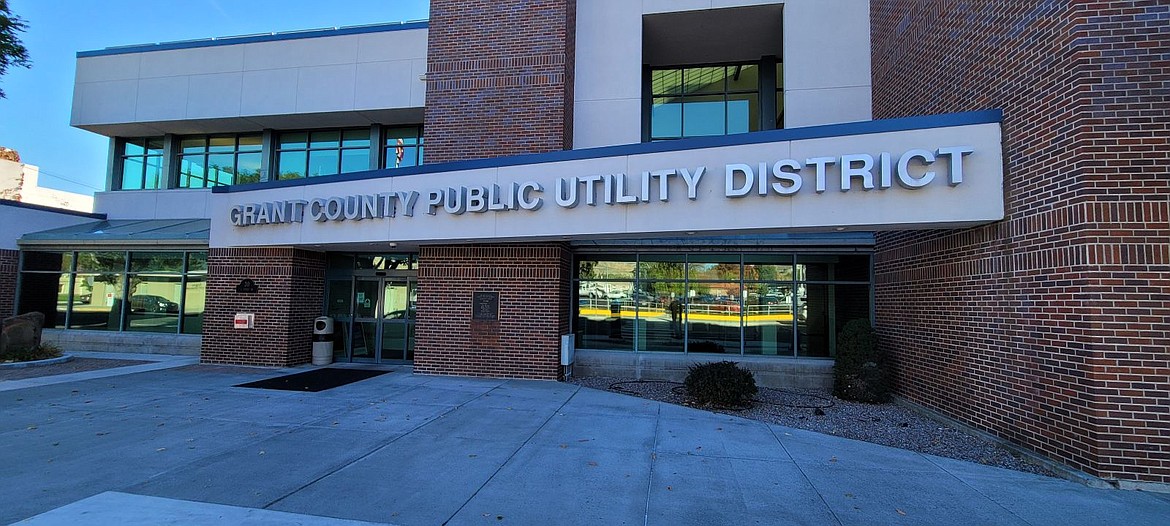
Grant County PUD commissioners are scheduled to discuss their ideas about future rate policies at the commission meeting Tuesday at the PUD headquarters in Ephrata, pictured.
R. HANS MILLER/COLUMBIA BASIN HERALD
Senior Reporter Cheryl Schweizer is a journalist with more than 30 years of experience serving small communities in the Pacific Northwest. She began her post-high-school education at Treasure Valley Community College and enerned her journalism degree at Oregon State University. After working for multiple publications, she has settled down at the Columbia Basin Herald and has been a staple of the newsroom for more than a decade. Schweizer’s dedication to her communities and profession has earned her the nickname “The Baroness of Bylines.” She covers a variety of beats including health, business and various municipalities. | October 22, 2023 1:30 AM
EPHRATA — Grant County PUD commissioners are scheduled to give individual statements on their goals and objectives in establishing rate-setting policy during the regular commission meeting Tuesday. Those statements are scheduled for 9:30 a.m., during the commission’s discussion session.
Board chair Nelson Cox asked each commissioner to provide their conclusions while reading a statement at an Oct. 17 workshop. A discussion of rates, and of options to change, or not change, how they’re assessed was scheduled for the workshop, but Cox canceled it. Instead, he told commissioners to spend the week thinking about their ideas and be prepared to make a statement Tuesday.
The current rate structure is governed by policies that start with analyzing the cost of providing electricity to each class of customers such as residential, agricultural, industrial and heavy industrial. It also establishes a general range for rates, with the goal of reaching those ranges by 2024.
“The intention is, we don’t have any customer class paying lower than 20% below cost to serve, and we don’t have any customer class paying more than 15% above the cost to serve,” said Ty Ehrman, PUD chief customer officer.
Those goals won’t be met by the end of 2023. Commissioner Larry Schaapman said in a meeting on Oct. 10 that because the resolution governing rates ends this year, commissioners have to do something.
Ehrman said rate discussions have been ongoing.
“We’re in the middle of this discussion,” he said. “We’ve certainly had a number of meetings up to this point, commission workshops where we have talked about the cost of service and the possibilities for rate increases. So it’s been going on for a little while already.”
Workshops are held on the third Tuesday of each month and are open to the public, but their agendas are not posted on the PUD website. A link is provided on the commission calendar, but it does not include access to workshop agendas or information about what will be discussed as of Oct. 20.
Julio Aguirre Carmona, the lead financial analyst for the PUD, said the cost of service analysis looks at the cost of maintaining and operating equipment, including the costs for labor, along with administrative costs and taxes, which is pretty standard for the power industry.
“And then on the other side, we look at the customer’s (power) load, when they use the system, how they use the system, how much energy they consume, what is their peak demand,” Aguirre Carmona said.
That analysis also factors in the number of customers, among other things.
“Looking at those two areas, we determine how much it costs us to serve each of the rate classes and determine the appropriate rates to be collected from each group,” Aguirre Carmona said.
That analysis is conducted periodically, Ehrman said. To date, the results have been relatively consistent.
“It does cost more to serve some customer classes than others when you look at it on a per-customer, per-kilowatt-hour basis,” he said.
“It’s also fairly consistent in that pattern with what a lot of utilities do,” Ehrman said. “So residential, in particular, generally in terms of what they pay, they pay below their cost to serve, and industrials generally pay more than their cost to serve. So it’s not an unusual pattern in the utility industry. Not all utilities have a large irrigation component, but they are also part of our core customer group. So they pay under the cost to serve as well.”
Ehrman said that allows adjustments that keep rates lower for residential and other low-use customers.
“The way we would put that is, (rate class) 15, the large industrial, is paying above cost to serve and that does cover a good portion of our revenue that allows us to keep rates below cost to serve for rate (classes) one, two and three,” he said.
Rate Class 1 is residential customers and Class 2 is general service, which includes commercial, outbuildings and multi-residential customers within specified power use limits. Class 3 is irrigation customers.
The proposed 2024 budget includes a 3% overall rate increase. Ehrman said that’s still under discussion, along with the direction commissioners want to go for future rate-setting policies.
“We are working toward a regular annual process of analyzing our costs, and what we want to do with rates, with the intention to provide the best value and the lowest rates going forward,” he said. “We obviously have a focus on our customers, and we do want to ensure the success of all our customers.”
Cheryl Schweizer can be reached via email at [email protected].
ARTICLES BY CHERYL SCHWEIZER

Road projects on hold for Labor Day weekend
MOSES LAKE — With Labor Day weekend dead ahead, drivers will be able to move freely about the state. Most road projects are on hold for the holiday weekend. Nobody will be working on the Hansen Road overpass on Interstate 90, but the lane restrictions that are in effect will continue through the end of the project.

Cost estimates for water source alternatives given to Moses Lake City Council
Protected under the U.S. Endangered Species Act, efforts are ongoing to keep it self-sufficient
MOSES LAKE — It’s going to cost a lot of money to provide alternative water sources for the city of Moses Lake, but some of the possible alternatives will cost more than others. City officials provided the Moses Lake City Council with costs for various alternatives Tuesday.

Dryer vent cleaning is important -- but often overlooked
MOSES LAKE — Not all the maintenance a house needs is visible. Sometimes a potential problem just goes unnoticed until it causes trouble, sometimes serious trouble. But a lot of potential problems give off warning signs. Clothes dryers often do when they need a good cleaning.