
El Nino's return could bring dry, warm winter to Western Montana
MATT BALDWIN | Hagadone News Network | UPDATED 2 years, 12 months AGO

Hagadone Media Montana REGIONAL MANAGING EDITOR Matt Baldwin is the regional editor for Hagadone Media Montana, where he helps guide coverage across eight newspapers throughout Northwest Montana. Under his leadership, the Daily Inter Lake received the Montana Newspaper Association’s Sam Gilluly Best Daily Newspaper in Montana Award and the General Excellence Award in 2024 and 2025. A graduate of the University of Montana School of Journalism, Baldwin has called Montana home for nearly 30 years. He and his wife, Sadie, have three daughters. He can be reached at 406‑758‑4447 or [email protected]. IMPACT: Baldwin’s work helps ensure Northwest Montana residents stay connected to their communities and informed about the issues that shape their everyday lives. | October 25, 2023 12:00 AM
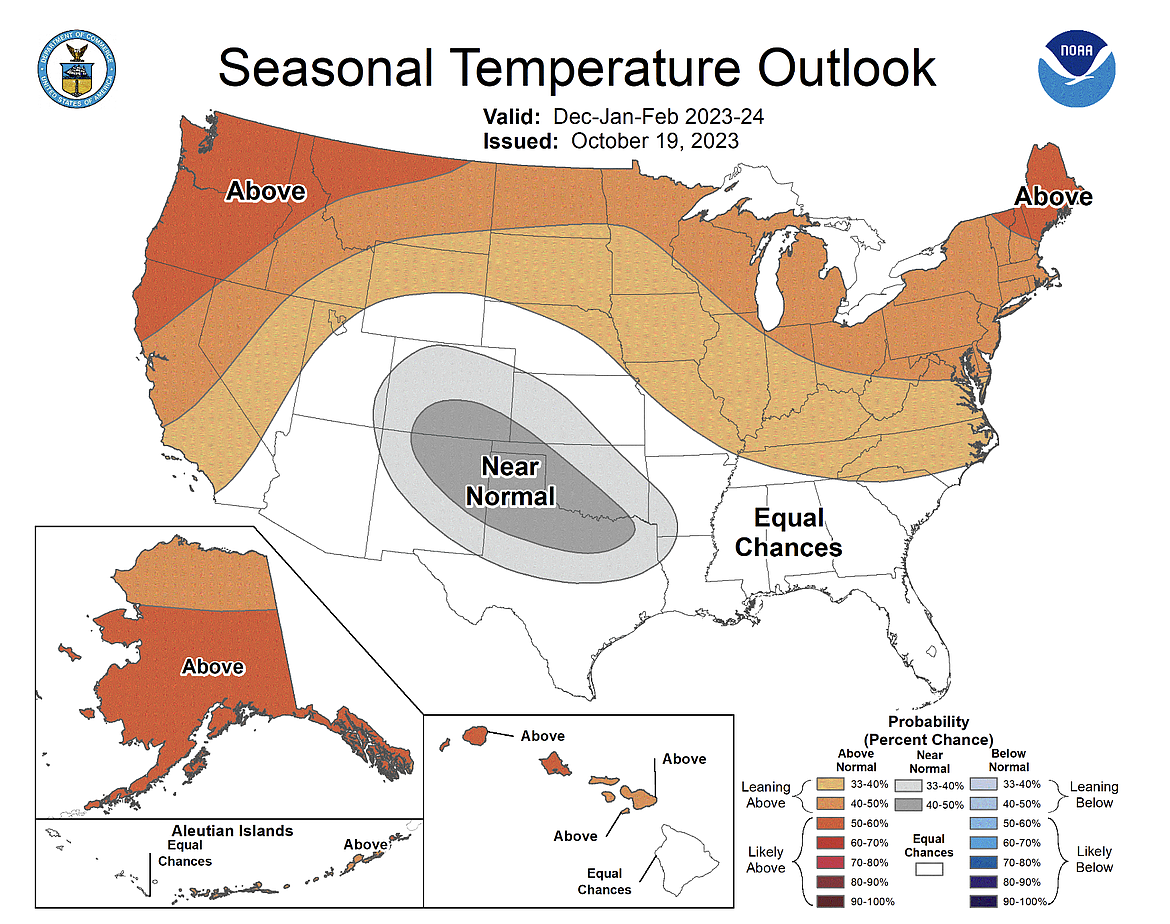
Above normal temperatures and below average precipitation is projected for Western Montana this winter as a strengthening El Nino climate pattern takes hold for the first time in four years.
The National Oceanic and Atmospheric Administration issued its winter forecast Oct. 19 for the northern tier of the U.S., calling for a strong El Nino influence.
Northwest Montana will feel the brunt of the impacts, according to Bob Nester, a senior forecaster with the National Weather Service in Missoula.
Northwest Montana snowpack during a strong El Nino historically ranges from 75-90% of average. Kalispell averages about 76% of normal snowfall, while West Glacier averages about 81% of normal.
“That’s mainly due to not has many strong westerly [jet streams] bringing a lot of Pacific moisture to the region,” Nester said, adding that the jet stream typically stays to the south during El Nino.
Much of Northwest Montana is already experiencing severe to extreme drought conditions.
Meanwhile, average temperatures in Northwest Montana during an El Nino winter are typically 2 to 4 degrees above normal.
“We just don’t get that many arctic air masses with this type of pattern,” Nester said.
Conditions will be ripe for fog and inversions, with more frequent high pressure ridges, Nester said.
February is most likely to exhibit the strongest El Nino characteristics, based on historical data.
“February seems to be the month where there is the greatest correlation to above normal temperatures, and the precent of normal snowfall is much lower,” he said.
Still, he cautions that not all El Nino winters are the same. There are some outliers, such as the winter of 1995-95 and 2015-16, where Western Montana precipitation finished the season above average.
“It doesn’t mean we’re not going to have snow,” Nester said. “We’re still going to have those snow events and colder events, but not quite as frequent.”
Meanwhile, El Nino brings wetter-than-average conditions for northern Alaska, parts of California, south-central Rockies, the southern Plains, Gulf Coast, Southeast and lower mid-Atlantic.
ARTICLES BY MATT BALDWIN

Region's residents flock to Kalispell for Trump appearance
Slyvia Timboe, 76, said it was the chance of a lifetime to see President Donald Trump speak in person. It took her just 20 minutes to drive to Majestic Valley Arena in Kalispell on Wednesday, where the president was scheduled to speak as part of a country-wide tour to stump for Republican candidates ahead of the midterm election.
Suspect arrested after Whitefish standoff involving SWAT, K-9
A suspect was arrested in Whitefish on Saturday evening following a standoff involving multiple law enforcement agencies and a K-9 unit.
Western Montana on track for season's first winter storm
It's time to pull out the ice scraper and shovel and put away the garden hose.