
Royal City mayor moving on
JOEL MARTIN | Hagadone News Network | UPDATED 3 years, 1 month AGO
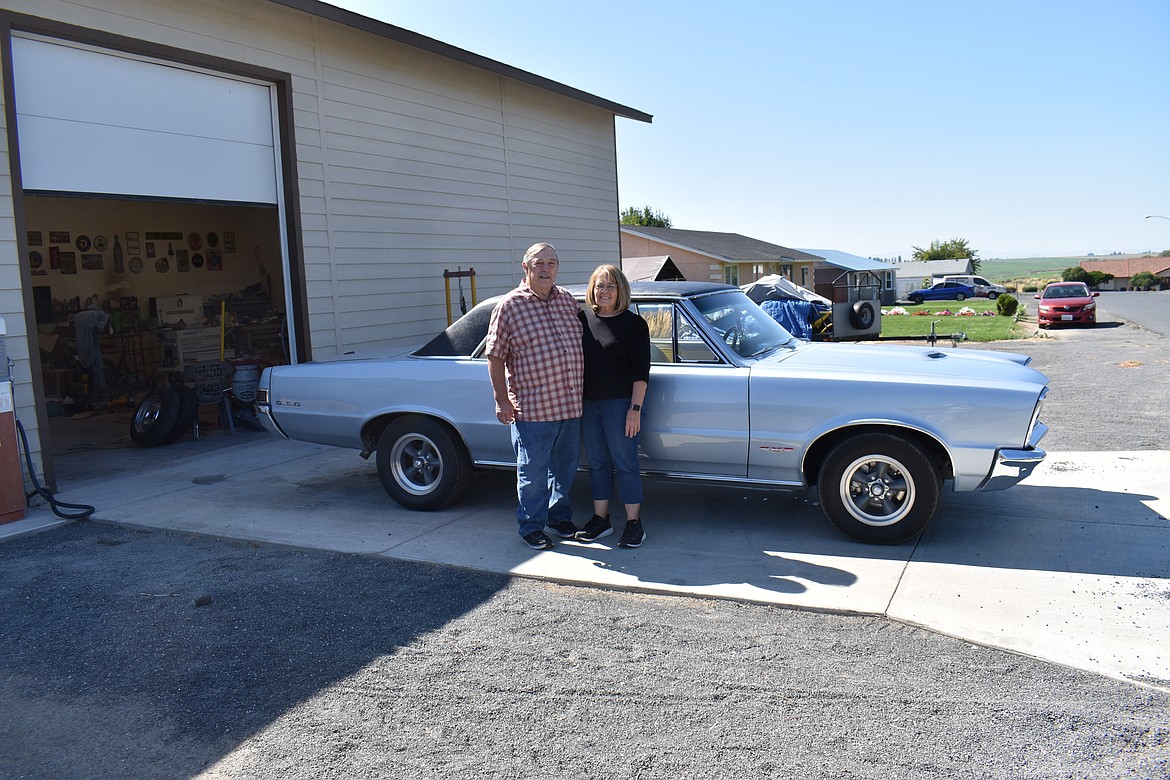
Outgoing Royal City Mayor Kent Andersen, left, and his wife Louise Andersen, stand in front of the Pontiac GTO he's is in the process of restoring. There’s a rare Volkswagen Beetle waiting in the garage that he’ll tackle when the Andersens return from a church mission, he said.
JOEL MARTIN/COLUMBIA BASIN HERALD
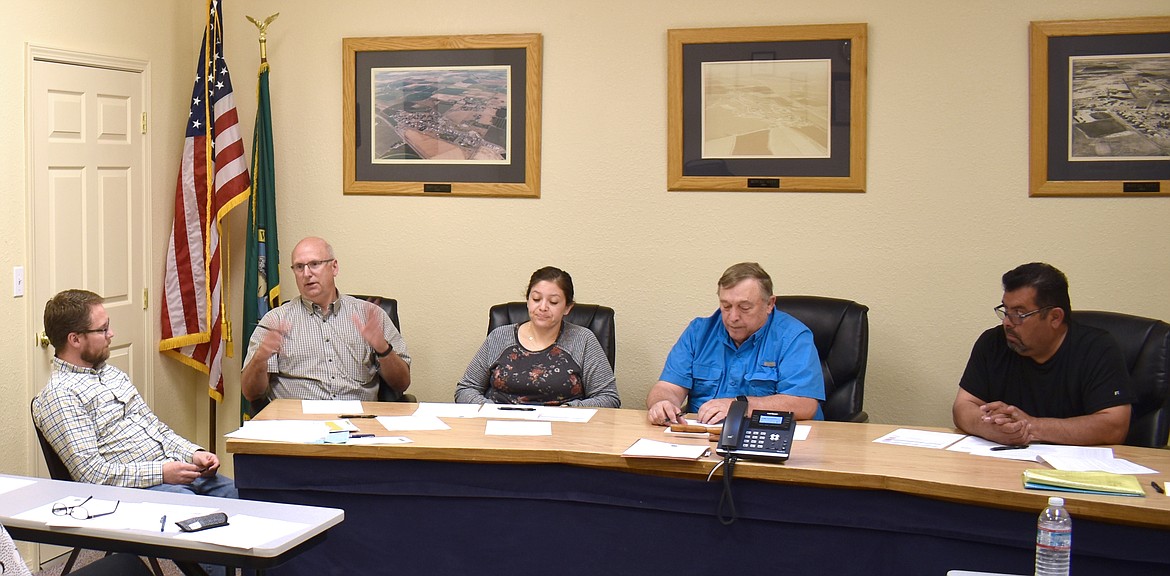
Outgoing Royal City Mayor Kent Andersen chairs a meeting of the Royal City City Council in May. From left: City Finance Director Shilo Christensen, Council Member Michael Christensen, Council Member Perla Garcia, Andersen, Council Member Hector Rodriguez.
Joel Martin has been with the Columbia Basin Herald for more than 25 years in a variety of roles and is the most-tenured employee in the building. Martin is a married father of eight and enjoys spending time with his children and his wife, Christina. He is passionate about the paper’s mission of informing the people of the Columbia Basin because he knows it is important to record the history of the communities the publication serves. | September 13, 2023 1:30 AM
ROYAL CITY — Royal City Mayor Kent Andersen is stepping down after about a decade of service to the city.
“I don’t know that we’ve had (a ‘nay’ vote on the city council) in 10 years,” said Royal City Mayor Kent Andersen, who’s stepping down from his post at the end of September after serving for a decade. He announced his resignation at the Sept. 5 council meeting.
He deferred the credit for a well-run town, however.
“We've got a good staff, a really good staff that has a good reputation with the state. So things go pretty good.”
“He's a great boss,” said Finance Director Shilo Christensen, who’s worked for the city for six years. “I think he's done a good job and that he really cares for the city. And when he is needed, he comes down (to City Hall). As a mayor, it's not a full-time position. So they're not here 8-5; they're here when needed, or when they feel like things need to get done a certain way.”
The Grant County Auditor’s Office has received the resignation letter, Election Deputy Aleanah Lopez confirmed, and now it’s up to the city council to appoint someone to serve as mayor pro tem for a two-year unexpired term. The seat will go up for election again in 2025.
Anderson and his wife Louise have been in Royal City since 1986, he said. He’s a retired school principal and was the athletic director for the Royal School District for 25 years.
Andersen didn’t set out to be mayor. About 11 years ago, then-mayor Justin Jenks found himself with some open city council seats to fill, Andersen said.
“He just kept bugging me about going on city council. I said, ‘No, I don't want to do that. I don't want to do that.’ Finally, he bugged me long enough. And I said, ‘Okay, I'll go on city council.’
A few months after that, Jenks resigned as mayor, Andersen said, and his successor did the same after about six months.
“So then I was the only person on the city council who was retired (and had time),” Andersen said. “They made me mayor, and then I stayed on the ballot, and no one's ever opposed me. I've never had (an election) sign.”
Stepping up
Andersen’s work was cut out for him.
“When I became mayor 10 years ago, Royal City had the highest poverty index of any city in the state of Washington, bar none. We were the highest poverty level of any city in the state. And we're not anymore.”
Royal City’s infrastructure was in a shambles, and it was because of a simple miscommunication with the various government agencies that issue grants, Andersen said.
“We would apply for things and would keep getting turned down,” he said. “So finally I called a meeting. We had every funding agency from the state, from the federal (government), from the county government. There's about 26 people now at City Hall, and I met with them and said, ‘OK, guys, what's going on here? I mean, we're the poorest town in the entire state, there's no one poorer. Why can’t we get anything approved?’ And they said, ‘You have too much money.’”
That seemed a little off, he said.
“We have some debt, but we don't have a lot of debt,” explained Christensen, who wasn’t in the job at the time but is familiar with the process. “So we have a little bit of money in our accounts. Let's say we had a couple hundred thousand dollars in our water account, and we want to do a water project. The funding agency says, ‘You have money, you do it.” And then it's like, ‘Hold on now, this water project might cost a million dollars. How does it make sense that we can't get funding for a new well, or whatever?’”
“Because the former mayors have been conservative, and we just don't spend,” Andersen said. “So I listed all the things that we needed to do and what the costs were. And I said ‘We're trying to be responsible and keep ourselves financially stable, and that's why we have this money. Because if we put our share towards this project and our share towards this project and our share towards this project, we're using all our money.’ Once they saw that, then they all started working together and said, ‘Well, we can do this for you, we can do this, we can do that.’ That's when everything just started steamrolling and we were able to get roads and water lines.”
A stabler community
Along with that has come the city’s encouragement of quality, affordable housing. Royal City is a very agriculturally-driven community, and where there’s agriculture there are migrant workers. Some municipalities try to keep migrant workers out of sight and out of mind, but Royal City took a different approach, Andersen said, pointing to the Rock Creek neighborhood that was developed around 2015. The development was created with the intention of giving orchard managers and workers the option to live locally rather than having to travel from somewhere else.
“Instead of coming from Othello, or coming from somewhere else, now there's housing for them here that they want to live in, and they want to be here and, and so that has really stabilized our community,” he said.
The demographic change that came with the growth of orchards in the area has been something Royal City has embraced, Andersen said, and it’s paid off. When the Andersens came to Royal City in the 80s, the town’s population was about 6% Hispanic, he said. According to the 2020 census, that figure is now 91%.
“When we came here, the amount of orchards that were here was just nothing, and now it's huge,” he said. “Well, whenever you have the change from local little family farms, they've been sold and bought and now you're really into more of the fruit production, it changes your demographics. And so early on, … one of our football coaches started a boys soccer (program). He said, ‘We've got to get these (Hispanic) kids involved, or we're never gonna be able to compete in anything.’ We've tried to include them and get things here that they want to participate in and encourage them to turn out. Because you know, there's a number of schools that I think don't do them justice. They don't really go out and recruit; they don't go out and really get everybody involved. And I think that's one of the things that our coaches saw early on that was necessary and needed.”
There were some other messes that needed some cleaning up when Andersen took over.
“One of the previous mayors sold some park ground to do (a) housing development, and the city got that land from a grant for parks. Well, you can't sell it. That's not your option; when you get a grant for a park that's a park for life, period. So the city would have been crossways with the State Parks Department for 20 years when I became mayor. That's one of the things that I did is, I got that fixed. We ended up buying some ground, but we haven't got it developed. We just got the grant to do a soccer field, but we haven't got it all developed. So that's one of the things that I wanted to get done. But I think it's well on its way.”
The new library is another project Andersen would like to have seen finished, he said, as are the improvements underway to the city’s water and sewer systems. But those projects are in good hands, he said.
Mission accepted
The Andersens are leaving town for a year and a half to fulfill a longtime ambition, performing a mission for the Church of Jesus Christ of Latter-day Saints. When that’s done, Andersen said, he’s happy to help his community but has no interest in getting back into local politics. Instead, he’s going to spend his time working on his project cars. He’s currently finishing the restoration of a Pontiac GTO, and has a very rare 1960s vintage Volkswagen Beetle on a lift in the garage waiting to be restored.
At the Sept. 5 council meeting, Andersen read his resignation letter to the council.
“Dear Royal City Council,” he said, “I will no longer be able to be mayor of the beautiful city of Royal City and must resign at the end of September 2023. I will be out of the area for 18 months. I want you to know that I have enjoyed working with each of you in trying to help Royal City grow and develop. I have learned much and will cherish this experience. I thank each of you for your loyal support over the last 10.plus years. We have a great staff and a community we can all be proud of and thank you for this experience.”
He hesitated for a moment.
“(Signed), me.”
Joel Martin may be reached at [email protected].
ARTICLES BY JOEL MARTIN

Endless battle
Noxious Weed Control Board works to keep invasive plants under control
MOSES LAKE — Some of the nastiest plants in Grant County were the topic of a class led by Jay Johnson, a consultant with the Grant County Noxious Weed Control Board, Tuesday. The Noxious Weed Control Board, as its name would suggest, is tasked with keeping weeds under control in Grant County. That’s not a small job; the board’s website lists 129 species of noxious weeds that are found around Grant County. A noxious weed is defined as an invasive, non-native plant that threatens agricultural crops, local ecosystems or fish and wildlife habitat, according to the Noxious Weed Control Board. Washington state law requires that these weeds be identified and their spread kept to a minimum, if not completely eradicated. “We’re one of those agencies a lot of people don’t really understand,” Johnson said. “We’re a county office and … our funding is tax-based assessment. When you get your tax bill and you look down at all the expenses that you pay for, there we are.”

BASIN EVENTS: Oct. 16-24
COLUMBIA BASIN — Whether you feel like shopping, crafting, learning or seeing a show, there’s something happening for you this week in the Basin. Oct. 16 ‘My Family (Mi Familia)’ screening Spanning three generations, “My Family (Mi Familia)” is a heartfelt drama that follows the Sánchez family as they build their lives in East Los Angeles. Through love, hardship, triumph, and sacrifice, the film explores the immigrant experience, the strength of family bonds, and the traditions that connect one generation to the next. Lowrider show and taco truck before the screening. Sponsored by Columbia Basin Allied Arts, EDUBS C/S and the Moses Lake Creative District. $12 per person. Doors open at 6 p.m., film begins at 7 p.m. at the Moses Lake Civic Center Auditorium, 401 S. Balsam St. Tickets and info: www.cba-arts.org.

Moses Lake author encourages women to look beyond church culture norms
MOSES LAKE — A Moses Lake author’s book, “A Christian Woman Striving to Live Her Faith in a Man-Controlled World,” takes aim at the role to which many churches relegate the female half of their congregations. “It’s to encourage women in the faith,” Linda Curran said. “A lot of churches say, ‘Teach Sunday school, do this, do that, but don’t (evangelize.)’" In her book, Curran recounts a time when she moved to a new community and joined a church there. She was surprised to learn that, as a new female member, she had been automatically assigned church cleaning duties. When she questioned it, she wrote, she was met with condescension and her objections were brushed aside. In other churches, she said, women who were capable of teaching were relegated to “women’s ministry.”