
Invasive plant completely eradicated from Beaver Lake
KATE HESTON | Hagadone News Network | UPDATED 2 years, 3 months AGO
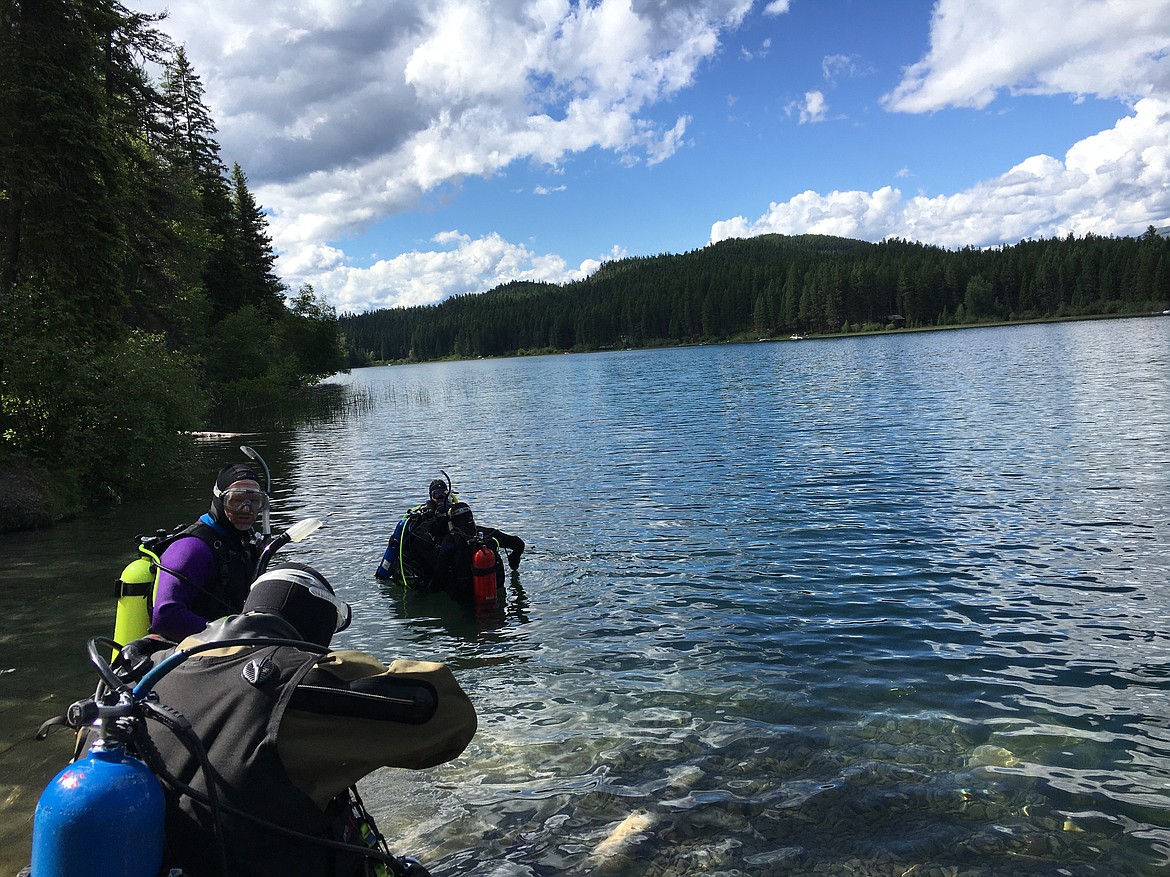
In this July 2020 photo provided by Montana Fish, Wildlife & Parks show members of the Montana Fish, Wildlife & Parks aquatic invasive species dive team prepare to work at Beaver Lake near Whitefish, Mont. The team was formed last year to provide a quick response to AIS issues, as well as to assist with fisheries projects. (Russ Hartzell, Montana Fish, Wildlife &Parks via AP)
Kate Heston covers politics and natural resources for the Daily Inter Lake. She is a graduate of the University of Iowa's journalism program, previously worked as photo editor at the Daily Iowan and was a News21 fellow in Phoenix. She can be reached at [email protected] or 406-758-4459. | September 14, 2023 12:00 PM
After nearly a decade of inhabiting Beaver Lake near Whitefish, the invasive Eurasian watermilfoil is seemingly gone — a phenomenon that many scientists call rare.
According to Montana Fish, Wildlife and Parks, no Eurasian watermilfoil was found in Beaver Lake this year following three comprehensive surveys for the first time in over a decade. Another survey will be completed in October as a follow up.
“We’re consciously optimistic that the Beaver Lake Eurasian watermilfoil can definitely be controlled,” said Mike Koopal, the executive director and founder of the Whitefish Lake Institute. “It’s definitely due to unique circumstances.”
It is rare for an invasive species to be detected and eliminated; in this case, the process took over 10 years.
Aquatic invasive species don’t have natural predators or controls to keep their populations in check. Eurasian watermilfoil, for example, will overgrow and choke off waterways, creating a monoculture of one plant.
The effort to control and eradicate the watermilfoil in Beaver Lake began in 2012 where multiple agencies worked to deploy bottom barriers, suppressing the largest population patches of the infestation. The Whitefish Lake Institute and city of Whitefish began suction dredge operations where divers remove plants as well.
In 2019, the state wildlife agency took control with the support of the Whitefish Lake Institute, utilizing more suction and divers. The institute has maintained a sediment curtain to prevent downstream drift of plant fragments into Whitefish Lake. They plan to remove the curtain this year as it has degraded over time.
WHILE BEAVER Lake is a rare success story, other invasive species continue to spread into Montana’s waters, which is why watercraft inspections are important, Koopal said.
Montana Fish, Wildlife and Parks, alongside its partners, inspected more than 86,000 watercraft this year. Of those, 45 were mussel-found and 400 were found with aquatic weeds.
“To our knowledge, we don’t have zebra mussels in Montana and so the goal, of course, is to prevent them from getting here,” Koopal said.
There are more than 17 road-side watercraft inspection stations across the state, according to the state agency. These locations can be found at https://fwp.mt.gov/conservation/aquatic-invasive-species or by calling the FWP Aquatic Invasive Species Bureau at 406-444-2440.
“Our agencies and local groups are doing everything they can to control infestations but the key is prevention,” Koopal said. “Make sure your equipment is cleaned, drained and dry before launching into a new water body.”
Reporter Kate Heston can be reached at [email protected] or 758-4459.
ARTICLES BY KATE HESTON

Veteran-owned mobile boat repair service anchors down in the Flathead Valley
The Kramers launched Flathead Mobile Marine to use their skills — they have decades of experience performing routine maintenance checks on a variety of boats as well as working with engines and electrical systems — and help boaters in the community.

With ski season near, resort reaches deal with staff
After 18 months of negotiations, Whitefish Mountain Resort executives and the resort’s ski patrol union are finalizing a one-year contract for the upcoming season.

Trapped in a car wreck, Woods Bay woman credits teens with saving her life
Driving home from a quilting event in Bigfork in September of last year, Carol Martin remembered that the sky was clear, the sun was shining, and she had a headache.