
Okanagan Specialty Fruits opens Moses Lake packing facility
JOEL MARTIN | Hagadone News Network | UPDATED 2 years, 11 months AGO
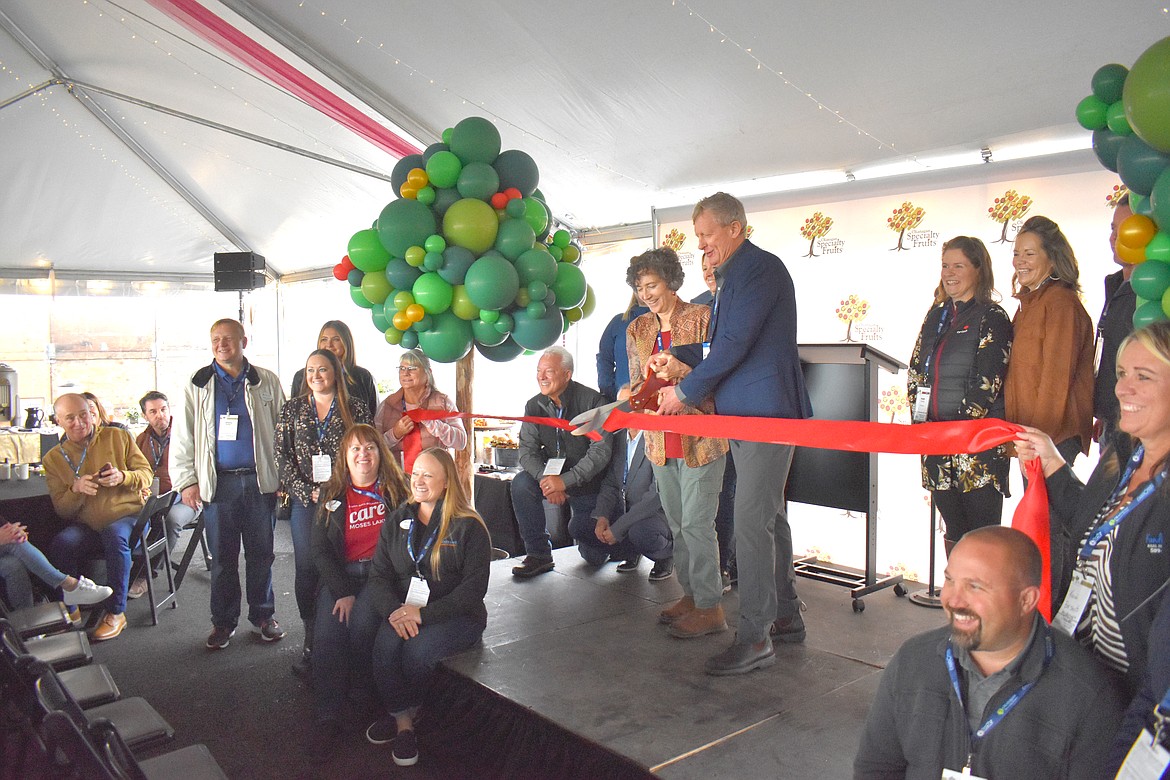
Okanagan Specialty Fruits founder and President Neal Carter, right, and his wife and co-founder Louisa Carter, cut the ribbon at the company’s new apple slicing and packing plant in Moses Lake.
JOEL MARTIN/COLUMBIA BASIN HERALD
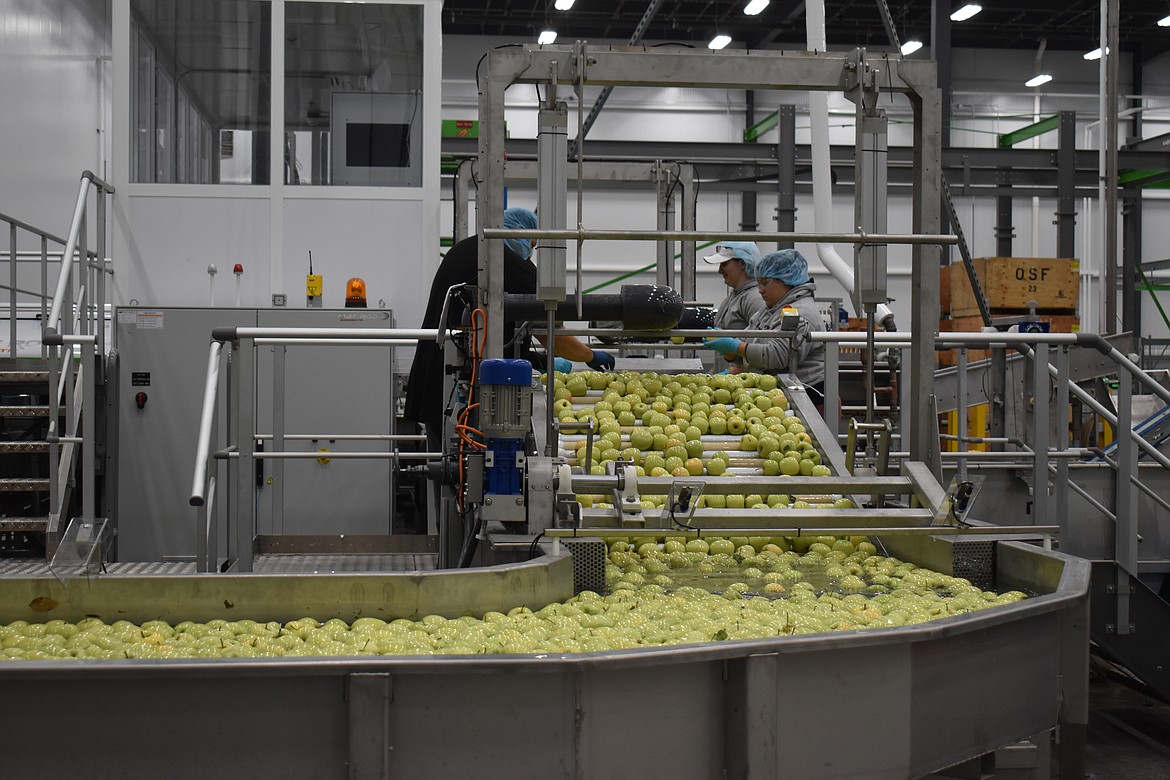
Okanagan Specialty Fruits employees check apples for stray leaves and defects before the fruit is floated into a high-tech camera system and sorter.
Joel Martin has been with the Columbia Basin Herald for more than 25 years in a variety of roles and is the most-tenured employee in the building. Martin is a married father of eight and enjoys spending time with his children and his wife, Christina. He is passionate about the paper’s mission of informing the people of the Columbia Basin because he knows it is important to record the history of the communities the publication serves. | September 28, 2023 5:40 PM
MOSES LAKE — The new Okanagan Specialty Fruits facility had its official ribbon-cutting Wednesday before a crowd of OSF team members, Moses Lake Chamber of Commerce members and local dignitaries. Along with the ceremony, the company offered a catered lunch along with tours of the plant and of an apple orchard.
“Today is a special day for our entire group, the entire management team and Okanagan Specialty Fruits, all the way to the staff that are in the facility,” said Senior Vice President Don Westcott at the ceremony.
The plant, located at 7571 Randolph Road NE across from Genie, broke ground in January 2022. The purpose of the facility is to process, slice and pack OSF’s product, Arctic Apples. The apples are genetically engineered to keep them from browning, and were the first genetically engineered apples approved for sale in the U.S., according to the FDA.
OSF founder and President Neal Carter began developing Arctic Apples in Summerland, British Columbia in 1996, he said at the ceremony.
“We were picking apples and looking at bruised fruit and looking at poor returns (and) declining apple consumption,” Carter said. “At the same time, we were watching the fresh-cut produce industry, you know, the cut-and-tumbled carrots, the salad mixes and ready-prepared salads. It was just taking off, explosive double-digit growth. And it's like, apples are not participating in this. Why? It's because they go brown. So how do we fix this?”
Carter, a bioresource engineer as well as an orchardist, set out to develop an apple that could stay fresh after it was cut, and had proof of concept in fruit in 2004, he said. The next five years were spent fine-tuning the apple and gauging the market.
“We started talking to consumers to see what they thought,” Carter said. “At the same time, there was a lot of anti-GM protests going on, and we spent lots of time getting invited to be the bad guys at conferences. We felt like we had a bit of a bull's eye on our back.”
Arctic Apples received FDA approval in 2015, and the first orchards were planted the same year. All of the Arctic Apples grown come from orchards in the U.S., according to the company’s website. The company produces several varieties of apples, including Golden, Granny and Fuji, all with the same anti-browning modification.
The Moses Lake facility is state-of-the-art. When the apples are picked at the orchard, they’re given a lot code that follows them all the way through the packing process to the consumer. With that code, the company can track any apple all the way back to the orchard row it was picked from, according to OSF Director of Sales Bob Wilkinson.
Apples start the packing process in large water flumes, where a team picks off leaves and checks them visually for defects. They then float through an enormous camera, which takes as many as 60 photos of each apple, scrutinizing them for size, color and any defects the human checkers may have missed. The scanner drops each apple onto a holder pre-programmed to drop the apple into one of 26 different flumes, depending on size. Each flume is set to kick the apples out and start refilling when the apple load reaches exactly 850 pounds.
The apples are then sent into a high-speed slicer and packaged. The most popular size is a 2-ounce packet, said Wilkinson, destined for schools and the military. Just-in-time cutting lets the apples stay fresh longer.
“Twenty-eight-day shelf life production, and two- to three-day delivery,” Wilkinson said. “That’s 10 days better than anyone else.”
The OSF plant employs a crew of 120 people, said Production Supervisor John Warr. Currently the plant runs one shift, with a sanitation crew coming in at night. At full capacity, the plant will be able to ship 350 million 2-ounce packages in a season, Wilkinson said.
“These are the best sliced apples out there,” Wilkinson said. “It still surprises me (at trade shows) when people come up to our booth and taste them, and say ‘Let me go get my buyer.’”
Joel Martin may be reached via email at [email protected].
ARTICLES BY JOEL MARTIN

Quincy National Night Out scales down
QUINCY — Quincy’s National Night Out was more compact this year, which worked out well, said QPD Sgt. Joe Westby, who’s in charge of event planning for the Quincy Police Department. “National Night Out is a big event, and the fact that we’re able to shrink it up is like a breath of fresh air,” Westby said. “If you're always doing the same thing, it's kind of nice to switch things up and see how it works.” National Night Out took place Thursday on the block of C Street next to the police station, a shift from previous years when it was held at Lauzier Park. The smaller space meant fewer emergency vehicles for children to explore, but it also meant less walking for attendees. Grant County Fire District 5 brought a fire truck, and the Grant County Sheriff’s Office had a patrol boat. Renew, the Grant County behavioral health agency, had a booth and so did Quincy Partnership for Youth. Veterans Operation Creation sang the national anthem, and the Quincy Animal Shelter brought kittens that piled over each other making friends with passersby. As before, the QPD served grilled hot dogs.
Quincy Police retirements leave big shoes to fill
QUINCY — There are some big shoes to fill at the Quincy Police Department. “We’re losing 48 years of experience between them,” Quincy Police Chief Ryan Green said at the retirement party for Capt. Jorge Trujillo and Det. Damon Powell Thursday. Trujillo, who grew up in Sunnyside, has been with QPD for 19 years, he said, coming on as a patrol officer fresh out of the military. From there he served as a field training officer, a detective and finally captain. “I consider him my left-hand man,” Green said. “He runs the operations side of the house … He knows the agency very well, and he knows the community.” Trujillo has some projects around the house to tackle now that he’s retired, he said.
Big fun on a small scale
Wheat Land Communities’ Fair opens Thursday
RITZVILLE — The Wheat Land Communities’ Fair isn’t as big or as flashy as some of the county fairs around central Washington, but the folks who keep it going like it just the way it is. “It’s somewhere you can go and get an old-time traditional feeling, and you’re comfortable letting your kids roam the grounds and experience all that it has to offer,” said Board Member Lori Williams. “It’s more of a feeling than (one) specific thing,” The fair starts Thursday in Ritzville and runs through Sunday. Starting Friday, the 56th Ritzville Rodeo will take place alongside the fair at the rodeo grounds. This year the entertainment budget was expanded, Williams said, to be able to offer more fun that’s covered by the cost of admission. For the kids, there’s face painting, balloon art, Lego crafts, races, contests and games. Children can also ride on a little train towed around the fairgrounds behind a tractor.