
Frontotemporal dementia
CHERYL SCHWEIZER | Hagadone News Network | UPDATED 2 years, 11 months AGO

Walkers took to the streets of Moses Lake Sept. 16 for the annual Walk to End Alzheimer’s fundraiser. Frontotemporal dementia is a variant of dementia, and strategies developed to help patients and families cope with Alzheimer’s may help frontotemporal dementia patients too.
CHERYL SCHWEIZER/COLUMBIA BASIN HERALD

Recent research into frontotemporal dementia may help with genetic testing for it, and eventually may help find treatments. The Sept. 16 Walk to End Alzheimer’s is one event that allows the public to financially support research while also raising awareness regarding dementia.

A walker’s t-shirt showed his reasons for participating in the Walk to End Alzheimer’s on Sept. 16. Researchers with the National Institutes of Health said research is providing more information that may eventually help find targeted treatments for all forms of dementia, including frontotemporal dementia.
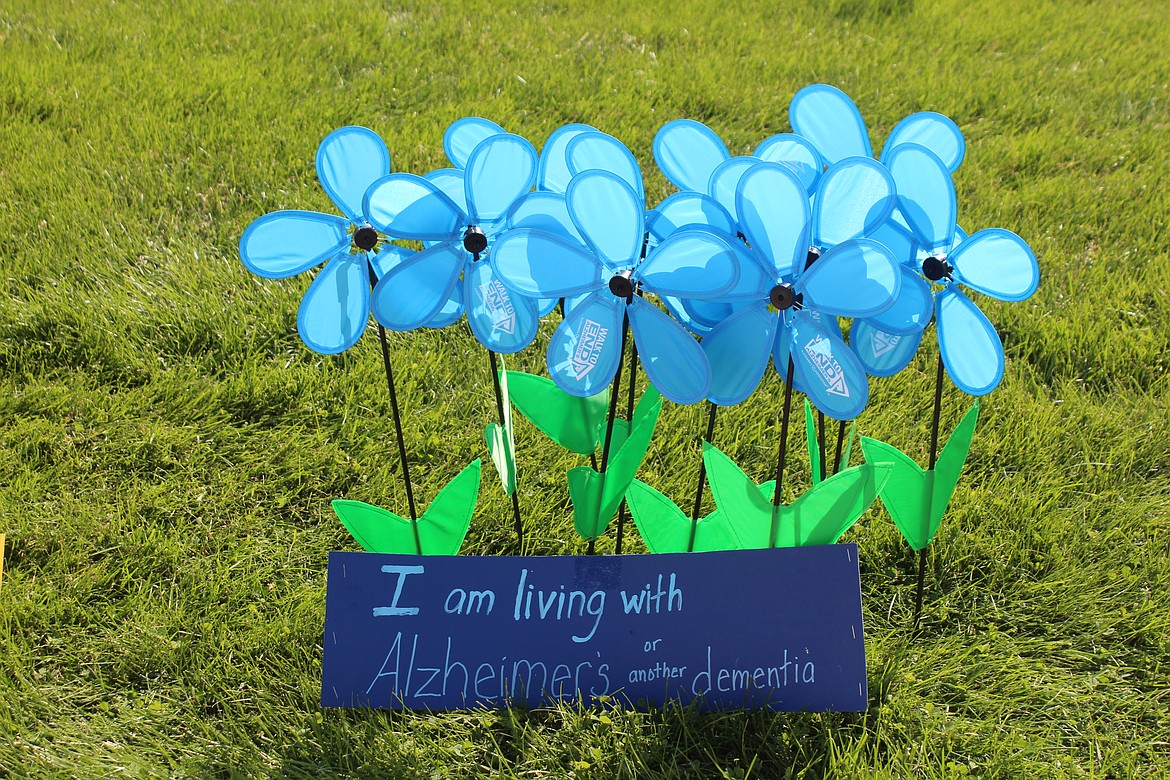
Blue flowers commemorate people living with Alzheimer’s and other forms of dementia, frontotemporal dementia among them, at the Sept. 16 Walk to End Alzheimer’s in Moses Lake.
Senior Reporter Cheryl Schweizer is a journalist with more than 30 years of experience serving small communities in the Pacific Northwest. She began her post-high-school education at Treasure Valley Community College and enerned her journalism degree at Oregon State University. After working for multiple publications, she has settled down at the Columbia Basin Herald and has been a staple of the newsroom for more than a decade. Schweizer’s dedication to her communities and profession has earned her the nickname “The Baroness of Bylines.” She covers a variety of beats including health, business and various municipalities. | September 29, 2023 1:30 AM
MOSES LAKE — Dementia is an ugly disease, and there are variants that make it even uglier. Frontotemporal dementia is one of those variants.
World FTD Awareness Week is Sept. 24 to Oct. 1.
The disease has been pushed into the news by the announcement in February that actor Bruce Willis, 68, has been diagnosed with FTD. Willis’ family announced in 2022 that he was retiring from his acting career because he had been diagnosed with aphasia, which affects the ability to speak and to understand the speech of others. The “primary progressive aphasia” that affected Willis is a form of FTD.
Erika Farrell, with the Washington chapter of the Alzheimer’s Association, said while FTD is a form of dementia, it’s rarer and different from Alzheimer’s, with different symptoms and different effects.
“There are some distinctions between something like Alzheimer’s disease and frontotemporal dementia. For one, people are typically diagnosed or start to show signs a little bit earlier, maybe in their 40s, 50s or early 60s,” Farrell said. “And those signs are not necessarily memory loss.”
Memory loss is one of the first signs of Alzheimer’s, but not an early sign of FTD, she said.
“There are different variants within that type of disorder, for example, a person might actually start to exhibit different behavioral symptoms or moodiness, personality changes that just may not be as typical while their memory is still very sharp,” Farrell said.
Frontotemporal dementia makes up about 10 to 20% of dementia cases, according to the Mayo Clinic.
Along with affecting speech and cognitive ability in some cases and behavior in others, FTD can affect the patient’s ability to walk or swallow and other kinds of muscle degeneration.
Because FTD is less common, it’s sometimes misdiagnosed.
“I’ve spoken with people (where) it might have taken them six to 10 years to get an FTD diagnosis,” Farrell said.
“Frontotemporal dementia can be misdiagnosed as a psychiatric problem or as Alzheimer’s disease,” according to the Mayo Clinic.
“In (FTD) the frontal and temporal lobes of the brain shrink,” according to the Mayo Clinic. “In addition, certain substances occur in the brain. What causes these changes is usually unknown.”
There is no cure for FTD and no specific treatments, according to information from the Alzheimer’s Association.
“With frontotemporal degeneration, there are medications and lifestyle interventions that may help reduce some of the symptoms, but no treatments that would be changing the underlying course of the disease, or the progression,” Farrell said.
A lot of the research being conducted into dementia is focused on specific types of the disease, she said, so the research’s applicability to other variations may be limited. But some of the research into helping patients and caregivers manage the symptoms may work for other forms of the disease, she said.
It’s an inherited disease in about one-third of the cases, according to the Alzheimer’s Association.
Researchers with the National Institutes of Health published the results of research earlier this year that may make it easier to identify people with genetic risk factors.
The research focused on what a press release from NIH called “structural variants,” where the disease has altered or removed segments of DNA.
“If you imagine our genetic code as a book, a structural variant would be a paragraph, page or even an entire chapter that has been removed, duplicated or inserted in the wrong place,” said Sonja W. Scholz, a senior author of the study.
Research indicates structural variants play an important role in the development of neurodegenerative disorders, including FTD, according to the NIH release.
Cheryl Schweizer may be reached via email at [email protected].


ARTICLES BY CHERYL SCHWEIZER
Road projects on hold for Labor Day weekend
MOSES LAKE — With Labor Day weekend dead ahead, drivers will be able to move freely about the state. Most road projects are on hold for the holiday weekend. Nobody will be working on the Hansen Road overpass on Interstate 90, but the lane restrictions that are in effect will continue through the end of the project.

Cost estimates for water source alternatives given to Moses Lake City Council
Protected under the U.S. Endangered Species Act, efforts are ongoing to keep it self-sufficient
MOSES LAKE — It’s going to cost a lot of money to provide alternative water sources for the city of Moses Lake, but some of the possible alternatives will cost more than others. City officials provided the Moses Lake City Council with costs for various alternatives Tuesday.

Dryer vent cleaning is important -- but often overlooked
MOSES LAKE — Not all the maintenance a house needs is visible. Sometimes a potential problem just goes unnoticed until it causes trouble, sometimes serious trouble. But a lot of potential problems give off warning signs. Clothes dryers often do when they need a good cleaning.