
Apple growers see large export market, challenges
GABRIEL DAVIS | Hagadone News Network | UPDATED 1 year, 8 months AGO
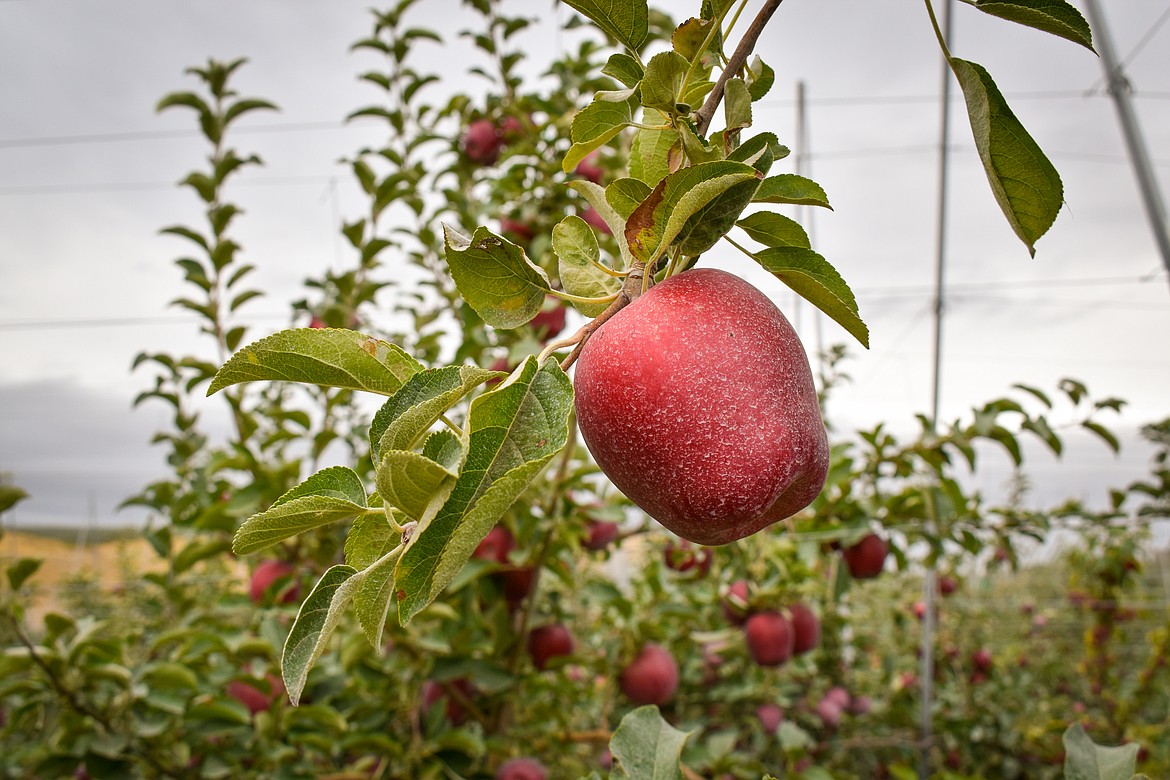
An apple hangs on a tree at FirstFruit Farms east of the Tri-Cities, in Walla Walla county. President of the Washington State Tree Fruit Association Jon DeVaney said last year’s apple crop was large, and the one before that was very small; this year’s crop may be more normal in size.
COURTESY PHOTO/WASHINGTON STATE TREE FRUIT ASSOCIATION
Gabriel Davis is a resident of Othello who enjoys the connections with his sources. Davis is a graduate of Northwest Nazarene University where he studied English and creative writing. During his free time, he enjoys reading, TV, movies and games – anything with a good story, though he has a preference for science fiction and crime. He covers the communities on the south end of Grant County and in Adams County. | April 13, 2024 1:00 AM
MOSES LAKE — According to Washington State Tree Fruit Association President Jon DeVaney, it is still too early in the year to make a firm apple crop prediction for 2024, but there are several factors that may play a part in the industry this year.
“We had a very large crop last year,” DeVaney said. “The year before the crop harvested in the fall of 2022 was unusually small; we had been averaging between 120 and 130 million boxes of fruits for several years. In the fall of 2022, we were down to 104 million. Then, this last fall, we bumped up to just under 140 million. So 104 to 140 was a big swing in one season, so growers are looking forward to a more normal range year, not too small, not too big as far as overall crop size. It appears that we may be on track for that now, though it’s very early. Right now you’re just looking at crop potential on the tree and so on.”
Washington Apple Commission International Marketing Specialist Jennie Strong suggested in an email to the Basin Business Journal the crop could be a more average size.
“Typically a large crop is followed by a small crop so we might see a ‘return to normal’ crop size of about 125-130 million 40-pound box equivalents,” she said.
Also writing in an email to the Basin Business Journal, Washington Apple Commission President Todd Fryhover commented on last season’s larger crop.
“For the grower, larger crops are always challenging from a return perspective,” he said. “Here in Washington we see high labor and input costs increasing the challenge of attaining positive grower returns … Long-term, increased production is good. The challenge is staying in business as prices get aggressive and costs (labor and inputs) increase.”
DeVaney said growers are seeing a lot of their production costs increasing.
“The same way that average consumers have been seeing a big inflationary bite in a lot of the prices of goods that they buy, growers have seen the same kind of cost increase on their inputs. They haven’t seen the same size increase at the retail level or at the wholesale level for the fruit that they’re selling,” DeVaney said. “In fact … the prices on many varieties are down. So, when you have an increase in your costs and a decrease in your prices it’s not a fun place to be, even if you have a lot of really good quality fruit.”
Labor shortage is another factor that will be affecting growers this year. DeVaney said apples are a labor-dependent crop, with about 60% of production costs being labor-related.
“With a labor shortage, overall many growers have had to go into the H2A guest worker program, which is very costly to use,” he said. “In Washington state, the minimum wage requirements for workers hired under the H2A program is $19.25 an hour this year, in addition to free housing and free transportation; there are a lot of hidden costs with hiring people in that program. You’re not going to use it unless it’s your only option. But they’re also subject to all the labor protections and laws that domestic workers are as well. If you’re already at a higher wage rate, and then you get those benefits plus you go into time-and-a-half overtime, very few people can afford to pay that.”
Fryhover also discussed the cost of the H2A guest worker program for growers.
“Growers are struggling to stay in business,” he said. “The policies of Western Washington often impact our labor costs in Eastern Washington.”
DeVaney also commented on state policies.
“This is the first year that the phase-in of the overtime pay requirements for agriculture are fully implemented,” he said. “So as of Jan. 1, any hours over 40 per week go to time-and-a-half in agriculture, as it has been in some other industries.”
The overtime policy is not suited to agricultural work, DeVaney said.
“Unlike other industries, where you can say ‘that’s fine … we’ll come back to our work, or our inbox, or our desktop, on Monday,’ in agriculture, there’s a lot of work that you need to do right now or you don’t do it at all,” he said. “And that presents a lot of problems for growers and for employees, frankly, because if growers are in dire financial straits and they’re seeing a 50% cost increase in their biggest expense, they just can’t absorb that added loss. So they are saying, ‘Well, I will just have to pick this fruit at a less optimal time next week or not at all.’ And that means that many workers are seeing fewer hours on offer, and they’re seeing an actual net decrease in their take home.”
DeVaney said another possible challenge for the apple industry this year could be water availability.
“We’ve seen some recovery in snowpacks in recent weeks, but the most recent forecast from the Department of Ecology and Bureau of Reclamation was still looking like about 70% of normal supply,” he said. “For some junior water rights that may mean some curtailment of availability, so we won’t know for sure for another few weeks.”
DeVaney also mentioned some positive trends in the industry.
“We’re seeing some downturn in prices right now. The industry has made substantial investments in newer orchards, including new varieties over the past few years,” he said. “So we’re seeing growth in both the organic apple production sector and in new varieties, including ones developed here in Washington, like the Cosmic Crisp. So we’re seeing high quality, good products that we are able to offer to consumers.”
Strong and DeVaney both mentioned the tariffs imposed on exports to India that were lifted last year.
“The tariffs, imposed in 2019, added an additional 20% duty on the importation of US apples to India,” Strong wrote. “This brought the total tariff to 70%, effectively shutting Washington apples out of the Indian market. Washington state apple growers saw their market share drop from 53% to less than 1%. With the tariff lifted, India is once again a viable export market for Washington apples. This was a huge win for the industry.”
DeVaney said another positive is that although the water availability might not be 100% this year, the Columbia Basin is still very reliable when it comes to water.
“It makes it one of the best places in the nation for producing high-quality agricultural products. You see more climate unpredictability in California and water rationing and curtailment down there,” he said. “I think we are going to see a lot more investment and interest in Washington agriculture.”
Gabriel Davis may be reached at [email protected]. Download the Columbia Basin Herald app on iOS and Android.
ARTICLES BY GABRIEL DAVIS

Work-based learning lets students build their own futures
MOSES LAKE — Work-based learning provides education opportunities for the workforce to receive hands-on training and technical education and prepare themselves to enter various industries. Educators and workforce development professionals from Eastern Washington discussed some the training they offer and the benefits of their programs. Next Generation Zone, an affiliate of WorkSource based in Spokane, provides job training opportunities for youth and young adults ages 16 to 24. Program Coordinator Kate Martin said there are multiple benefits to the program. “One of them is a paid work experience, and that’s where we reach out to area employers who are willing to take a young person and train them,” she said. “This is a short-term learning experience, so it’s typically about 240 hours; sometimes it could be longer or shorter. We’re the actual employer; we cover all of their wages, taxes, the L&I, and the employer just agrees to give them the experience and train them in whatever field it is that they’re wanting to go into.”

Serving schools: ESD superintendents reflect on operations, priorities
MOSES LAKE — Educational service districts are government-mandated agencies put in place to provide services to school districts across the state. ESD Superintendents discussed what they do and their priorities in operating their districts. ESD 105, led by Superintendent Kevin Chase, serves four counties, including Kittitas, Yakima and portions of Klickitat and Grant counties and provides support for 25 school districts – including Royal School District and Wahluke School District – and more than 66,000 students. “We help them collaborate with each other as well or collaborate with other partners,” Chase said. “(It’s) a lot of advocacy work, either regionally or across the state, or even federally, working on different issues that impact our education. And we provide very specialized services in certain situations in order to meet the needs of our students in our region and of our school districts.”

Columbia Basin Project making headway through Odessa Groundwater program
CASHMERE — The Columbia Basin Project is making gradual progress toward completion with particularly significant accomplishments for the Odessa Groundwater Replacement Program in the last six months or so, according to Columbia Basin Development League Executive Director Sara Higgins. “When we’re dealing with a project of this size, advancement is kind of like watching paint dry, but yes, there have been (developments),” she said. “There are a lot of exciting things happening right now.” There are more than 300 miles of main canals, about 2,000 miles of lateral canals and 3,500 miles of drains and wasteways in the irrigation project, according to the U.S. Bureau of Reclamation website. The CBDL advocates for the operation of those waterways and for the project to continue “build-out.”