
A place of her own
JOEL MARTIN | Hagadone News Network | UPDATED 2 years, 6 months AGO
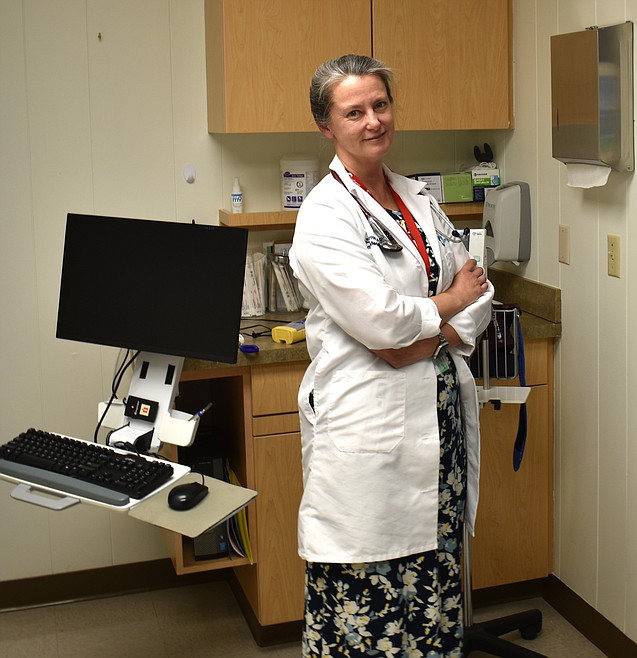
Tara Zamarron, ARNP, stands in the little Confluence Health clinic in Royal City. Zamarron took over the clinic in February, and plans to make the clinic her professional home.
Joel Martin/Columbia Basin Herald
Joel Martin has been with the Columbia Basin Herald for more than 25 years in a variety of roles and is the most-tenured employee in the building. Martin is a married father of eight and enjoys spending time with his children and his wife, Christina. He is passionate about the paper’s mission of informing the people of the Columbia Basin because he knows it is important to record the history of the communities the publication serves. | April 15, 2024 1:20 AM
ROYAL CITY — Tara Zamarron has found her home.
“We grew up, my husband and I both, in Michigan, born and raised,” Zamarron said. “We had some friends who moved out here in 2005, or 2006, and they asked us to come visit them. And we're like, ‘Sure, we’ll come visit you, we’ve never been out west.’ And we fell in love with it.”
Zamarron recently became the primary – in fact, pretty much the only – provider at Confluence Health’s Royal City clinic. Zamarron isn’t a physician; she’s an advanced registered nurse practitioner, which means she does most of the things a doctor does without the title “doctor” before her name. She’s joined at one of the smallest clinics in the Confluence system – a little over 1,700 square feet in downtown Royal City – by a registered nurse and a receptionist.
Family practice is what Zamarron does, which isn’t really what you’d call a specialty.
“It’s ‘jack of all trades, master of none,’ but you’ve got to be a master of all,” she said. “You have to be able to recognize those concerning things.”
Zamarron has been in health care in one form or another since she was 16, she said. She was accepted into nursing school in October 1993, her senior year of high school, then did her prerequisites and EMT training the next year and entered nursing school in the fall of 1995.
“So I had my RN by the time I was 20,” she said. “It was kind of a whirlwind.”
Answering a call
Zamarron worked happily as an RN for 16 years, she said, in family practice for Samaritan Healthcare in Moses Lake, in rheumatology at Lourdes Hospital in Pasco and in the emergency room at Kadlec Hospital in Richland.
Everything changed in 2013 when Zamarron and her husband, who also has paramedic training, went to visit a clinic run by their church in Haiti.
“It really felt like a calling,” she said. “It truly was a calling, like ‘I need to do more.’ I realized that old adage, ‘The more you know, the more you know you don’t know.’ And it was then that I (understood) how helpless I felt without having that kind of background of primary care and how to help these poor folks who had nothing.
“It was the best, worst trip of our life,” she added.
Zamarron decided then that she would go after certification as a nurse practitioner. She finished her Master of Science in Nursing at Simmons University in Boston in 2016, flying back and forth as needed. A few months later she went to work at Samaritan Health Care in Moses Lake as an ARNP.
Country life
Zamarron’s heart was always in the small towns and the countryside, she said. She was born and raised in Greenville, a town of about 9,000 in central Michigan, and moved to nearby Carson City, population 1,100, when she got married. They now live out in the country near Othello.
“It was funny, even when I worked in Moses Lake, because we live just outside of Othello, I had always kept my eye on this little clinic,” she said. “But I thought Jose (Estrellado) would be here forever.”
Estrellado left Royal City between three and four years ago, said Confluence Clinic Manager Mike Delgado, who oversees the clinics in Moses Lake, Ephrata and Royal City. Another provider took over, but he too left after about a little over a year.
“I think that commute (was a challenge),” Delgado said. “We try to encourage (providers) to stay in the community, but unless they have some kind of roots, (it’s difficult.)”
“They (Confluence) were looking for a long-termer, and I was looking for a home,” Zamarron said.
Settling in
Zamarron took over at the end of February, and she’s made a big difference already, Delgado said, revamping the clinic’s hours from the usual five eight-hour days to four 10-hour days. That allows her to see patients for a couple of hours before and after regular business hours, a huge asset in an agricultural community where people often work on an unpredictable schedule.
One thing that’s getting a workout is her command of Spanish, Zamarron said. Royal City is about 88% Hispanic and almost half of residents are born outside the U.S., according to the 2022 census. Zamarron has picked up most of her Spanish on the job, and most of the time works through an interpreter connecting from Wenatchee via iPad.
“For the most part, I will pull up the interpreter, and just let her know, ‘I'd like to practice my Spanish, but fill in the blanks.’ That way, if the patient is trying to explain something in more detail that I would completely miss, the interpreter is really helpful.”
Zamarron is charging ahead to lessen her dependence on outside interpreters, Delgado said.
“She is determined,” he said. “She's actually challenged our certification testing, and she is focused to get certified so that she can be recognized within our health system as a bilingual provider.”
Zamarron plans to spend the rest of her career at Royal City, she said, but she and her husband may go back when the opportunity arises and volunteer again in Haiti, where she saw the desperate need first-hand.
“These children are so poor, I've never seen anything like it,” she said. “The malnourishment sucks the black out of their hair. Their hair turns orange, because they're so malnourished. It was awful. It was amazing. It was heart-wrenching.”
Joel Martin may be reached via email at [email protected].
ARTICLES BY JOEL MARTIN

Endless battle
Noxious Weed Control Board works to keep invasive plants under control
MOSES LAKE — Some of the nastiest plants in Grant County were the topic of a class led by Jay Johnson, a consultant with the Grant County Noxious Weed Control Board, Tuesday. The Noxious Weed Control Board, as its name would suggest, is tasked with keeping weeds under control in Grant County. That’s not a small job; the board’s website lists 129 species of noxious weeds that are found around Grant County. A noxious weed is defined as an invasive, non-native plant that threatens agricultural crops, local ecosystems or fish and wildlife habitat, according to the Noxious Weed Control Board. Washington state law requires that these weeds be identified and their spread kept to a minimum, if not completely eradicated. “We’re one of those agencies a lot of people don’t really understand,” Johnson said. “We’re a county office and … our funding is tax-based assessment. When you get your tax bill and you look down at all the expenses that you pay for, there we are.”

BASIN EVENTS: Oct. 16-24
COLUMBIA BASIN — Whether you feel like shopping, crafting, learning or seeing a show, there’s something happening for you this week in the Basin. Oct. 16 ‘My Family (Mi Familia)’ screening Spanning three generations, “My Family (Mi Familia)” is a heartfelt drama that follows the Sánchez family as they build their lives in East Los Angeles. Through love, hardship, triumph, and sacrifice, the film explores the immigrant experience, the strength of family bonds, and the traditions that connect one generation to the next. Lowrider show and taco truck before the screening. Sponsored by Columbia Basin Allied Arts, EDUBS C/S and the Moses Lake Creative District. $12 per person. Doors open at 6 p.m., film begins at 7 p.m. at the Moses Lake Civic Center Auditorium, 401 S. Balsam St. Tickets and info: www.cba-arts.org.

Moses Lake author encourages women to look beyond church culture norms
MOSES LAKE — A Moses Lake author’s book, “A Christian Woman Striving to Live Her Faith in a Man-Controlled World,” takes aim at the role to which many churches relegate the female half of their congregations. “It’s to encourage women in the faith,” Linda Curran said. “A lot of churches say, ‘Teach Sunday school, do this, do that, but don’t (evangelize.)’" In her book, Curran recounts a time when she moved to a new community and joined a church there. She was surprised to learn that, as a new female member, she had been automatically assigned church cleaning duties. When she questioned it, she wrote, she was met with condescension and her objections were brushed aside. In other churches, she said, women who were capable of teaching were relegated to “women’s ministry.”