
BBCC clean energy conference highlights workforce needs
JOEL MARTIN | Hagadone News Network | UPDATED 2 years, 6 months AGO

Big Bend Community College President Sara Thompson Tweedy addresses attendees at the Building the Future Energy Workforce Conference Thursday.
COURTESY PHOTO/TIFFANY FONDEREN/BBCC
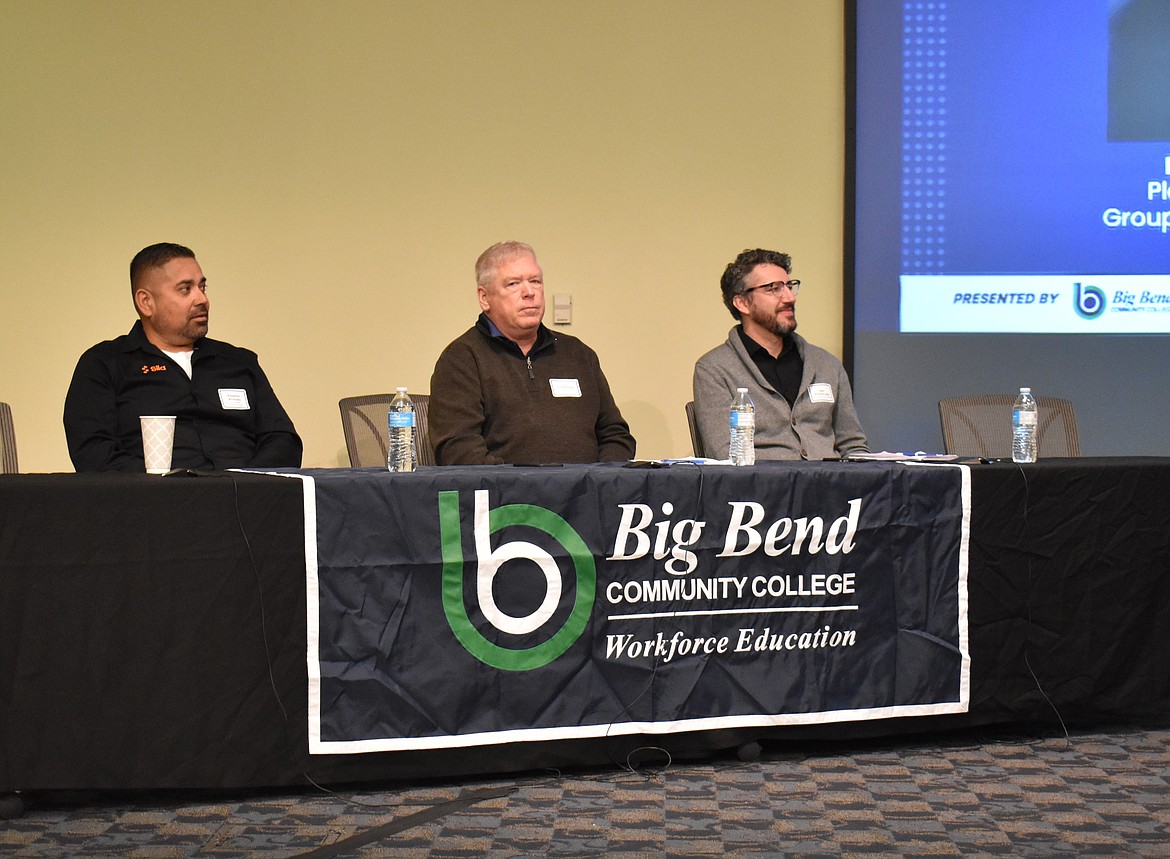
From Left: Sila Nanotechnologies Plant Manager Rosendo Alvarado, Group14 Plant Manager Don Kersey and Group14 Senior Recruiter Stan Pichinevskiy field questions during a panel discussion at the Building the Future Energy Workforce Conference Thursday at Big Bend Community College.
Joel Martin has been with the Columbia Basin Herald for more than 25 years in a variety of roles and is the most-tenured employee in the building. Martin is a married father of eight and enjoys spending time with his children and his wife, Christina. He is passionate about the paper’s mission of informing the people of the Columbia Basin because he knows it is important to record the history of the communities the publication serves. | April 16, 2024 5:57 PM
MOSES LAKE — Preparing a workforce for today’s clean energy industries was the focus of the Building the Future Energy Workforce Conference held at Big Bend Community College on April 11.
“We designed this as a way for us to showcase what Big Bend Community College has to offer in the way of flexible training and for folks to see their labs, and also as a way to introduce the battery manufacturing businesses to your local area and find out what is involved with this new emerging technology that's so important,” said Monica Brummer, director of the Pacific Northwest Center of Excellence for Clean Energy and one of the organizers of the conference.
The event was attended by about 110 people from the local community, according to BBCC Center for Business and Industry Services Director Beth Laszlo, who organized the BBCC side of the event along with Dean of Workforce Education Daneen Berry-Guerin. There was a panel discussion on the clean energy industry’s workforce needs with representatives from Sila Nanotechnologies and Group14, two of the electric vehicle manufacturers that are setting up production in Moses Lake; another on workforce development with Berry-Guerin, the Columbia Basin Technical Skills Center, Apple STEM Network, the North Central Washington Tech Alliance SkillSource and the state Employment Security Department; and a legislative panel with Reps. Alex Ybarra, R-Quincy and Vandana Slatter, D-Bellevue and Grant County Economic Development Council Director Brant Mayo.
“We had people from almost every industry sector: public education, the health care system, manufacturers,” said Laszlo. “We had city representatives, we had county representatives, our legislators were there … But the most exciting part was that we had people who were wanting to get a job. One of the teachers of our Adult Basic Ed program brought her class, so that class could hear what are the employers looking for, and how can they be prepared to get a job with these really fantastic new employers in town?”
The keynote speaker, University of Washington Clean Energy Institute Director Daniel T. Schwartz, gave an example of the speed with which the clean energy industry is evolving in the person of a UW chemical engineering student who started a battery testing company before he graduated in 2018.
“And then in 2020, they were acquired by Tesla,” Schmidt said. “In my 30-plus years (in the field), I've never seen a chemical engineering idea get tested at the small scale, and then be able to scale globally … And that is what we mean by accelerating the adoption of scalable clean energy: getting ideas out, getting them tested.”
“Manufacturing has changed. My grandma was an original Rosie the Riveter,” Brummer said. “(We’re) using a lot of automation … (but) we still need people to fix and fine-tune and make things better.”
Group14 is up to 100 employees, and looking to double that, said its plant manager Don Kersey.
“There's a big push to get that done,” he said. “It's tough to find the local people; we're aggressively going after them.”
Group14 has had to recruit from as far away as Texan and Louisiana, Kersey said, looking for people who have worked in oil refineries and developed the sort of skills needed in the EV battery industry.
Companies looking to set up in the area often meet ahead of time with BBCC, Laszlo said, to find out what the local workforce prospects are, and the college uses that to focus its educational efforts.
“The industries that come to our communities want to know that there are educational opportunities available, that those employees that they're going to need to hire will have access to excellent education,” she said. “It (gives) us a heads-up to start working in that sector, to think about what kinds of needs do they have? And how is that different from what we currently offer? And what do we need to tweak? All that work has been done for years, but we now have the opportunity, especially with new clean energy sector (groups) coming, to be able to demonstrate it clearly.”
“(Technology is being developed) that is cleaner, more sustainable and considers not just our immediate needs of this moment, but our nation’s and our world’s needs,” said BBCC President Sara Thompson Tweedy. “And we are here to learn how we can join together to meet the needs of this emerging industry that is developing right before our eyes here in Moses Lake … and at Big Bend Community College, we are preparing people to have the skills they need to be an integral part of this.”
Joel Martin may be reached via email at [email protected].
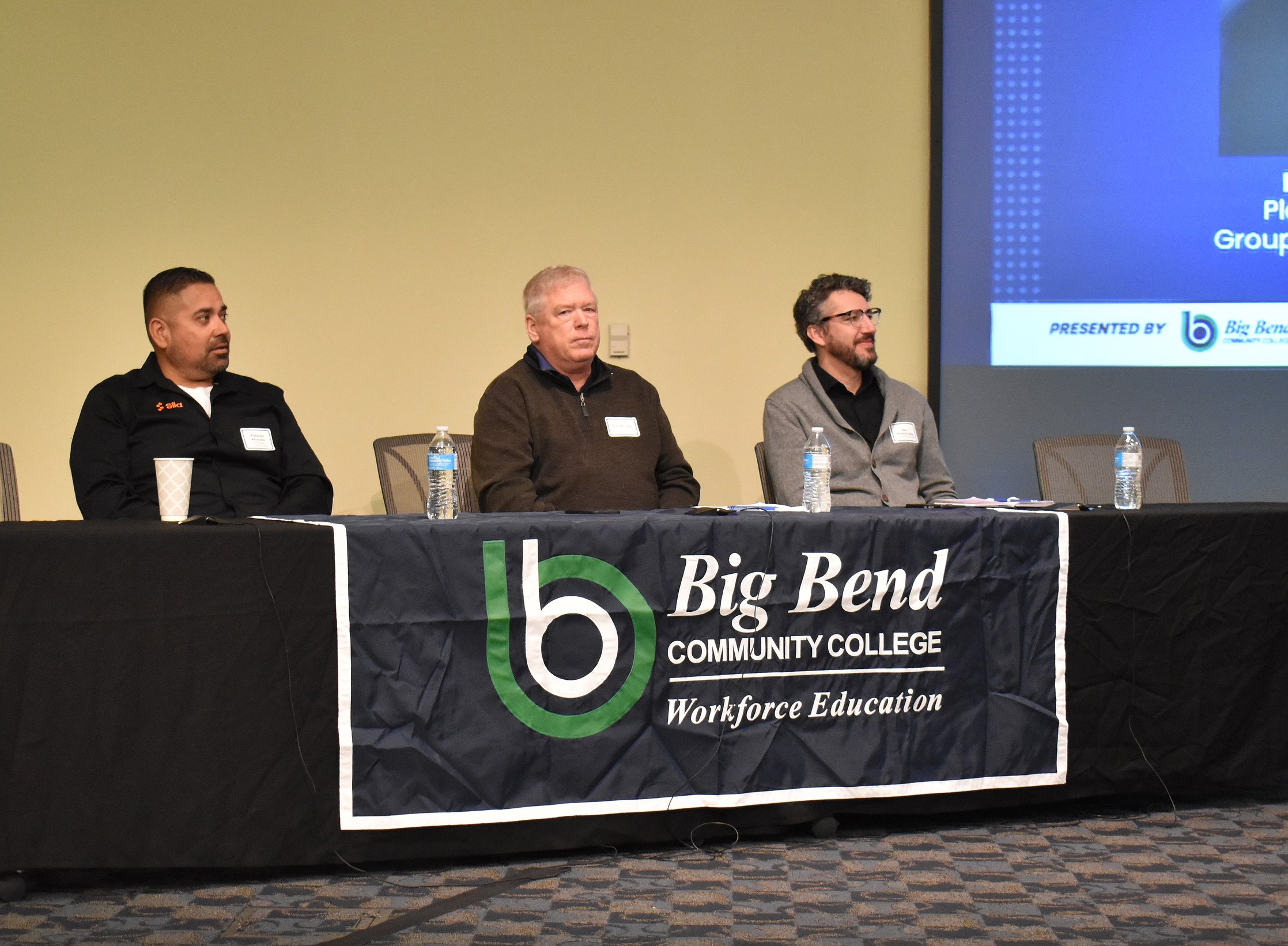 From Left: Sila Nanotechnologies Plant Manager Rosendo Alvarado, Group14 Plant Manager Don Kersey and Group14 Senior Recruiter Stan Pichinevskiy field questions during a panel discussion at the Building the Future Energy Workforce Conference Thursday at Big Bend Community College.
ARTICLES BY JOEL MARTIN

Endless battle
Noxious Weed Control Board works to keep invasive plants under control
MOSES LAKE — Some of the nastiest plants in Grant County were the topic of a class led by Jay Johnson, a consultant with the Grant County Noxious Weed Control Board, Tuesday. The Noxious Weed Control Board, as its name would suggest, is tasked with keeping weeds under control in Grant County. That’s not a small job; the board’s website lists 129 species of noxious weeds that are found around Grant County. A noxious weed is defined as an invasive, non-native plant that threatens agricultural crops, local ecosystems or fish and wildlife habitat, according to the Noxious Weed Control Board. Washington state law requires that these weeds be identified and their spread kept to a minimum, if not completely eradicated. “We’re one of those agencies a lot of people don’t really understand,” Johnson said. “We’re a county office and … our funding is tax-based assessment. When you get your tax bill and you look down at all the expenses that you pay for, there we are.”

BASIN EVENTS: Oct. 16-24
COLUMBIA BASIN — Whether you feel like shopping, crafting, learning or seeing a show, there’s something happening for you this week in the Basin. Oct. 16 ‘My Family (Mi Familia)’ screening Spanning three generations, “My Family (Mi Familia)” is a heartfelt drama that follows the Sánchez family as they build their lives in East Los Angeles. Through love, hardship, triumph, and sacrifice, the film explores the immigrant experience, the strength of family bonds, and the traditions that connect one generation to the next. Lowrider show and taco truck before the screening. Sponsored by Columbia Basin Allied Arts, EDUBS C/S and the Moses Lake Creative District. $12 per person. Doors open at 6 p.m., film begins at 7 p.m. at the Moses Lake Civic Center Auditorium, 401 S. Balsam St. Tickets and info: www.cba-arts.org.

Moses Lake author encourages women to look beyond church culture norms
MOSES LAKE — A Moses Lake author’s book, “A Christian Woman Striving to Live Her Faith in a Man-Controlled World,” takes aim at the role to which many churches relegate the female half of their congregations. “It’s to encourage women in the faith,” Linda Curran said. “A lot of churches say, ‘Teach Sunday school, do this, do that, but don’t (evangelize.)’" In her book, Curran recounts a time when she moved to a new community and joined a church there. She was surprised to learn that, as a new female member, she had been automatically assigned church cleaning duties. When she questioned it, she wrote, she was met with condescension and her objections were brushed aside. In other churches, she said, women who were capable of teaching were relegated to “women’s ministry.”