
Labor costs a challenge for asparagus growers, but opportunities exist
R. HANS MILLER | Hagadone News Network | UPDATED 1 year, 7 months AGO
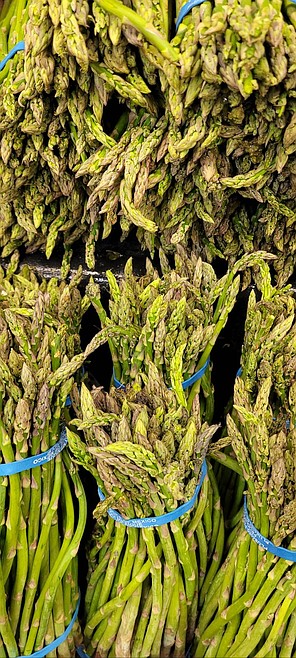
The Washington asparagus industry has some challenges, especially when it comes to the cost of labor, said Washington Asparagus Commission Executive Director Alan Schreiber. Labor in the state is much more expensive with piece-rate workers earning more in an hour than some Mexican and Peruvian workers make in a day doing the same work. That makes it hard to compete price-wise with products from Central and South America like the Mexican asparagus shown here.
R. HANS MILLER/BASIN BUSINESS JOURNAL
Managing Editor Rob Miller is a 4-year U.S. Army veteran who grew up in Western Montana in a community about the size of Soap Lake. An honors graduate of Texas State University, he enjoys spending time with his wife, Brandee, and their three dogs, Draco, Pepper and Cinnamon. He has one son, William. During his free time, he enjoys photography, video games, reading and working on the house he and his wife bought in Ephrata. He is passionate about the First Amendment and educating communities. | August 13, 2024 1:00 PM
ELTOPIA — While the crop has been good overall, Washington Asparagus Commission Executive Director Alan Schreiber said the state’s asparagus industry is in crisis.
“There is no two ways about it,” he said. “The Washington asparagus industry is in trouble with a capital T, and it’s in trouble because we have the highest minimum wage in the Western Hemisphere.”
That wage has caused a significant cost increase for asparagus growers, he said.
Minimum wage increased by 54 cents on January 1, moving from $15.74 per hour to $16.28 per hour, according to the Washington Department of Labor and Industries.
While asparagus cutters are paid a piece rate rather than minimum wage, the amount paid per piece goes up along with the state’s minimum wage. A good asparagus cutter now makes in the mid-20s when their piece rate is averaged out, Schreiber said. In some instances, the best cutters made more than $40 per hour. While Schreiber doesn’t begrudge a good worker making a solid wage, the costs reduce the competitiveness for Washington asparagus farmers, especially when one takes into account that the main competition pays significantly less for labor.
“We are competing with Mexico and Peru, whose workers will make $20 a day. We pay more per hour than our competitors pay their workers in a day. Add to that, we have to cut asparagus seven days a week, every day, which puts us into an overtime situation. Washington has the most lucrative overtime in agriculture,” he said.
Overtime at the state’s current minimum wage is $24.42 per hour under the time-and-a-half rule. For folks averaging $25 an hour at the piece rate, that comes out to around $37.50 hourly, making things difficult for the grower.
“Between the high cost of labor and overtime, it has made (Washington) asparagus noncompetitive with imported asparagus,” Schreiber said.
Drought didn’t impact asparagus very much this year and overall yield was good, he said. Final numbers for this year’s crop aren’t out yet through.
“Most asparagus growers have senior water rights,” he said. “There’s very little asparagus grown in places that have junior water rights, but in those places, they’ve got enough water at the right time and it’s not having a negative impact on asparagus.”
Washington does have some advantages in the market though, he said. The state has an environment that leads to high yields for asparagus. Additionally, the four Washington growers – including Schreiber’s own farm – who are organic have a leg up because Mexico and Peru don’t have much in the way of organic asparagus.
“The organic market is stronger, but we have to be able to get labor. You’ve got to manage it, and you’ve got to be able to sell it at a good price,” Schreiber said.
Generally, Schreiber said there’s reason to have hope for Washington asparagus. It’s a matter of being intentional about how a farmer manages the crop. If someone chooses the right variety, plants with high density, attracts and holds labor while managing labor costs effectively, it’s possible to make a go of it. Generally, an asparagus field takes about five years to get to full productivity, so that’s a factor to keep in mind as well.
“It’s five years from the time you jump into it until you’re at full harvest. It’s not quick, easy money, but anybody that plants and does what I just told you, those steps, can make money in asparagus,” Schreiber said.
ARTICLES BY R. HANS MILLER

Court cases in March 2025 shooting death of Moses Lake teen moving forward
EPHRATA — Jose D. Beltran Rodriguez, 21, of Moses Lake, and Matthew Gabriel Valdez, 19, also of Moses Lake, remain in custody at the Grant County jail after being arrested in connection with a March 21, 2025, drive-by shooting in Moses Lake.

Sentencing hearing set in 2022 Moses Lake murder case
EPHRATA — Juan Gastelum, the suspect in the March 2022 killing of Yanira Cedillos, changed his plea from not guilty to guilty on March 3. He is now scheduled for an April 28 sentencing hearing. According to court documentation, Gastelum, 32, of Hermiston, Ore., pleaded guilty to Murder in the Second Degree with Sexual Motivation. The minimum sentence Gastelum may receive under the law is two years in prison, but the maximum is life imprisonment and up to a $50,000 fine. However, the sentencing hearing is under Special Set Sentencing, an option under Washington state law which allows adjustments to sentencing if a suspect pleads guilty.

Court case in Nov. 2025 Moses Lake shooting moving forward
EPHRATA — The trial into the shooting of a 23 year old Moses Lake man is progressing through Grant County Superior Court. Darwin Nahun Tejada Martinez, 29, of Seattle is on trial facing a single charge of Assault in the First Degree after investigators say he shot the victim in a Nov. 25, 2025, incident.