
Home Ec building at the fair a reminder of a bygone age
JOEL MARTIN | Hagadone News Network | UPDATED 2 years, 2 months AGO
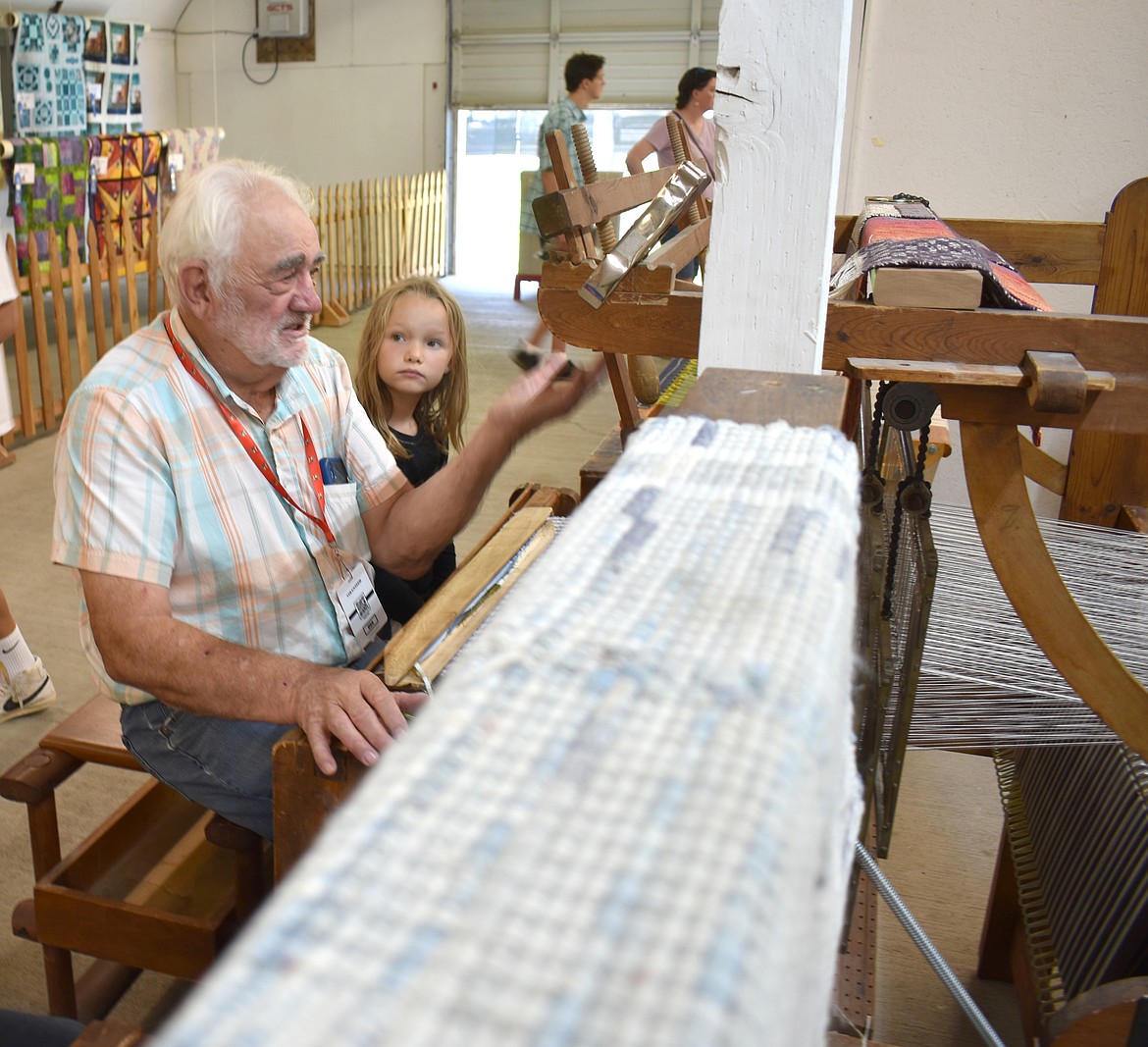
Steve Hess of Soap Lake demonstrates the intricacies of a 1918 wooden loom to Jael Pinkerton, 7, of Quincy at the Grant County Fair Tuesday. Hess restored the loom himself, he said, along with many others.
JOEL MARTIN/COLUMBIA BASIN HERALD
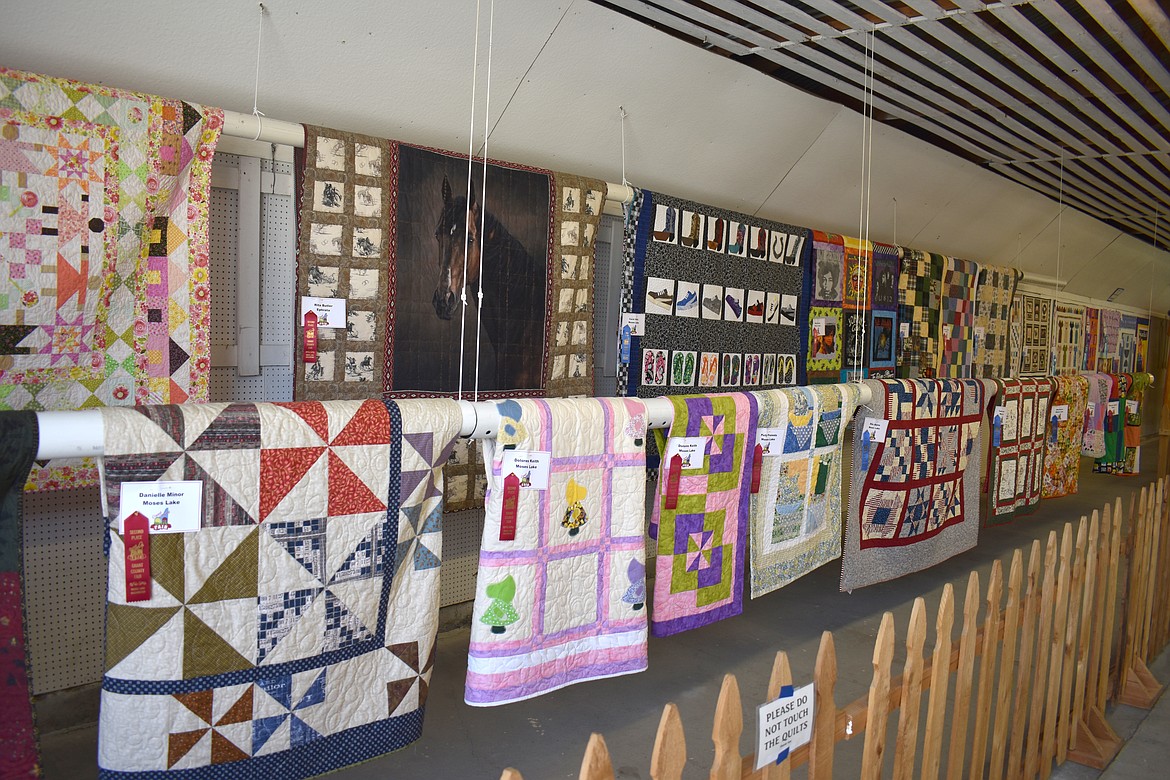
Quilts cover the walls of the Home Economics Building at the Grant County Fair Tuesday.
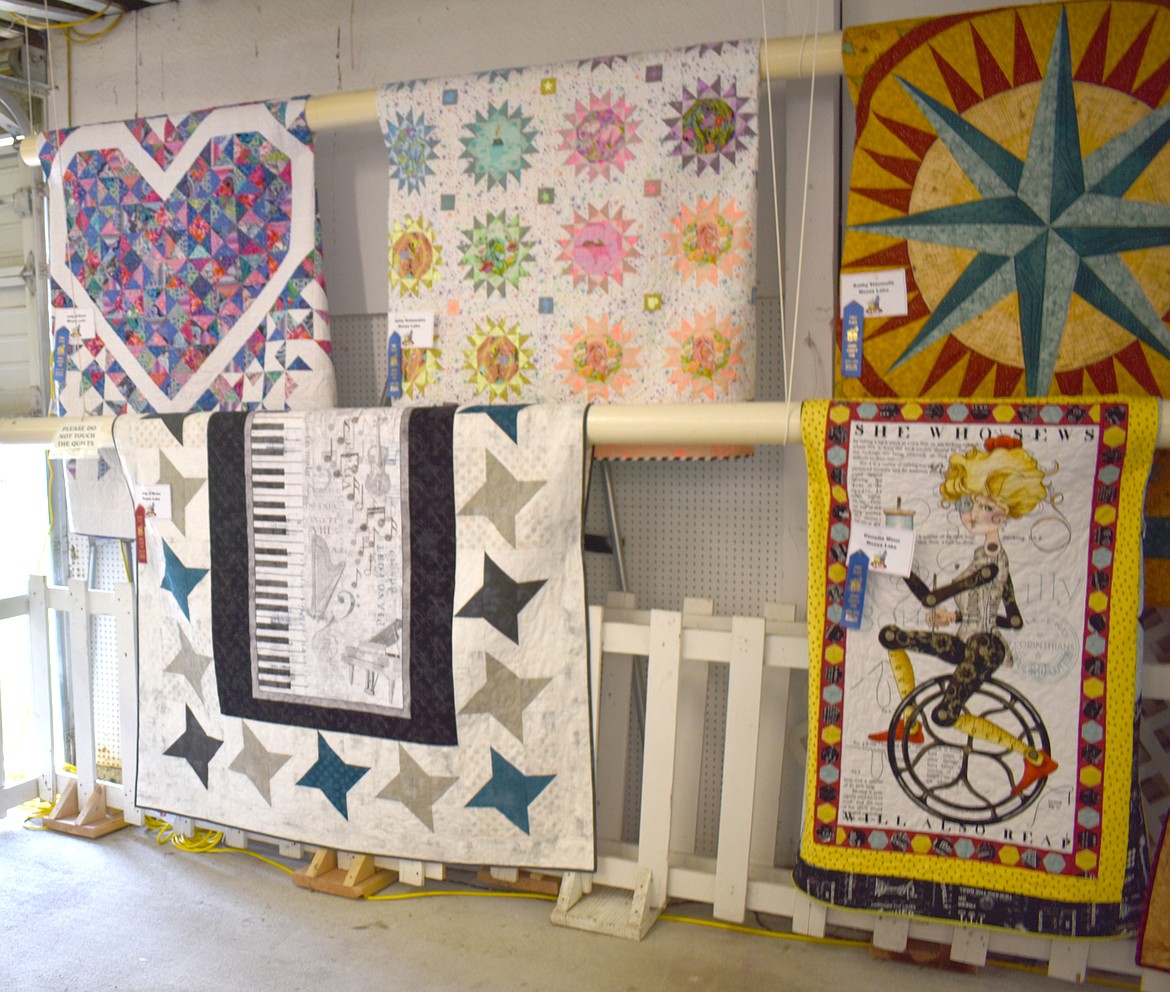
Some of the quilts on display at the Grant County Fair Tuesday were quite intricate, including a compass rose, a musical motif and a stylized unicycle rider with the words “She who sews will also reap.”
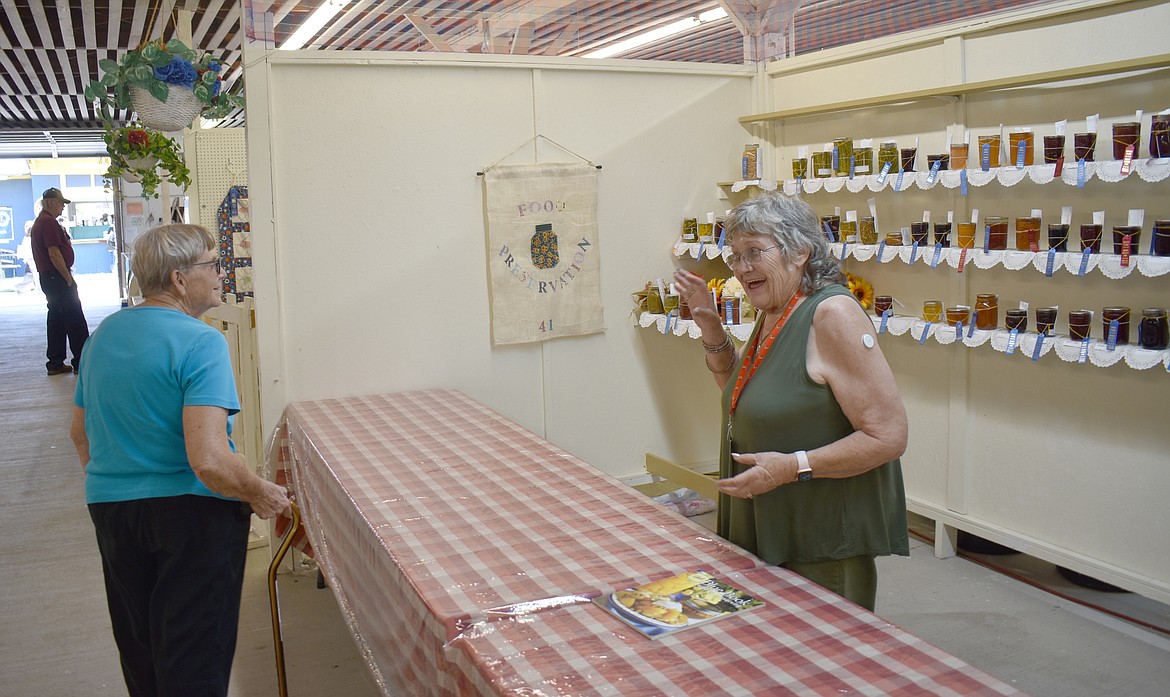
Fran Christensen, left, of Moses Lake chats with food preservation Superintendent Gayle Sullivan at the Grant County Fair. Food canning is a lost art, Sullivan said, but one well worth knowing.
Joel Martin has been with the Columbia Basin Herald for more than 25 years in a variety of roles and is the most-tenured employee in the building. Martin is a married father of eight and enjoys spending time with his children and his wife, Christina. He is passionate about the paper’s mission of informing the people of the Columbia Basin because he knows it is important to record the history of the communities the publication serves. | August 15, 2024 2:10 AM
MOSES LAKE — A traveler from a century ago would recognize the craftsmanship of the displays in the Home Economics Building at the Grant County Fair, possibly more readily than a modern observer.
“This whole thing is revisiting my childhood,” said Steve Hess of Soap Lake, who had a wooden loom set up and was demonstrating old-fashioned weaving techniques. He’d discovered a love for fabric when he was a boy, and his mother gave him a stack of rags to sew together to keep his hands busy, he said. “She turned me loose with a sewing machine, and said ‘You can go any speed you want if you’ll sew those rags for me.’ So I’d tear the rags apart, flannel and sew them together, and my great-aunt would weave rugs.”
Hess, now in his 70s, reconnected with that memory about 20 years ago at a folk fair in Spokane. There were all sorts of weavers and spinners there, he said, and they steered Hess to where he could buy an old loom. Since then, he’s rebuilt numerous decrepit looms, he said, and he had one from 1918, and another from the 1940s at the fair with him. He makes rugs out of a mixture of virgin material, which he buys by mail order, and old rags and discarded clothing.
“He uses shirts, jeans, blankets, all kinds of things,” said Diane Rapp, who was helping Hess with his display. “He has a little gadget that cuts it into strips, then he sews the strips together and rolls them into a ball of fabric that he then puts on the shuttle to make the rug.”
“All those balls of stuff up there,” she said, gesturing to a row of balls of miscellaneous cloth strips, “people have thrown it away. It probably had a big stain in the middle of it; you can cut around that and you can make stuff as good or not-so-good as you want.”
Not far away, Carol Getz was overseeing the exhibit of quilts. There were 67 quilts entered, Getz said, which was up from last year’s 60.
“These are from everywhere in Grant County,” Getz said, “everything from king-size quilts down to little, tiny wall hangings.”
The youth section covered a corner of the display, and the adult quilts took up a long wall of the building. Many but not all of them were made by members of the Basin Piecemakers Quilt Guild. The quilts are judged against other pieces of the same size, and judges look for quilts that are even and symmetrical and whose seams line up neatly, and if the color theory matches with the pattern, she said.
Some of the quilts were very intricate. There was one with a piano theme and other musical instruments and symbols in black and white, and another with what appeared to be a steampunk woman riding a unicycle made from an old sewing machine wheel. Yet another was made from the fronts of various concert T-shirts: Johnny Cash, Jimi Hendrix, the Rolling Stones and others.
“A lot of them, the person said they hadn’t gone to, so they just went online and got brand-new and used T-shirts and so they could fill the gaps where they didn’t have anything.”
Gayle Sullivan, overseeing the food preservation area, had full shelves of jars with various foodstuffs in them, but not as full as she would have liked, she said. Still, the youth participation was the largest she’d ever seen, she added.
Canning food is a precise thing, Sullivan said. Registrants have to list not only what the product is but when it was made, whether it was processed in a cold bath, a hot bath or a pressure cooker, and even the elevation at which it was canned. Much of Grant County is somewhere around 1,000 feet above sea level, and the elevation affects the cooking time.
“I had a couple of people get really angry with me this year because they forgot to put their elevation in,” Sullivan said. “All of these (instructions books) are at sea level. This (book) has the prep processing time; we want to cook it for 40 minutes in a quart jar, but we have to add to that time because of the elevation. One of our judges lives at 4,500 feet.”
The canned goods are judged on how much space is between the food and the lid, the color and consistency of the food and the uniformity of the cut, Sullivan said.
Sullivan’s granddaughter Farah Sullivan was there to help with the display, but she doesn’t do any canning herself, she said.
“Food canning is a lost art,” Gayle Sullivan said. “And I really believe that the times we’re living in, (people) are going to need it. They’re going to need to know how to raise their garden, raise their own food … It’s not that hard to do. It’s just having somebody willing to teach you how to do it.”
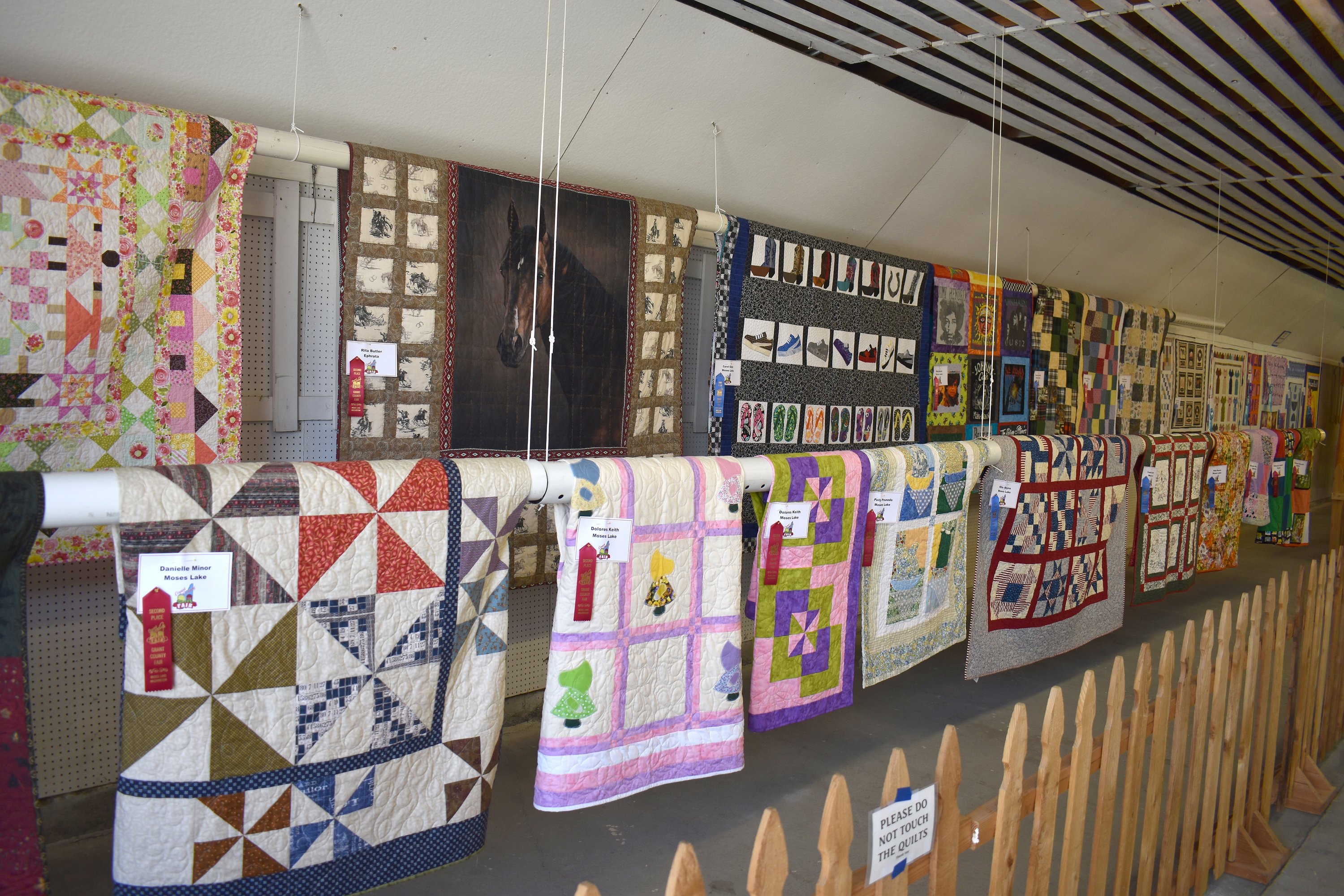 Quilts cover the walls of the Home Economics Building at the Grant County Fair Tuesday.
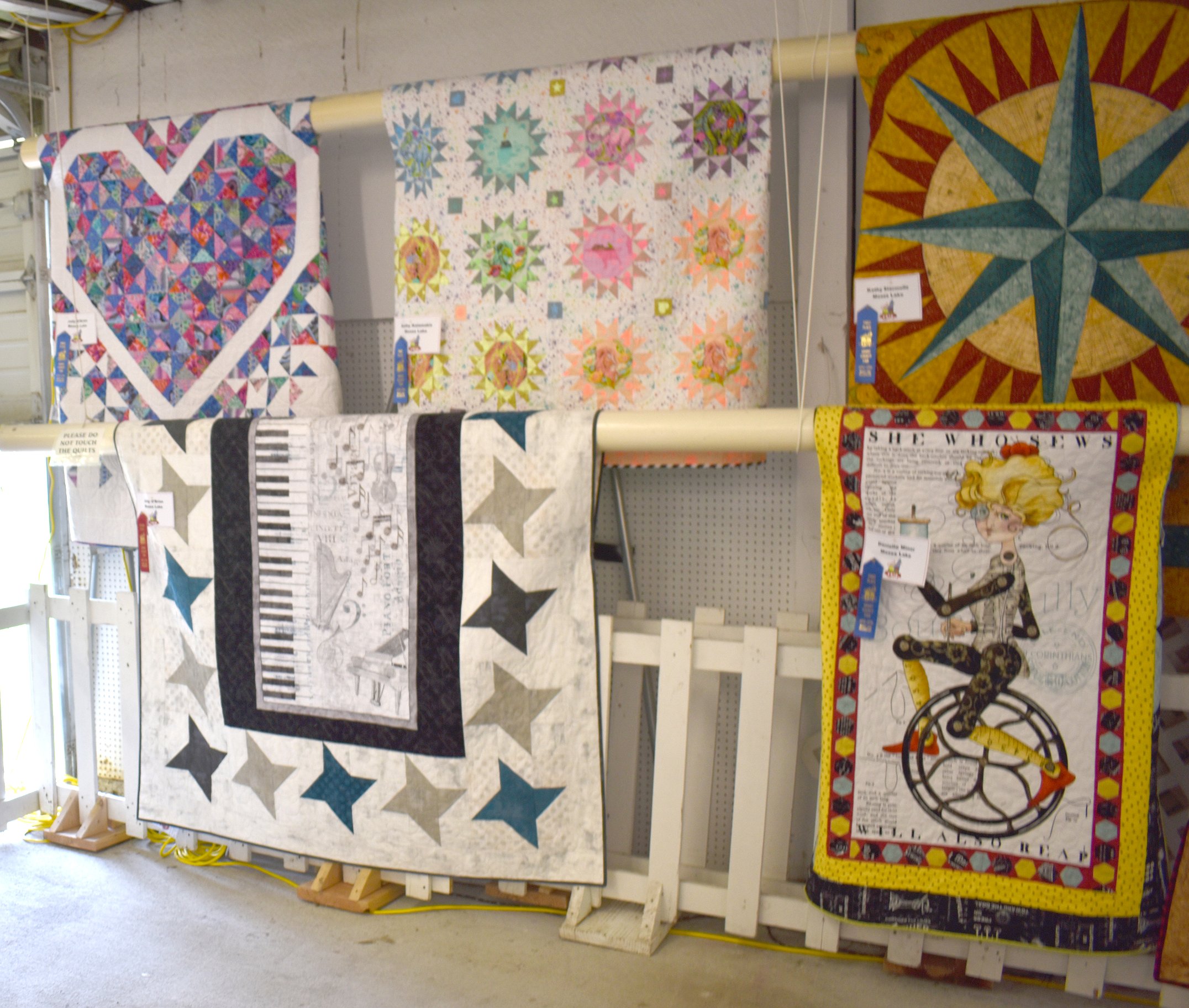 Some of the quilts on display at the Grant County Fair Tuesday were quite intricate, including a compass rose, a musical motif and a stylized unicycle rider with the words “She who sews will also reap.”
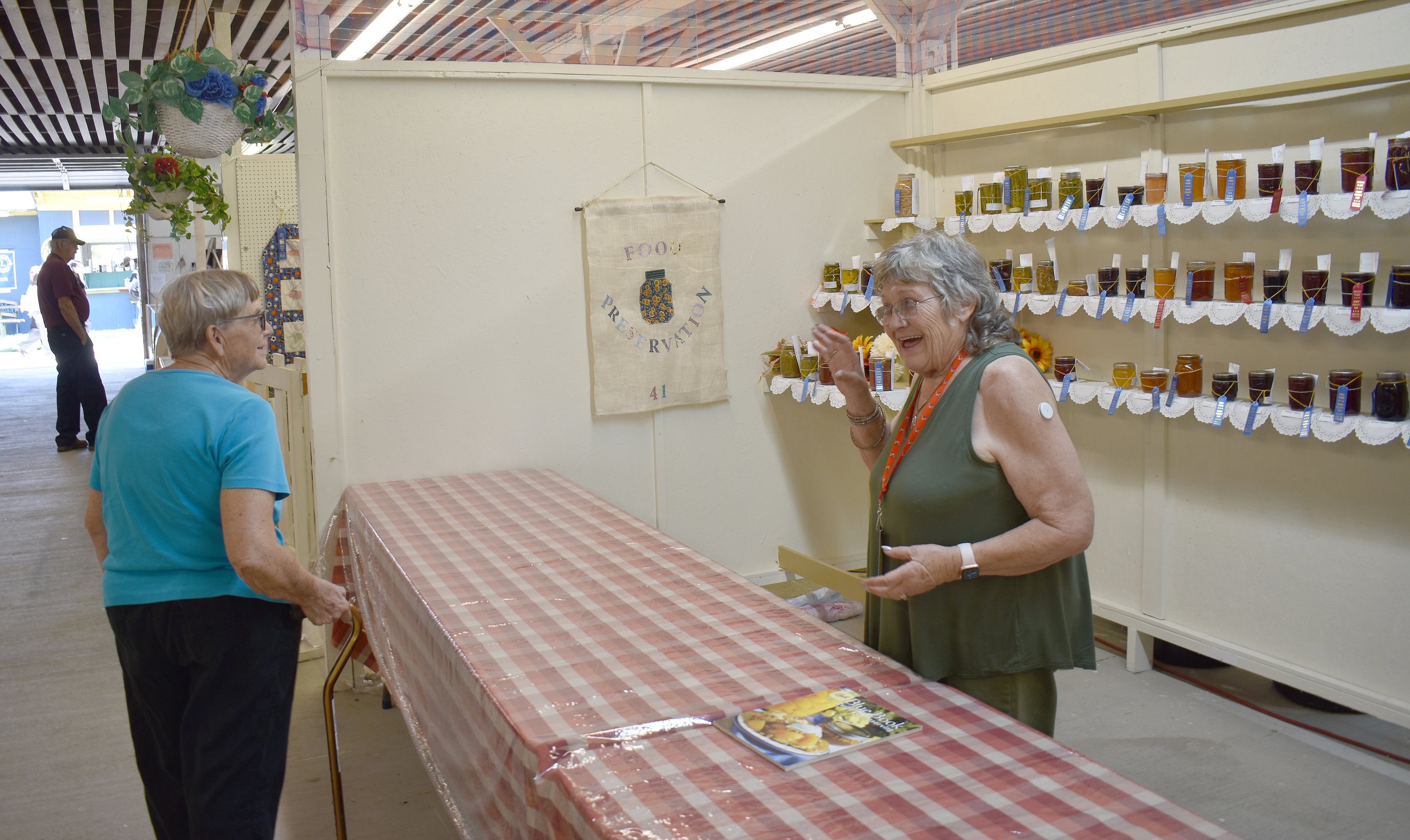 Fran Christensen, left, of Moses Lake chats with food preservation Superintendent Gayle Sullivan at the Grant County Fair. Food canning is a lost art, Sullivan said, but one well worth knowing.
ARTICLES BY JOEL MARTIN

Endless battle
Noxious Weed Control Board works to keep invasive plants under control
MOSES LAKE — Some of the nastiest plants in Grant County were the topic of a class led by Jay Johnson, a consultant with the Grant County Noxious Weed Control Board, Tuesday. The Noxious Weed Control Board, as its name would suggest, is tasked with keeping weeds under control in Grant County. That’s not a small job; the board’s website lists 129 species of noxious weeds that are found around Grant County. A noxious weed is defined as an invasive, non-native plant that threatens agricultural crops, local ecosystems or fish and wildlife habitat, according to the Noxious Weed Control Board. Washington state law requires that these weeds be identified and their spread kept to a minimum, if not completely eradicated. “We’re one of those agencies a lot of people don’t really understand,” Johnson said. “We’re a county office and … our funding is tax-based assessment. When you get your tax bill and you look down at all the expenses that you pay for, there we are.”

BASIN EVENTS: Oct. 16-24
COLUMBIA BASIN — Whether you feel like shopping, crafting, learning or seeing a show, there’s something happening for you this week in the Basin. Oct. 16 ‘My Family (Mi Familia)’ screening Spanning three generations, “My Family (Mi Familia)” is a heartfelt drama that follows the Sánchez family as they build their lives in East Los Angeles. Through love, hardship, triumph, and sacrifice, the film explores the immigrant experience, the strength of family bonds, and the traditions that connect one generation to the next. Lowrider show and taco truck before the screening. Sponsored by Columbia Basin Allied Arts, EDUBS C/S and the Moses Lake Creative District. $12 per person. Doors open at 6 p.m., film begins at 7 p.m. at the Moses Lake Civic Center Auditorium, 401 S. Balsam St. Tickets and info: www.cba-arts.org.

Moses Lake author encourages women to look beyond church culture norms
MOSES LAKE — A Moses Lake author’s book, “A Christian Woman Striving to Live Her Faith in a Man-Controlled World,” takes aim at the role to which many churches relegate the female half of their congregations. “It’s to encourage women in the faith,” Linda Curran said. “A lot of churches say, ‘Teach Sunday school, do this, do that, but don’t (evangelize.)’" In her book, Curran recounts a time when she moved to a new community and joined a church there. She was surprised to learn that, as a new female member, she had been automatically assigned church cleaning duties. When she questioned it, she wrote, she was met with condescension and her objections were brushed aside. In other churches, she said, women who were capable of teaching were relegated to “women’s ministry.”