
Dragon show
JOEL MARTIN | Hagadone News Network | UPDATED 1 year, 6 months AGO
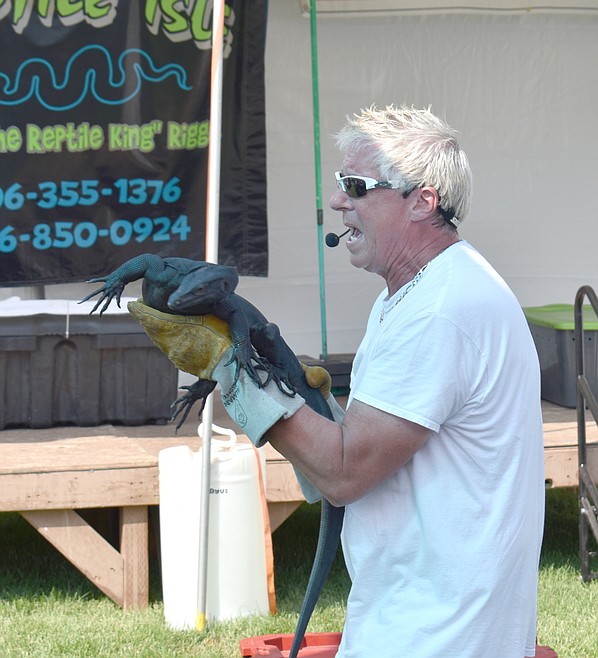
Don Riggs, billed as the Reptile King, shows Toothless the black dragon at his Reptile Isle show at the Grant County Fairgrounds last week. Toothless is one of only 250 of his kind in the world, up from four 11 years ago, Riggs said.
JOEL MARTIN/COLUMBIA BASIN HERALD
Joel Martin has been with the Columbia Basin Herald for more than 25 years in a variety of roles and is the most-tenured employee in the building. Martin is a married father of eight and enjoys spending time with his children and his wife, Christina. He is passionate about the paper’s mission of informing the people of the Columbia Basin because he knows it is important to record the history of the communities the publication serves. | August 20, 2024 1:00 AM
MOSES LAKE — It’s not every day a dragon visits the fair.
“That’s exactly what they’re called, a black dragon,” said Don “the Reptile King” Riggs, Thursday. “One of only 250 in the world. We’re trying to increase those numbers; there were only four 11 years ago when we started working with them.”
The dragon in question is a rare variety of Asian water monitor, and his name is Toothless, after a children’s book and subsequent movie titled “How to Train Your Dragon.” He was one of the animals that Reptile Isle, Riggs’ traveling show, brought to the Grant County Fair last week.
Reptile Isle has been at the fair for the last three or four years, giving children a chance to meet not just Toothless, but also alligators, snakes and other creatures that might send them screaming for shelter if they saw them in the wild.
“I've never met anybody who's been chased down the road by them, but everybody bases their opinion off what they get from movies and TV,” Riggs said. “So when given the opportunity to actually touch and interact with animals in a proper environment, they realize they're not trying to chase you down the street.”
Riggs also has less-frightening reptiles like skinks, chameleons and tortoises both small and giant. He breeds and cares for more than 1,100 animals on 40 acres near Vancouver, he said. He has a special soft spot for Parson’s chameleons, a rare giant chameleon from Madagascar, but they don’t travel well, he said.
“We can only transport so many of them to the shows,” he said. “We have duplicates and triplicates of a lot of the animals, because of how hard it is; we actually rotate them through the shows when we come out.”
Usually, the animals are transported in a climate-controlled trailer, Riggs said, but because of the limitations of the Grant County Fairgrounds, for this trip he brought a U-Haul trailer. The temperature wasn’t a problem, he said, because they’re all cold-blooded.
“They’re from warm areas,” he said. “They’re way better in the heat than we are, so they’re soaking it up. It’s the cooler temperatures you have to worry about.”
Riggs held Toothless out on a leather-gloved hand for the children to see up close, and filled them in on a little about Toothless’ habits. He’s had Toothless all his life, so he’s not put off by the curious crowds.
“Guys, that dragon tongue right there is one of the best sniffers in the animal kingdom,” Riggs told the audience. “They can actually smell their dinner up to five miles away. Now, my kids can smell McDonald's at least two or three miles away, but five miles away? That’s one of the best sniffers in the world.”
Riggs’ mother was a marine biologist, he said, and his father was a professional musician, so the combination of critters and showmanship came naturally to him. He had originally gone to school to study physiology, but then met Steve Irwin, the Crocodile Hunter, in the early 1990s. After working four or five years with Irwin, who passed away in 2006, Riggs had found his calling. Reptile Isle’s breed-and-release programs include South American red-footed tortoises, which Riggs and his team reintroduce slowly into their native habitat.
“If we can have a future zoologist in the crowd that decides that, because of this experience, they're actually going to help work with these animals in the future and help us conserve them, (or even) if we can stop one kid from throwing a rock or a stick at the next snake or lizard that they see, then I did my job,” Riggs said. “These animals are disappearing at such a terrific rate in both the countries that they come from and here that if we don't, especially with the younger generation, get people to fall in love with them, they're not going to be here anymore.”
ARTICLES BY JOEL MARTIN

Space Burger booth open March 13-15
MOSES LAKE — Those who can’t wait for the Grant County Fair can get their Space Burger fix next weekend, according to an announcement from the Lioness Club of Moses Lake. The iconic Grant County sandwiches will be available at the Grant County Fairgrounds March 13-15, according to the announcement. There is no admission fee to get into the fairgrounds that weekend.

SENIOR EVENTS: March 2026
COLUMBIA BASIN — Plays, art shows, auctions and more await seniors in the Columbia Basin this month. Here are some opportunities to get out and about in March.

Valentine’s Day cards flood Brookdale Hearthstone with love
MOSES LAKE — Residents at Brookdale Hearthstone Assisted Living in Moses Lake got Valentine’s Day greetings from across the country last month. “I believe that the only states we have not received (cards from) yet are Vermont and Maine,” Lifestyle Director Imelda Broyles said Feb. 24. “We keep receiving new cards every single day. They have not stopped. My residents are in awe with every single one of the cards that we’ve been receiving.” The Hearts Across America project started as a way for children in school classrooms to exchange Valentine’s Day cards with classes in other states or even countries, but the idea has expanded to senior living facilities, according to the project’s social media.