
Questions, answers, discussion at MLSD community forum
CHERYL SCHWEIZER | Hagadone News Network | UPDATED 1 year, 9 months AGO
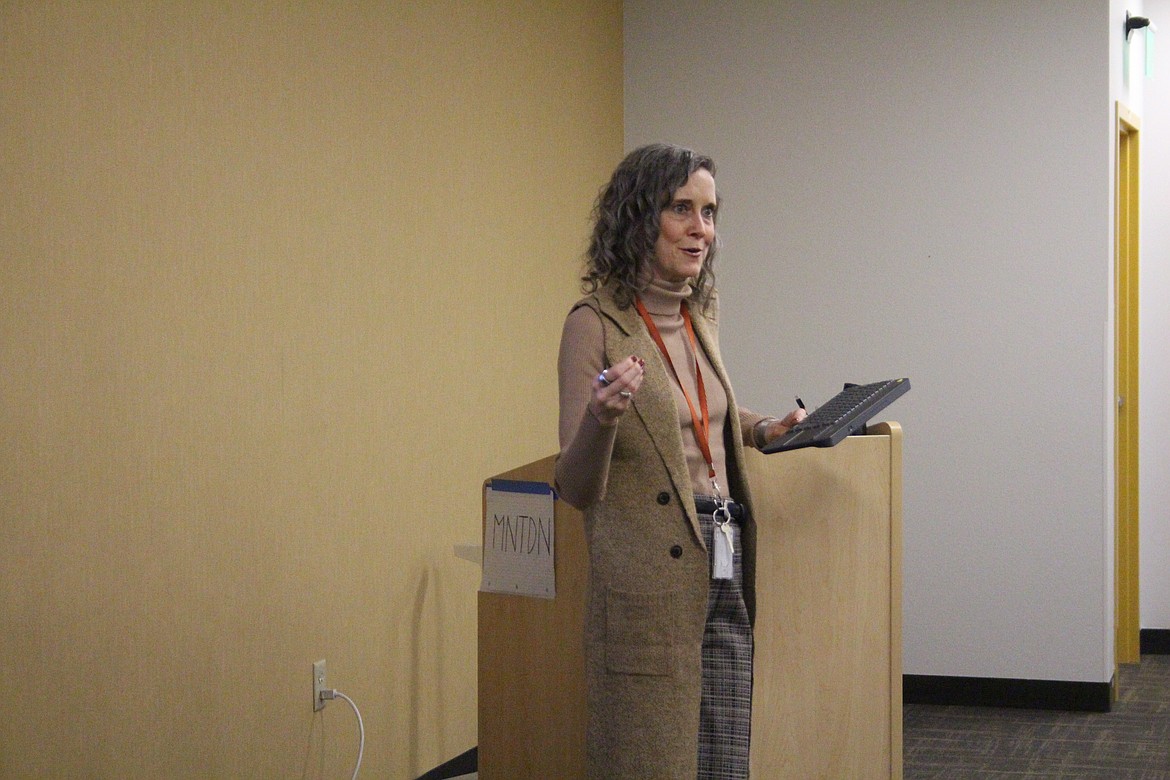
Moses Lake School District Superintendent Carol Lewis answers questions during an information forum sponsored by the MLSD Thursday. Lewis has served as temporary superintendent following the start of the district's financial crisis which was discovered at the beginning of the year and was recently appointed to the role permanently. She has said she understands why district residents have a lack of confidence in the district and that confidence must be earned back.
CHERYL SCHWEIZER/COLUMBIABASINHERALD
Senior Reporter Cheryl Schweizer is a journalist with more than 30 years of experience serving small communities in the Pacific Northwest. She began her post-high-school education at Treasure Valley Community College and enerned her journalism degree at Oregon State University. After working for multiple publications, she has settled down at the Columbia Basin Herald and has been a staple of the newsroom for more than a decade. Schweizer’s dedication to her communities and profession has earned her the nickname “The Baroness of Bylines.” She covers a variety of beats including health, business and various municipalities. | December 6, 2024 3:00 AM
MOSES LAKE — Moses Lake School District Superintendent Carol Lewis answered questions about school operations in the wake of severe budget cuts, technology, teachers responding to challenges in the classroom and billing during a wide-ranging question and answer forum Thursday.
It's part of a series of forums scheduled for December and January leading up to, among other things, an educational programs and operations levy request that will go out to MLSD voters Feb. 11. The levy questions and discussion will be the subject of a separate story.
A second forum is scheduled for 6 to 7 p.m. Monday at the district’s main office, called the learning services center, 1620 S. Pioneer Way.
District voters rejected a two-year EP&O levy earlier this year, which was followed by the discovery that accounting errors led to the draining of the district’s reserve funds. Moses Lake School Board member Paul Hill said the accounting errors accounted for about 50% of the district’s funding shortfall.
The resulting budget shortfall led the district to eliminate about 100 teaching positions and about 85 non-teaching positions, also known as classified staff.
In answer to a question about the availability of technology district-wide, Lewis said the staff cuts affected student access to computers.
“Basically, we had to reduce our technology staff by a huge amount, and with that came the need to remove a lot of our Chromebook access for our students,” Lewis said. “Because you have to have staff to maintain all of that technology if you’re going to have it.”
Previously fifth graders, junior high and high school students were issued school computers but that’s not possible with the technology staff cuts, Lewis said. She was asked how the reduction in computer access was affecting students, since a lot of classroom tasks, like homework assignments, had moved online.
“I’m not going to lie – it has affected our students’ ability to access everything that they need. And it’s one of the things that’s top of mind when we’re able to restore some things, particularly for our high school students,” Lewis said.
“It’s also affected our teachers, the way they teach – super-interesting, (although) when you think about it, this makes complete sense. Our veteran teachers, they’re like, ‘Oh yeah, we got this. I taught with a chalkboard.’ Our newer teachers, though, they were the ones that really needed some help from those veteran teachers. How do I teach without a computer?” she said.
The budget shortfall meant that some projects proposed by building administrators had to be deferred, Lewis said, answering a question about upgrades to an elementary school lunchroom. Along with projects like the lunchroom, the budget cuts affected most school operations. Lewis used the example of custodial staff.
“Some of the things that have been going on – our buildings are being cleaned by teachers, by principals. Our elementary principals have learned how to drive the Zamboni thing to clean the floors. Our high school principal, she got some extra vacuums and she’s like, ‘Here you guys go.’ (Teachers and administrators) are vacuuming their floors and things like that,” Lewis said.
“I go and visit a school and the principal (says), ‘You can meet me in the cafeteria because I’m mopping the floor right now, and who’s going to take the trash out?’” she added.
Having principals mop floors and teachers dump the trash is not, in her opinion, the most efficient use of MLSD staff, she said.
“That is very worthy work, but it’s not what we’re paying our teachers and principals to be doing,” Lewis said.
A question about transporting children to First Grade Farm Day led to a discussion about school financing, and why it seems to take so long for things to happen.
School parent support organizations paid for the transportation from the schools out to the Grant County Fairgrounds. The trip was in mid-October, and various school organizations had yet to receive an invoice as of early December.
“Just know that everything in a school district (runs) on a month calendar, so everything is going to be delayed at least a month. So, while it seems like you would get it right away, things happen kind of slowly, just because of the way the state funds us and things like that,” Lewis said.
That time lag gave the impression over the summer the district was still spending money when in fact it wasn’t, she said.
“When we did our spending freeze in May and really froze everything all summer, it was kind of like a slow turnover of the engine,” she said. “The end of August was when we finally saw the freeze happening. Board members kept saying, ‘Why are we still getting bills for all these things?’ Because you got the bill in June for (an expenditure) in February.”
The district has about $12 million in the Grant County treasury at the beginning of December, she said. The target for reserves set by the Moses Lake School Board is 12.5% of the district budget, which Lewis estimated equates to about $16 to $17 million.
The reserves are needed because the amount of money allocated to the district by the state changes from month to month, she said. Districts may have to use some of the reserves to pay expenses, at least temporarily. Lewis estimated the MLSD payroll is between $8 to $10 million per month.
The experience of the last year has led to changes in the way board members and district officials review expenses, she said.
“We have all those financial documents posted on our district website. Anybody in the public can see how our money is being spent. We also have two board members coming in every two weeks (to review) accounts payable before it ever goes to the board,” Lewis said. “We are having very detailed budget status reports presented to our school board each month, which is a normal expectation for a school district, (but) that hadn’t necessarily been happening much previously, and now it is.”
ARTICLES BY CHERYL SCHWEIZER

Road projects on hold for Labor Day weekend
MOSES LAKE — With Labor Day weekend dead ahead, drivers will be able to move freely about the state. Most road projects are on hold for the holiday weekend. Nobody will be working on the Hansen Road overpass on Interstate 90, but the lane restrictions that are in effect will continue through the end of the project.

Cost estimates for water source alternatives given to Moses Lake City Council
Protected under the U.S. Endangered Species Act, efforts are ongoing to keep it self-sufficient
MOSES LAKE — It’s going to cost a lot of money to provide alternative water sources for the city of Moses Lake, but some of the possible alternatives will cost more than others. City officials provided the Moses Lake City Council with costs for various alternatives Tuesday.

Dryer vent cleaning is important -- but often overlooked
MOSES LAKE — Not all the maintenance a house needs is visible. Sometimes a potential problem just goes unnoticed until it causes trouble, sometimes serious trouble. But a lot of potential problems give off warning signs. Clothes dryers often do when they need a good cleaning.