
Long journey: WSU scientists travel from India to Adams County
JOEL MARTIN | Hagadone News Network | UPDATED 1 year, 9 months AGO
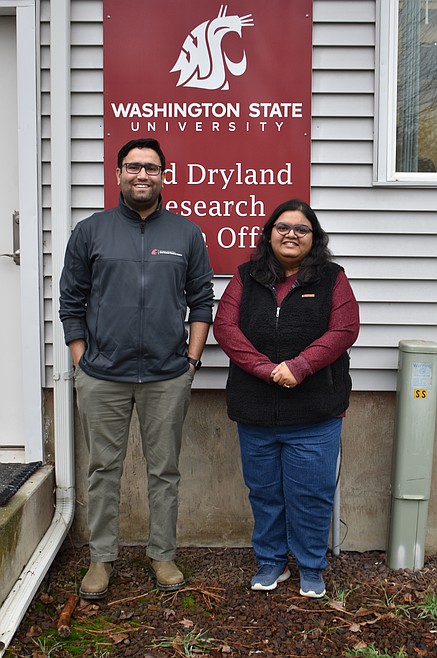
Surendra, left, and Shikha Singh stand outside the office of the Washington State University Lind Dryland Research Station. The Singhs came to the station in April 2023, Surendra as director and Shikha as an assistant research professor.
JOEL MARTIN/COLUMBIA BASIN HERALD
Joel Martin has been with the Columbia Basin Herald for more than 25 years in a variety of roles and is the most-tenured employee in the building. Martin is a married father of eight and enjoys spending time with his children and his wife, Christina. He is passionate about the paper’s mission of informing the people of the Columbia Basin because he knows it is important to record the history of the communities the publication serves. | December 24, 2024 2:25 AM
LIND — As the crow flies, the state of Rajasthan in Northwestern India is a long way from the state of Washington. But in some ways, they’re very similar.
“A mountain range goes through the middle of the state (of Rajasthan),” said Dr. Surendra Singh, director of the Washington State University Lind Dryland Research Station. “The other side gets all the rain and we don't. And after 10 years, I ended up again on the drier side of the mountains.”
Singh’s family farm faced many of the same challenges Eastern Washington farmers do, he said: sandy soil with groundwater buried deep, suited to growing canola, lentils or wheat. His uncle runs the farm, he said, while his father works for the state health department.
Singh attended Punjab Agricultural University, majoring in agronomy, soil science and agroforestry. He came to the U.S. in 2015 and earned his master’s degree at the University of Arkansas, concentrating on soil nutrient management in rice. His Ph.D. in soil science came from the University of Tennessee, and postdoctoral work at Oregon State University in Hermiston brought him to the Northwest. He took over the reins at the WSU Lind Dryland Research Station in April 2023, which has a staff of 10, one of whom is his wife, Shikha Singh, a research assistant professor and soil scientist.
“When (the director’s) position opened up, we both were the finalists for that position,” Shikha said.
“We were competitors,” Surendra said with a chuckle.
The university made job offers to them both, he added.
Shikha also grew up in a farm family, albeit a very different kind of farm.
“I grew up in the eastern part of India, which is really wet,” she said. “It gets a lot of rainfall, and we grow a lot of standing water rice. My grandfather is a farmer, so he does rice-wheat rotation, and in between those two crops, we also grow lentils. Because of so much rain, we can grow continuous crops.”
Shikha and Surendra were classmates at Punjab Agricultural University, they said, but she did her master’s in plant science at South Dakota State University. The Singhs married in February 2017 and Shikha continued her education alongside Surendra’s, earning her doctorate in environmental and soil science at the University of Tennessee.
Surendra took over the Lind station from longtime director Bill Schillinger, who had managed the place for 29 years, according to information from WSU. The station itself is located a couple of miles outside of Lind, but the researchers have trials going on over a larger area, ranging from the Wilke Research Farm near Davenport all the way down to Pendleton, Ore.
“We are in an area where (there are) a lot of microclimates,” he said. “Even if you go like 50 miles, things start to change in terms of rainfall. From (Lind Research Station) to Ritzville, we have couple of inches of difference in the rainfall. So that's kind of fine-tuned, all the research we do, for local applicability.”
Agricultural sciences aren’t the sort of thing where experiments come quickly, the Singhs emphasized. The trials they’re conducting in Ritzville have been going on for 25 years now, with ongoing research into soil, pathology, weed science and other aspects. Dryland agricultural research is especially slow to act, Surendra said.
“Dryland research is not a sprint, it’s a marathon,” he said. “I think at the Pendleton Station at Oregon State, they have trials dating back to 1931 … Long-term research is what we call living labs. It helps us state what are the problems growers are going to face, for example, in 10 years. We can stay ahead of the game that way.”
“We have an amazing group of farmers here,” Shikha said. “(They’re) very supportive of us and they give us good feedback.”
The housing market being what it is in Adams County, the Singhs found themselves facing the necessity of commuting from either Moses Lake or the Tri-Cities, although they’d like to find something closer to the station, they said. They drive up every day from Pasco, Surendra said.
“Given about the same driving distance, we had better options of finding accommodation there,” he said. “So far, it’s working well, because we both drive together. One way I drive and the other way she does … It's good that we both like the same kind of research area, so we can talk and bounce ideas off each other. We (spend) about two hours every day in (the car with) no phone, no TV. So, what you're going to do? You're going to discuss science.”
“Sometimes we go to Portland just for groceries,” Shikha said. “Especially for Indian groceries, it’s easier to get more stuff there.”
The Singhs used to go back to India to visit family every couple of years, Shikha said, but the COVID-19 pandemic put that pattern on hold. They’re hoping to go back next year. Shikha’s parents came to visit them in Washington last year, she said, and Surendra’s father wants to come visit when he retires. Because both of them come from agricultural backgrounds, they and their families have plenty to talk about.
“Growing up on farms, we have that perspective,” Surendra said. “And then we have been in school for like 10 years, so we have the science side of it. We do a pretty good combining both (into) something useful.”
ARTICLES BY JOEL MARTIN

Endless battle
Noxious Weed Control Board works to keep invasive plants under control
MOSES LAKE — Some of the nastiest plants in Grant County were the topic of a class led by Jay Johnson, a consultant with the Grant County Noxious Weed Control Board, Tuesday. The Noxious Weed Control Board, as its name would suggest, is tasked with keeping weeds under control in Grant County. That’s not a small job; the board’s website lists 129 species of noxious weeds that are found around Grant County. A noxious weed is defined as an invasive, non-native plant that threatens agricultural crops, local ecosystems or fish and wildlife habitat, according to the Noxious Weed Control Board. Washington state law requires that these weeds be identified and their spread kept to a minimum, if not completely eradicated. “We’re one of those agencies a lot of people don’t really understand,” Johnson said. “We’re a county office and … our funding is tax-based assessment. When you get your tax bill and you look down at all the expenses that you pay for, there we are.”

BASIN EVENTS: Oct. 16-24
COLUMBIA BASIN — Whether you feel like shopping, crafting, learning or seeing a show, there’s something happening for you this week in the Basin. Oct. 16 ‘My Family (Mi Familia)’ screening Spanning three generations, “My Family (Mi Familia)” is a heartfelt drama that follows the Sánchez family as they build their lives in East Los Angeles. Through love, hardship, triumph, and sacrifice, the film explores the immigrant experience, the strength of family bonds, and the traditions that connect one generation to the next. Lowrider show and taco truck before the screening. Sponsored by Columbia Basin Allied Arts, EDUBS C/S and the Moses Lake Creative District. $12 per person. Doors open at 6 p.m., film begins at 7 p.m. at the Moses Lake Civic Center Auditorium, 401 S. Balsam St. Tickets and info: www.cba-arts.org.

Moses Lake author encourages women to look beyond church culture norms
MOSES LAKE — A Moses Lake author’s book, “A Christian Woman Striving to Live Her Faith in a Man-Controlled World,” takes aim at the role to which many churches relegate the female half of their congregations. “It’s to encourage women in the faith,” Linda Curran said. “A lot of churches say, ‘Teach Sunday school, do this, do that, but don’t (evangelize.)’" In her book, Curran recounts a time when she moved to a new community and joined a church there. She was surprised to learn that, as a new female member, she had been automatically assigned church cleaning duties. When she questioned it, she wrote, she was met with condescension and her objections were brushed aside. In other churches, she said, women who were capable of teaching were relegated to “women’s ministry.”