
Sila breaks ground on Washington facility
JOEL MARTIN | Hagadone News Network | UPDATED 2 years, 9 months AGO
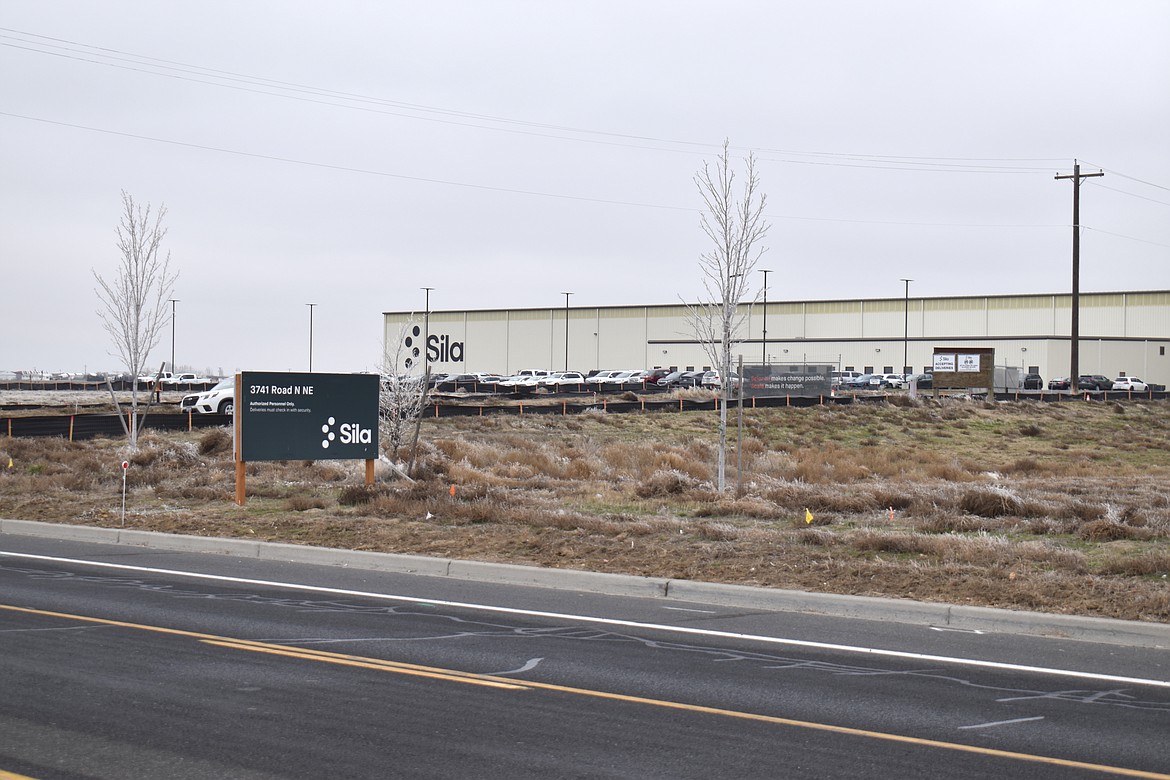
Sila Nanotechnologies officially began getting its plant in Moses Lake ready Wednesday with a construction ceremony.
Joel Martin/Basin Business Journal
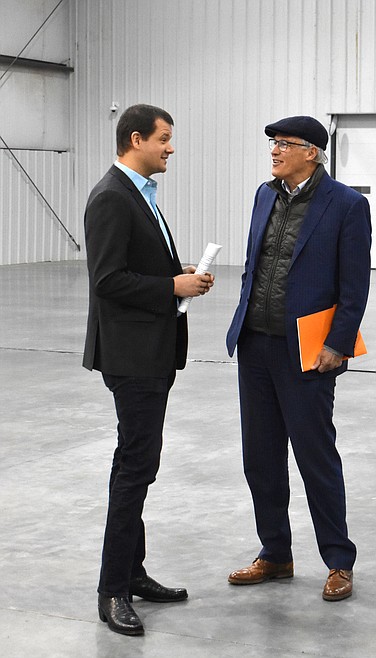
Sila Nanotechnologies CEO Gene Berdichevsky, left, talks with Gov. Jay Inslee
Joel Martin/Basin Business Journal
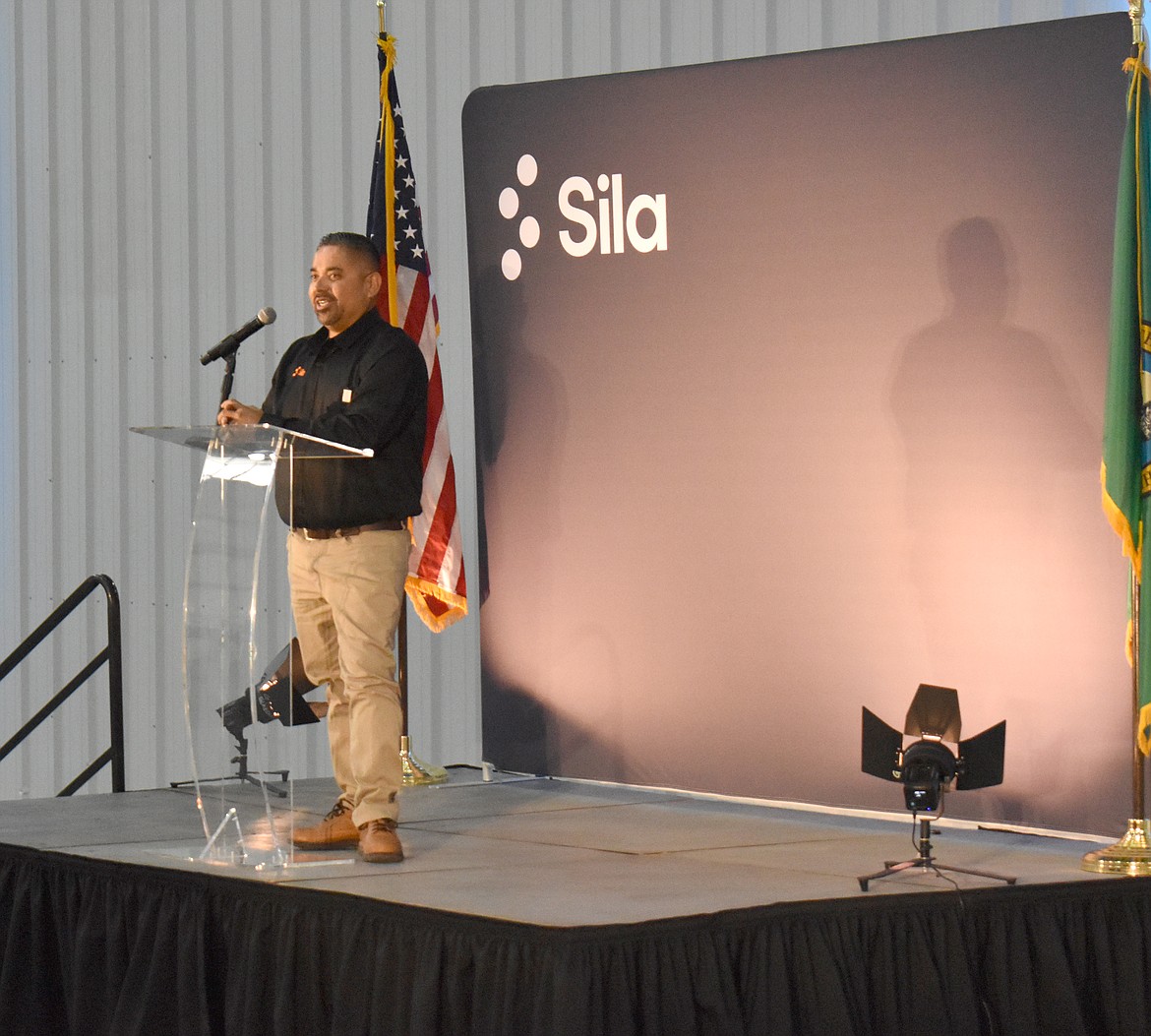
Sila Moses Lake Plant Manager Rosendo Alvarado speaks at the plant’s construction ceremony Wednesday.
Joel Martin/Basin Business Journal
Joel Martin has been with the Columbia Basin Herald for more than 25 years in a variety of roles and is the most-tenured employee in the building. Martin is a married father of eight and enjoys spending time with his children and his wife, Christina. He is passionate about the paper’s mission of informing the people of the Columbia Basin because he knows it is important to record the history of the communities the publication serves. | January 6, 2024 1:00 AM
MOSES LAKE — Sila Nanotechnologies officially opened its Moses Lake plant Nov. 29.
“This moment has been 12 years in the making,” said Gene Berdichevsky, co-founder and CEO of Sila.
“And the journey to this point can be summed up, really, in two words: passion and persistence. Many startups have origin stories that began in a garage, but we were not that cool. We started out in a windowless basement lab of Georgia Tech. Back then there were only 13 of us, working shoulder to shoulder back to back literally intent on doing what we believed – what many believed — was impossible.”
That not-impossible feat was developing a nano-composite silicon that could increase the efficiency of lithium-ion batteries, for electric vehicles and other applications.
“I started my career as a mechanical engineer, and I ended up having the good fortune of being the seventh employee at Tesla, back 15-plus years ago, and I did a lot of the work on the Roadster battery system,” Berdichevsky said in an interview. “So I've been a battery guy my whole career. I led a lot of the development on that, and after we got that into production, I wanted to work on something even harder. So I went back, and I studied chemistry and material science.”
Berdichevsky founded Sila in 2011, along with fellow Tesla alum Alex Jacobs and Dr. Gleb Yushin, professor of materials science at the Georgia Institute of Technology. Sila, which has a small production facility in Alameda, California, purchased the 600,000-square-foot Washington building last year. The building’s previous two owners had never actually used it, according to Construction Manager Steve Hastings.
Sila’s product is called Titan Silicon, and it’s designed to replace the graphite that’s the standard material used in battery anodes.
“The silicon anode is incredibly hard to get right,” Berdichevsky said in an interview. “But if you get it right – and we have – you can store 20-40% more energy in every battery that you make ... and over the next few years, we'll get that up to 30% and 40%.”
“You’ve got to understand what 20% increase in density means,” Gov. Jay Inslee said at the opening, which was also attended by state legislators. “It means 20% increased mileage for electric cars. If you took the zero out of there and it was 2%, it (would deserve) the Heisman trophy and the Nobel Peace Prize, both. Twenty percent is a quantum leap for humans, not just the state of Washington.”
Replacing graphite with silicon is also a way of reducing dependence on foreign imports, explained Giulia Siccardo, director of the U.S. Department of Energy Office of Manufacturing and Energy Supply Chains.
“Graphite is currently the most widely used material in lithium-ion battery production,” Siccardo said. “But over 90.95% of graphite is currently mined and processed in China. This is a significant challenge for us as we think about the risks that it poses to our supply chain and the risks that it creates in terms of disruption and instability.”
Moses Lake is well suited to Sila’s operation, Berdichevsky said, because of its clean, cheap electricity and workforce with high-tech manufacturing experience. Sila’s Moses Lake plant is also located right across the road from REC Silicon, which will manufacture the silane that’s used to make Titan Silicon.
Sila will hire about 100 full-time employees, or “Silazens,” to operate the plant at the outset, Berdachevsky said. The plant will take about a year to complete, he said, and will begin shipping product in mid-2025. Sila already has an agreement with Mercedes-Benz to material for its G-Wagon luxury electric SUV. Berdichevsky said he hopes to grow the operation to put out material for 1 million vehicles a year with a team of 500 employees or more in the next five to seven years.
Plant Manager Rosendo Alvarado, an eastern Washington native and former manager at REC Silicon, said Sila’s values were a good fit for the community.
“My parents came here in the early ’50s,” Alvarado said. “They moved up from Texas because there was a lot of agricultural work. We worked at farms surrounding this area; they owned trucks and hauled potatoes. So at a really, really young age, I started working out in these fields and really had the opportunity to learn the values of hard work and long days … Now it's my job to move this this project forward and to get this plant up and running and established to scale up that they have in their vision. And we'll definitely make that possible.”
“A lot has changed since that time in the windowless lab,” Berdichevsky said. “I've personally gotten a little more sun, and the world has moved towards embracing electrification in our cities, our roads, our lives. The shift has brought a new wave of innovation in manufacturing, which one, that is very much a part of the legacy here in the U.S. And after 30 years of outsourcing our technologies, we're inventing again, and we're building again and we're producing again.”
Joel Martin may be reached via email at [email protected].
 Sila Nanotechnologies CEO Gene Berdichevsky, left, talks with Gov. Jay Inslee
Joel Martin/Basin Business Journal
 Sila Moses Lake Plant Manager Rosendo Alvarado speaks at the plant’s construction ceremony Nov. 29.
Joel Martin/Basin Business Journal
ARTICLES BY JOEL MARTIN

Endless battle
Noxious Weed Control Board works to keep invasive plants under control
MOSES LAKE — Some of the nastiest plants in Grant County were the topic of a class led by Jay Johnson, a consultant with the Grant County Noxious Weed Control Board, Tuesday. The Noxious Weed Control Board, as its name would suggest, is tasked with keeping weeds under control in Grant County. That’s not a small job; the board’s website lists 129 species of noxious weeds that are found around Grant County. A noxious weed is defined as an invasive, non-native plant that threatens agricultural crops, local ecosystems or fish and wildlife habitat, according to the Noxious Weed Control Board. Washington state law requires that these weeds be identified and their spread kept to a minimum, if not completely eradicated. “We’re one of those agencies a lot of people don’t really understand,” Johnson said. “We’re a county office and … our funding is tax-based assessment. When you get your tax bill and you look down at all the expenses that you pay for, there we are.”

BASIN EVENTS: Oct. 16-24
COLUMBIA BASIN — Whether you feel like shopping, crafting, learning or seeing a show, there’s something happening for you this week in the Basin. Oct. 16 ‘My Family (Mi Familia)’ screening Spanning three generations, “My Family (Mi Familia)” is a heartfelt drama that follows the Sánchez family as they build their lives in East Los Angeles. Through love, hardship, triumph, and sacrifice, the film explores the immigrant experience, the strength of family bonds, and the traditions that connect one generation to the next. Lowrider show and taco truck before the screening. Sponsored by Columbia Basin Allied Arts, EDUBS C/S and the Moses Lake Creative District. $12 per person. Doors open at 6 p.m., film begins at 7 p.m. at the Moses Lake Civic Center Auditorium, 401 S. Balsam St. Tickets and info: www.cba-arts.org.

Moses Lake author encourages women to look beyond church culture norms
MOSES LAKE — A Moses Lake author’s book, “A Christian Woman Striving to Live Her Faith in a Man-Controlled World,” takes aim at the role to which many churches relegate the female half of their congregations. “It’s to encourage women in the faith,” Linda Curran said. “A lot of churches say, ‘Teach Sunday school, do this, do that, but don’t (evangelize.)’" In her book, Curran recounts a time when she moved to a new community and joined a church there. She was surprised to learn that, as a new female member, she had been automatically assigned church cleaning duties. When she questioned it, she wrote, she was met with condescension and her objections were brushed aside. In other churches, she said, women who were capable of teaching were relegated to “women’s ministry.”