
MLSD levy proposal put to voters in February
CHERYL SCHWEIZER | Hagadone News Network | UPDATED 1 year, 11 months AGO
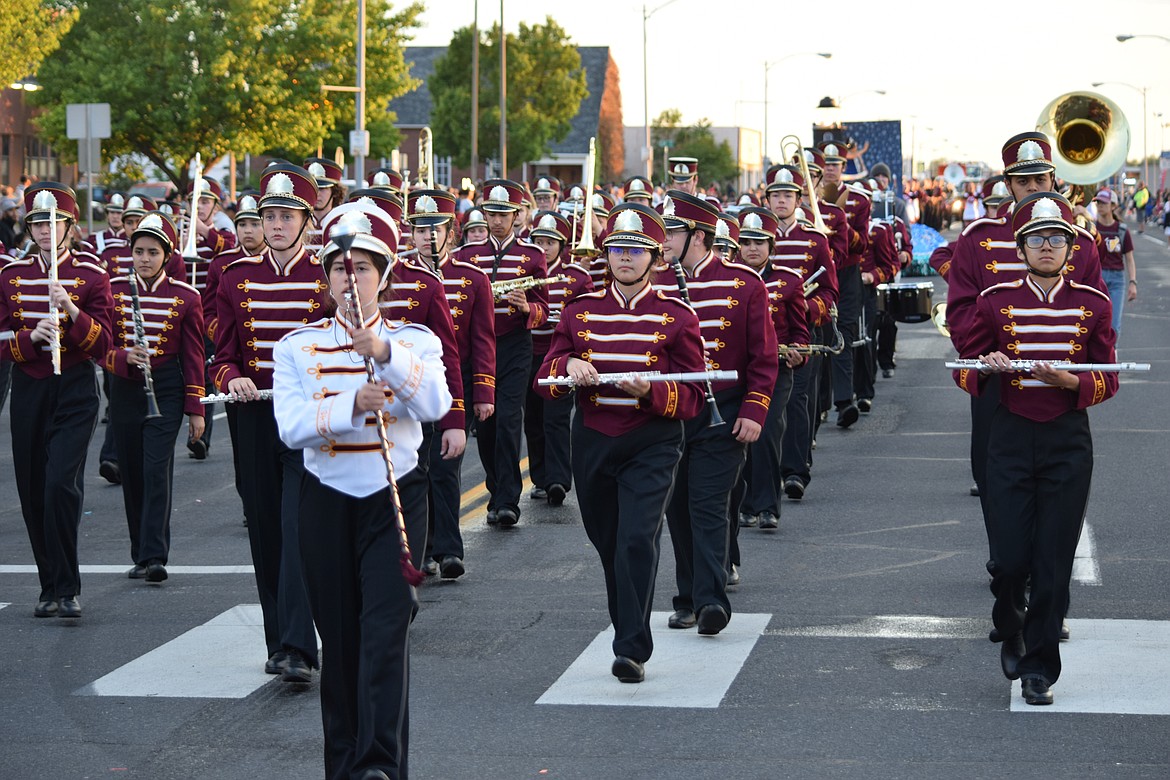
The Moses Lake High School band marches in the 2023 Spring Festival parade. Band is among the programs partially supported by the district’s educational program and operations levy, which is on the Feb. 13 ballot.
FILE PHOTO
Senior Reporter Cheryl Schweizer is a journalist with more than 30 years of experience serving small communities in the Pacific Northwest. She began her post-high-school education at Treasure Valley Community College and enerned her journalism degree at Oregon State University. After working for multiple publications, she has settled down at the Columbia Basin Herald and has been a staple of the newsroom for more than a decade. Schweizer’s dedication to her communities and profession has earned her the nickname “The Baroness of Bylines.” She covers a variety of beats including health, business and various municipalities. | January 23, 2024 5:24 PM
MOSES LAKE — Moses Lake School District voters will be asked to accept or reject a two-year educational program and operations levy request in a special election Feb. 13. Ballots are being mailed this week.
If the levy is approved, it would replace a three-year levy approved by district voters in 2021.
The request is for $15.78 million in the first year and $18.94 million in the second year. If it’s approved, property owners would pay $2 per $1,000 of assessed property value each year.
A property owner with land valued at $300,000 would pay $600 per year. The owner of property valued at $350,000 would pay $700 per year in property taxes.
Because it’s a school levy, it requires a bare majority, 50% plus one vote, to pass.
The tax rate requested in the levy is 50 cents higher than the 2021 levy. Communications and public information officer Claren McLaughlin said in answer to a question from the Columbia Basin Herald that the increase reflects the impact of inflation and changes to state funding.
“Our district will be losing about 6% additional revenue from the state (about $4.5 million) after the state reformulated funding based on regionalization,” McLaughlin wrote.
Regionalization is designed to factor the cost of living in any given school district into its funding; part of the funding formula analyzes home prices within a given district and for a 15-mile area around it. District superintendent Monte Sabin said in an earlier meeting that the money Moses Lake receives through regionalization is going down, and eventually will be eliminated.
Increases in property valuation in Moses Lake also affect the amount of levy money collected, she wrote.
“When voters authorize a levy, they’re ultimately approving a taxing amount,” she wrote. “If assessed valuation increases beyond what is predicted the tax rate lowers, resulting in a district not collecting as much as voters approved.
“In our case, the assessed valuation in Moses Lake increased drastically in the past couple of years, but we were capped at the approved amount we can collect, which was below the approved rate,” she wrote.
The 2021 levy set the levy amount at about $7.6 million for 2023, with a levy rate of $1.50 per $1,000 of assessed property value. The district could collect up to the $7.6 million, but no more. Because the assessed property valuation in the district went up, the actual levy rate went down.
McLaughlin said the levy would allow the district to maintain the programs it has.
“(The levy would) maintain our current level of staffing and programs offered for students,” she wrote.
Moses Lake does qualify for local effort assistance funding, also called levy equalization. That’s additional state funding given to districts with relatively lower property tax rates that pass a levy.
But because property values in the district have increased, the district would qualify for less levy equalization than in previous years.
Levy money is used to plug gaps in personnel and programs not filled by state funding. In Moses Lake that includes additional nurses and counselors, security and school resource officers, bus drivers and psychologists, among other staff. It also pays for equipment initiatives, such as providing each student with a computer, and extra support for art, music, the district’s highly capable program and transportation.
State school funding doesn’t pay for athletics or most extracurricular activities. Those must be paid for locally.
Cheryl Schweizer can be reached via email at [email protected].
ARTICLES BY CHERYL SCHWEIZER
Othello approves $29M budget for 2026
OTHELLO — The city of Othello is projected to spend about $10.1 million from its general fund in 2026, the biggest part of a $29 million overall budget. Council members approved the 2026 budget earlier this month, and city Finance Director Spencer Williams said budget planning started in late summer.
New Othello mayor, council members sworn into office.
OTHELLO — New Othello Mayor Ken Johnson and two of three new Othello City Council members were sworn in Monday during the last council meeting of 2025. Alma Carmona and Kelli Camp joined Johnson Monday for the swearing-in.
Port of Moses Lake to build electrical generation, transmission lines
MOSES LAKE — The Port of Moses Lake will start construction of electrical transmission lines between port property and Rocky Ford to the north and the port and Connell to the south. Port officials also are working to build electrical generation facilities on port property.