
Agriculture bills filed for WA legislative session
JOEL MARTIN | Hagadone News Network | UPDATED 2 years, 1 month AGO
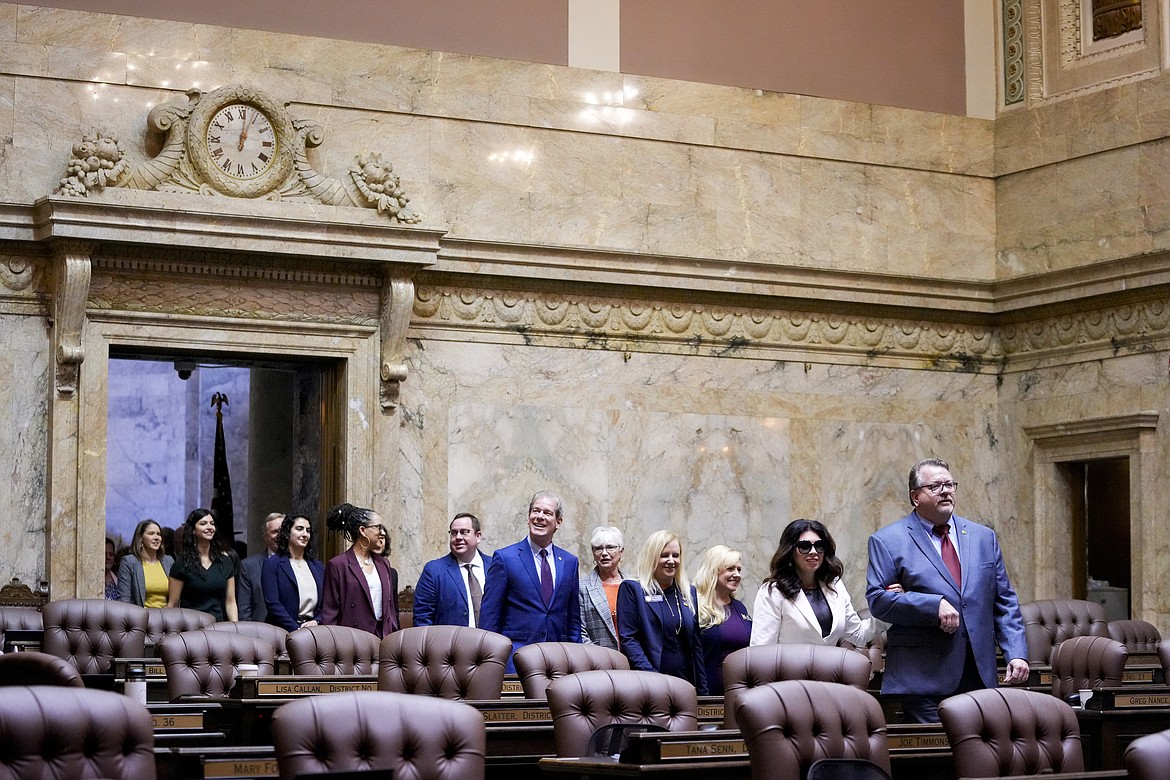
Members of the House, including Rep. Michelle Caldier, R-Gig Harbor, and Rep. Eric Robertson, R-Sumner, at front, walk into the House chambers during opening ceremonies on the first day of the legislative session at the Washington state Capitol, Monday, Jan. 8, 2024, in Olympia, Wash. (AP Photo/Lindsey Wasson)
AP
Joel Martin has been with the Columbia Basin Herald for more than 25 years in a variety of roles and is the most-tenured employee in the building. Martin is a married father of eight and enjoys spending time with his children and his wife, Christina. He is passionate about the paper’s mission of informing the people of the Columbia Basin because he knows it is important to record the history of the communities the publication serves. | January 30, 2024 1:00 AM
OLYMPIA — Another new year, another legislative session in Olympia. The session began Jan. 8, and state lawmakers are hard at work. Some bills pass through fairly smoothly, said Rep. Tom Dent, R-Moses Lake, and some take years of a modification here and a concession there before they become law – if they ever do.
“Many of the bills that we run or ideas that we have, you know, they’re sometimes simple, easy bills that will move really fast,” Dent said. “And then the more complex ones, they’re more of a heavy lift. Those are the ones that you work on every year. They don’t pass, but you gain some knowledge; you maybe make some amendments, and begin to develop the support that you need from the stakeholders and in the legislature.”
Here are some bills we’re following that affect the agricultural community.
House Bill 1866: Concerning the academic and support needs of children of seasonal farm workers. This bill would create a study to examine expanding the educational and other government services offered to the children of migratory farm workers to children whose families work seasonally but live in one place. Sponsor: Lillian Ortiz-Self, D-Mukilteo.
HB 1868: Reducing emissions from outdoor power equipment. This bill would encourage the changeover from gas-powered tools under 25 horsepower, like brush cutters, chainsaws and stump grinders, by exempting electric tools of the same kind from state sales taxes, and would prohibit internal combustion tools manufactured after January 2026. An exemption would be made for government agencies or contractors working in emergency management, such as extinguishing wildfires or cleaning up oil spills. Sponsor: Amy Walen, D-Kirkland.
HB 1936: Concerning tax exemptions for farmers. This bill would create a business and occupation tax credit for 25% of expenditures for new equipment, infrastructure, seed, seedlings, spores, animal fees and amendments.
“A win-win for our farmers and nature, this program helps farmers keep natural resources and farmland healthy for all,” wrote the bill’s primary sponsor, Rep. Clyde Shavers, D-Whidbey Island, on his website. “By participating in conservation/stewardship programs, this tax credit can go towards new equipment, seed, feed, and other expenditures.”
HB 1971: Concerning a rangeland fire protection association pilot project. This bill would create a pilot project in three to-be-determined areas of eastern Washington that equips and organizes farmers and ranchers for quick response to wildfires.
“The advantage of doing this is … if you have a wildfire, the people that are going to be there first are the people that live there, right?” said Dent, the bill’s primary sponsor. “The people that know the ground, and so they would be first on the scene to fight the fire. Well, the way it is now, that can happen, but as soon as whoever — a fire district or (the Department of Natural Resources – comes in to take control of the fire, they send (the local firefighters) home. This (bill) changes things. This lets those guys stay there.”
HB 1993: Concerning water rights adjudication commissioners and referees. This bill would authorize superior court judges to appoint attorneys to act as water commissioners, adjudicating disputes related to water rights. Sponsor: Joe Timmons, D-Bellingham.
HB 2147: Concerning agriculture pest and disease response. This bill would create an account in the state treasury “to prevent, quickly detect, and rapidly respond to emerging threats from agricultural pests and diseases.” Sponsor: Tom Dent, R-Moses Lake.
Senate Bill 5784: Concerning deer and elk damage to commercial crops. This bill would increase the amount of money available to compensate farmers and ranchers for damage to commercial crops caused by wild deer or elk.
“What’s been happening is a producer will come in with $100,000 in damages,” said Sen. Kevin Van De Wege, D-Port Angeles, the bill’s primary sponsor. “Right now the (Department of Fish and Wildlife) caps their awards, I believe, at $10,000. But then that ag producer can go to an administrative law judge, and more often than not those administrative law judges have been giving the full amount. So what money is available is gone very quickly.”
Increasing the cap on awards will also incentivize the DFW to take measures to mitigate elk and deer damage to crops, Van De Wege added, because it’s cheaper to plant a crop somewhere else that elk like better than to pay out claims for damages.
ARTICLES BY JOEL MARTIN
Space Burger booth open March 13-15
MOSES LAKE — Those who can’t wait for the Grant County Fair can get their Space Burger fix next weekend, according to an announcement from the Lioness Club of Moses Lake. The iconic Grant County sandwiches will be available at the Grant County Fairgrounds March 13-15, according to the announcement. There is no admission fee to get into the fairgrounds that weekend.
SENIOR EVENTS: March 2026
COLUMBIA BASIN — Plays, art shows, auctions and more await seniors in the Columbia Basin this month. Here are some opportunities to get out and about in March.

Valentine’s Day cards flood Brookdale Hearthstone with love
MOSES LAKE — Residents at Brookdale Hearthstone Assisted Living in Moses Lake got Valentine’s Day greetings from across the country last month. “I believe that the only states we have not received (cards from) yet are Vermont and Maine,” Lifestyle Director Imelda Broyles said Feb. 24. “We keep receiving new cards every single day. They have not stopped. My residents are in awe with every single one of the cards that we’ve been receiving.” The Hearts Across America project started as a way for children in school classrooms to exchange Valentine’s Day cards with classes in other states or even countries, but the idea has expanded to senior living facilities, according to the project’s social media.