
Pilot program
JOEL MARTIN | Hagadone News Network | UPDATED 2 years, 2 months AGO
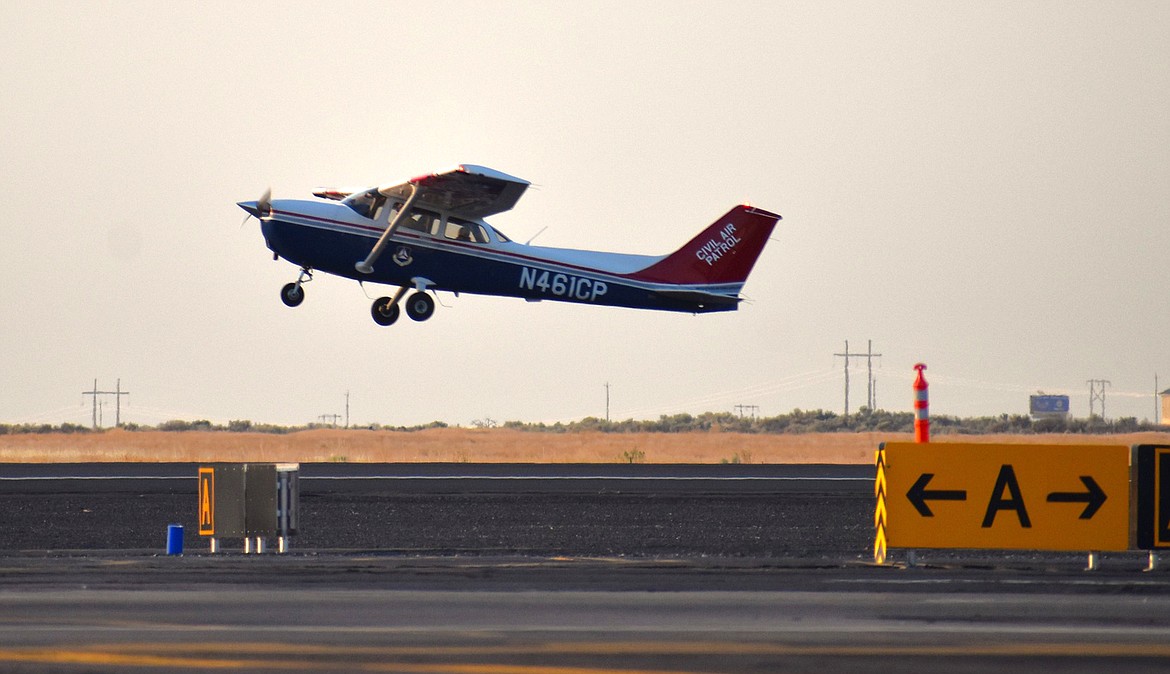
A Civil Air Patrol cadet pilots a trainer plane Thursday at the National Flight Academy at the Ephrata Airport.
COURTESY PHOTO/CMSGT LAUREN SCHULTZ
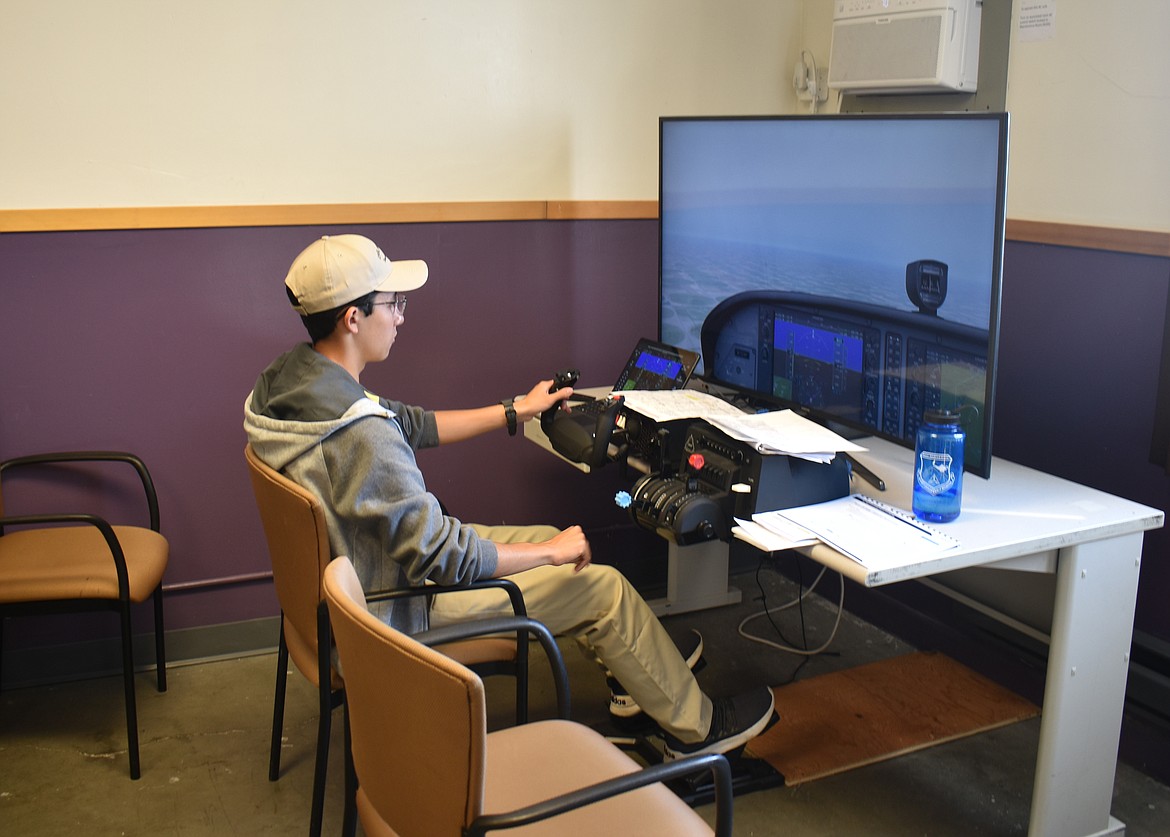
A Civil Air Patrol cadet practices on a simulator at the National Flight Academy Thursday.
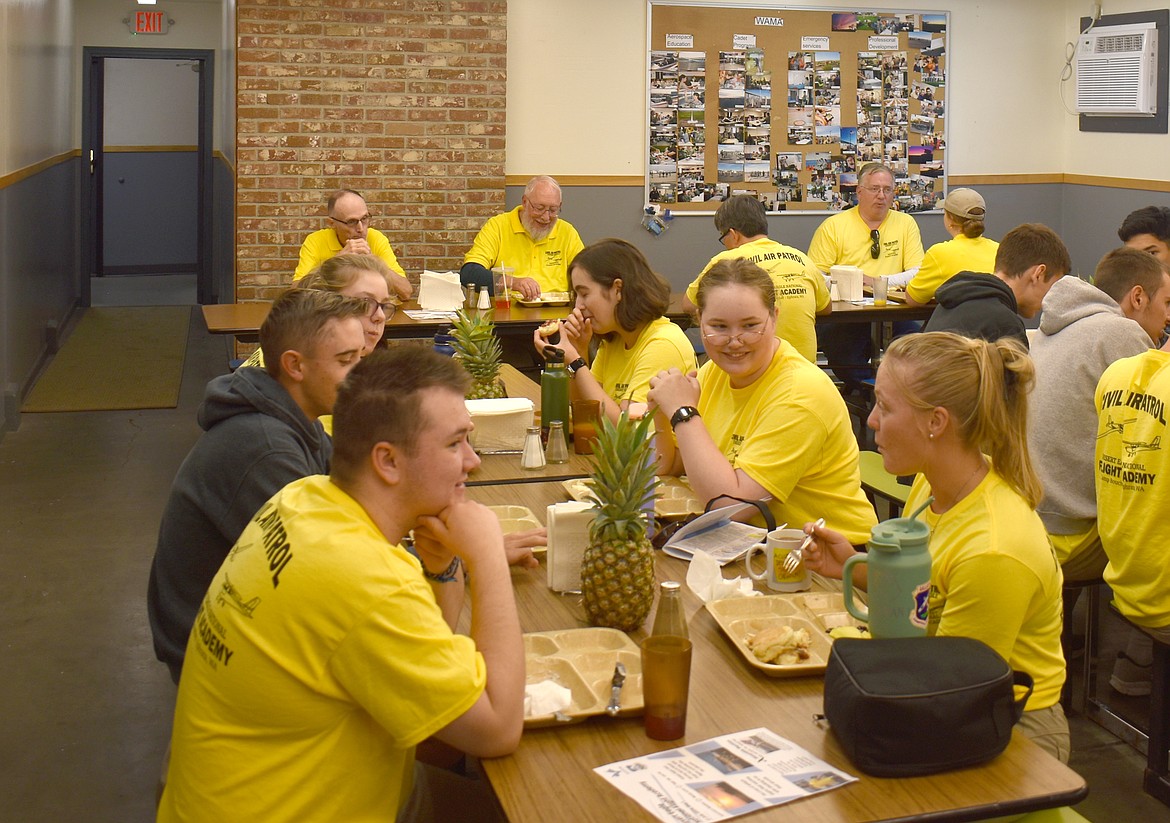
Cadets have breakfast at the National Flight Academy Thursday at the Ephrata Airport. Ephrata has hosted the academy for 20 years largely because it has sleeping and dining facilities for the cadets onsite.
Joel Martin has been with the Columbia Basin Herald for more than 25 years in a variety of roles and is the most-tenured employee in the building. Martin is a married father of eight and enjoys spending time with his children and his wife, Christina. He is passionate about the paper’s mission of informing the people of the Columbia Basin because he knows it is important to record the history of the communities the publication serves. | July 23, 2024 3:00 AM
EPHRATA — This week, that plane buzzing overhead could be piloted by a teenager.
The Civil Air Patrol in Ephrata is holding its Desert Eagle National Flight Academy, for CAP cadets between the ages of 16 and 19. They’ll get intensive flight instruction for 10 days, both in powered planes and on the ground, learning, said Lt. Col. Sid Wiggs, the public affairs officer for the academy.
Students spend time both in trainer planes and on the ground, learning airplane systems, pre- and post-flight procedures, navigation and weather theory as well as take-off, flight maneuvers and landing. At the end of the 10-day program, they’re ready to fly solo.
“We usually solo probably 95% of our students,” Wiggs said. “They’re alone in the plane, and their instructor is on pins and needles by radio talking them through the whole thing.”
The Civil Air Patrol was formed in 1941, just a week before the bombing at Pearl Harbor brought the U.S. into World War II.
“Its main job was to help with the defense of our country, for those that couldn't go into the military,” said Lt. Col. Kathy Maxwell, cadet program activities officer for the Columbia Basin Squadron, based in Ephrata. “A lot of the young people played a part in that during that time. They did sub patrols on the western coastline, towed targets. But it's been it's been a very well kept secret, if you will, since then.”
Washington state has held a National Flight Academy since 1975, Maxwell said. The venue rotated around the state until 20 years ago, when it settled permanently at Camp Robert L. Boucher at the Ephrata Airport. At other locations, the cadets would have to stay in college dorms or the equivalent and be transported to the airfield, but Camp Boucher has all the facilities on the spot,” Maxwell said.
“This is a self-contained facility,” she said. “We have our own kitchen, we have a dining room, we have beds, we have classrooms, simulators setup for this. So they're getting a full meal deal right in one spot.”
There are 19 cadets in this year’s academy, drawn not just from the Northwest but from Florida, Georgia, Colorado, Montana, Utah and Puerto Rico, Wiggs said.
The only cadet from eastern Washington is Cadet Capt. Daisy Carpenter, 17, from East Wenatchee, who was about to take off for some air maneuvers with her instructor, Maj. Karin Hollerbach Thursday morning.
“Yesterday, we worked on your basic turns because it was the first day,” she said. “So today, I believe we're doing steeper turns, and possibly practicing stalls.”
Carpenter has been in the Civil Air Patrol for almost four years, she said.
“I went up in a plane for the first time and I thought, ‘Wow, this is awfully cool. I'd love to do this more,’” she said.
Hollerbach said that the planes the cadets learn in are designed with inexperienced pilots in mind.
“These are built for training and built for stability,” she said. “So even if you're in a turn or you're climbing or descending and it's a little more than you want, even if you were to totally let go, the plane wants to fly, It will just go back to flying configuration.”
There are only so many planes available, so when they’re not in an actual cockpit, the cadets have simulators they can practice on, computers that are about as close as you can get to flying the actual planes without leaving the ground. The controls mimic those of a trainer plane, said Capt. Madeline Patterson, who was instructing the cadets on the simulators, and the ground they see on the screen is Ephrata and its surroundings.
“Sometimes after the flights, their flight instructors will say, Okay, I need you to go to the simulator and practice these things that we went over today,” Patterson said. “Or they're preparing for their flights and they know what maneuvers they're gonna practice, so they're working through some of those simulators. It’s almost an exact copy of what the cockpit of the aircraft looks like.”
After the academy, cadets have the option to stay after the academy for an additional intensive ground school, which lets them take the written pilot exam for the FAA, Wiggs said.
“It's to help develop the youth towards a career as a pilot,” he said. “They don't always go into careers, but at least we get them to where they can be a private pilot.”
Joel Martin may be reached via email at [email protected].
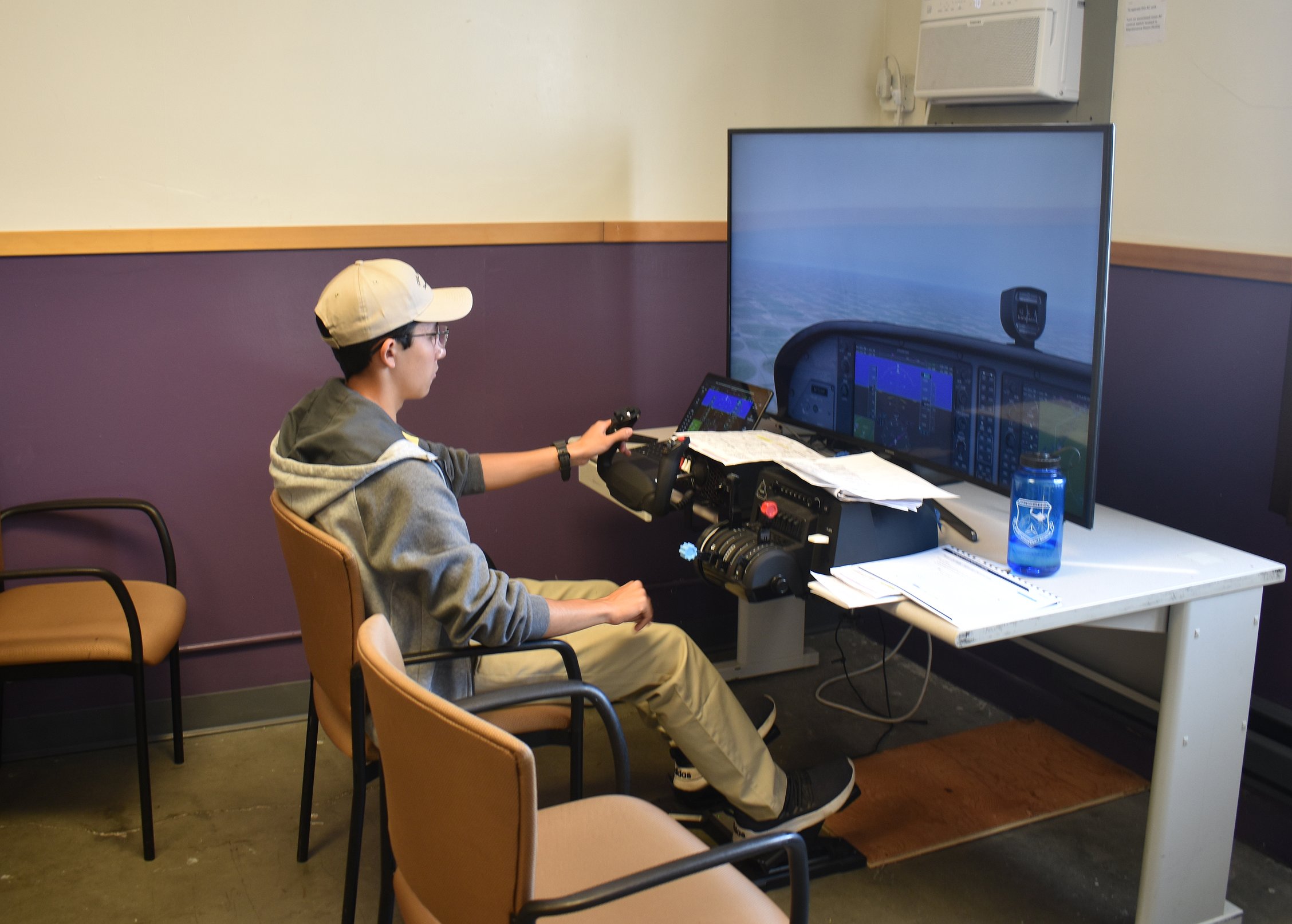 A Civil Air Patrol cadet practices on a simulator at the National Flight Academy Thursday.
 Cadets have breakfast at the National Flight Academy Thursday at the Ephrata Airport. Ephrata has hosted the academy for 20 years largely because it has sleeping and dining facilities for the cadets onsite.
ARTICLES BY JOEL MARTIN

Endless battle
Noxious Weed Control Board works to keep invasive plants under control
MOSES LAKE — Some of the nastiest plants in Grant County were the topic of a class led by Jay Johnson, a consultant with the Grant County Noxious Weed Control Board, Tuesday. The Noxious Weed Control Board, as its name would suggest, is tasked with keeping weeds under control in Grant County. That’s not a small job; the board’s website lists 129 species of noxious weeds that are found around Grant County. A noxious weed is defined as an invasive, non-native plant that threatens agricultural crops, local ecosystems or fish and wildlife habitat, according to the Noxious Weed Control Board. Washington state law requires that these weeds be identified and their spread kept to a minimum, if not completely eradicated. “We’re one of those agencies a lot of people don’t really understand,” Johnson said. “We’re a county office and … our funding is tax-based assessment. When you get your tax bill and you look down at all the expenses that you pay for, there we are.”

BASIN EVENTS: Oct. 16-24
COLUMBIA BASIN — Whether you feel like shopping, crafting, learning or seeing a show, there’s something happening for you this week in the Basin. Oct. 16 ‘My Family (Mi Familia)’ screening Spanning three generations, “My Family (Mi Familia)” is a heartfelt drama that follows the Sánchez family as they build their lives in East Los Angeles. Through love, hardship, triumph, and sacrifice, the film explores the immigrant experience, the strength of family bonds, and the traditions that connect one generation to the next. Lowrider show and taco truck before the screening. Sponsored by Columbia Basin Allied Arts, EDUBS C/S and the Moses Lake Creative District. $12 per person. Doors open at 6 p.m., film begins at 7 p.m. at the Moses Lake Civic Center Auditorium, 401 S. Balsam St. Tickets and info: www.cba-arts.org.

Moses Lake author encourages women to look beyond church culture norms
MOSES LAKE — A Moses Lake author’s book, “A Christian Woman Striving to Live Her Faith in a Man-Controlled World,” takes aim at the role to which many churches relegate the female half of their congregations. “It’s to encourage women in the faith,” Linda Curran said. “A lot of churches say, ‘Teach Sunday school, do this, do that, but don’t (evangelize.)’" In her book, Curran recounts a time when she moved to a new community and joined a church there. She was surprised to learn that, as a new female member, she had been automatically assigned church cleaning duties. When she questioned it, she wrote, she was met with condescension and her objections were brushed aside. In other churches, she said, women who were capable of teaching were relegated to “women’s ministry.”