
MLSD deficit more than $13 million after cuts
JOEL MARTIN | Hagadone News Network | UPDATED 2 years, 4 months AGO
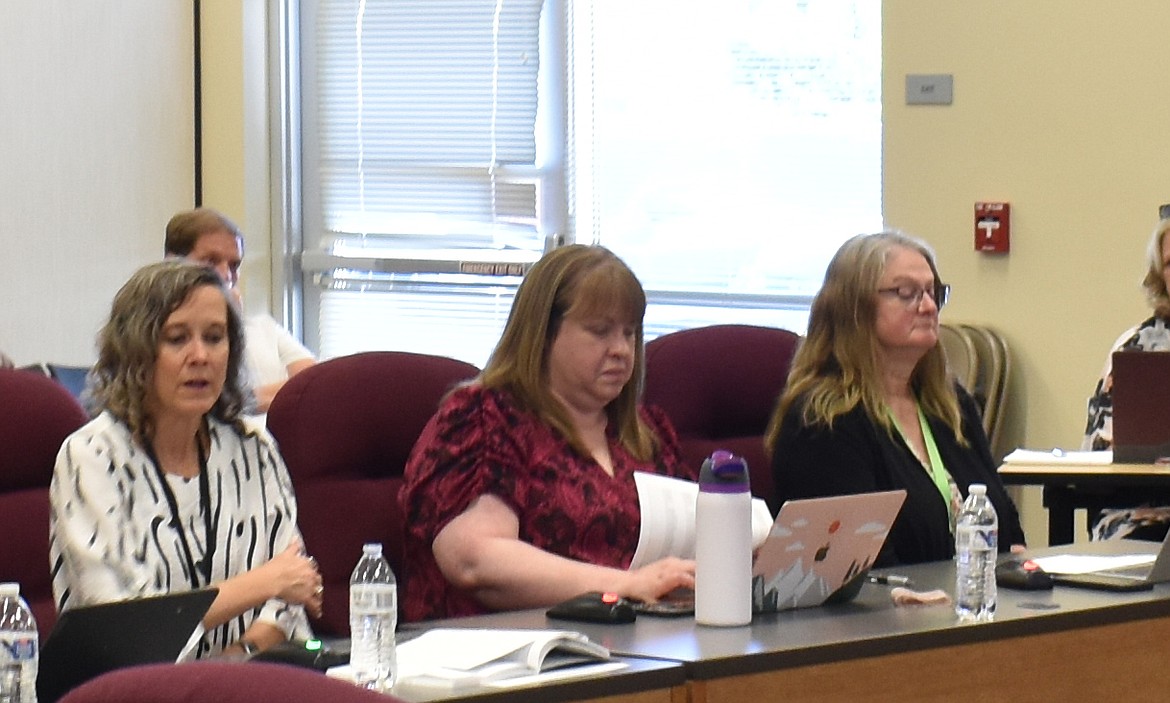
From left: Moses Lake School District Acting Superintendent Carol Lewis, with Human Resources Director Michelle Musso and Executive Director of Elementary Education Robbie Mason, lay out the district’s financial picture to the school board at a special study session Monday.
JOEL MARTIN/COLUMBIA BASIN HERALD
Joel Martin has been with the Columbia Basin Herald for more than 25 years in a variety of roles and is the most-tenured employee in the building. Martin is a married father of eight and enjoys spending time with his children and his wife, Christina. He is passionate about the paper’s mission of informing the people of the Columbia Basin because he knows it is important to record the history of the communities the publication serves. | June 13, 2024 1:20 AM
MOSES LAKE — The Moses Lake School Board held a study session Tuesday to discuss the district’s reduced education program for the next school year.
“When you have to make significant cuts, you think ‘How can we do the same as what we’re doing with less?’” said Moses Lake School District Acting Superintendent Carol Lewis. “I think … we all have to recognize that things are going to look different, we’re not going to be able to do everything we’ve always done.”
The district had previously estimated that it would be necessary to make cuts of about $20 million, but Lewis said it would likely be necessary to cut more. In addition, the district needs to figure out how to repay the loan to the general fund from the capital projects budget that the board approved at its May 30 meeting to cover payroll and other expenses for June.
So far, staff has been reduced by between 14 and 15.5% across all classifications of employment, Lewis said. Those reductions represent a savings of about $18.9 million, she said.
The general fund balance has been fairly healthy in years past, Lewis said, but between the 2021-22 and 2022-23 school years it dropped dramatically, from about $17.5 million to around $5 million. Part of the reason for the decline was that the district was counting ESSER III funds — federal COVID-19 relief for school districts — as part of the general fund, but also spending it at the same time, Lewis said, in effect counting it twice.
“We’ve spent through the fund balance and … there’s an $11 million ESSER grant that you no longer have,” added Trisha Shock, Assistant Superintendent of Administrative Services for the North Central Educational Service District. “So that’s what you’re seeing here.”
Lewis said the first place to look at cuts is materials, supplies and operating costs, or MSOCs, for basic education. For the 2024-25 school year, the state legislature has allocated about $12.5 million to the MLSD after the last round of cuts, but the budgeted cost is closer to $13.4 million, necessitating cuts of almost another $1 million.
For comparison, MSOC spending in the 2022-23 school year was $29.7 million, and for the 2023-24 year to date was $22.2 million, Lewis said. School resource officers are included under the MSOC heading, she added.
Part of the discrepancy between the allocation and the amount the district budgeted for is related to the Educational and Programs Levy, which failed twice this year, Shock said.
“It’s fairly typical for schools to overspend on MSOCs because they backfill that with levy funds,” she said, but with the levy’s failure, those funds won’t be available.
Contracted staff for basic education presents another deficit, Lewis said. For those who were not let go in the initial round of cuts, the state has allocated $49.2 million, but the district’s obligation is $55.6 million, leaving a gap of about $7 million. At the same time, the number of basic education staff desired — as opposed to required, Lewis said, because how many personnel the schools will be mandated to have within class size limits is still being determined — is 417, whereas only 397 are currently contracted. Besides teachers, that figure includes school nurses and counselors, Lewis explained.
“So (with) tight staffing … we need 20 more teachers,” Lewis said. “That would come to $2,900,000. So the total deficit there would be close to $10 million.”
The picture is similar for some of the more specialized programs. The gap between state-allocated funds and current staff costs for preschool and transitional kindergarten is $338,628, Lewis said. Besides that, the program needs four more teachers, which will cost roughly another $580,000. However, there are other state and federal funds that may be available for that program, she added, and staff are looking into those sources. Money allocated for substitutes came to about $243,000, and the district spent about $3.91 million last year, counting timesheets for staff who covered for absent personnel when no substitutes were available. Funding for classified substitutes has customarily come from levy funds in the past, Lewis explained.
Classified staff for general education, including custodial workers, paraeducators, secretaries and other non-certified personnel, are currently expected to cost the district about $16 million, while the state has only allocated about $10.4 million, leaving a deficit of $5.8 million. That figure applies to the workforce after the round of job cuts. Campus security, which does not include school resource officers, is budgeted for about $490,000, according to Lewis, none of which the state pays for. Building administrators’ pay and benefits showed a deficit of about $1.04 million. For district administrators and classified staff not assigned to a particular school the deficit was $44,539.
Discussing job cuts is never easy, Lewis told the board.
“We fully realize that we're talking about people's lives and livelihoods,” she said. “So as we talk about positions in a sterile and financial way, just know that we know that we're talking about people when we talk about those things.
For special education, currently employed staff were covered by the state’s allocation, but there are 17 fewer certified staff than desired, and filling those positions would create a deficit of $1.9 million.
There were a few bright spots in the list of expenses Lewis presented to the board. The Running Start program, nutrition services and transportation to and from school all fell within budget, she said.
The total gap between the state’s allocation and budgeted expenses was $25.5 million, according to Lewis’ figures. Funding sources other than state allocation, including the federal Learning Assistance Program and receipts for the remainder of the levy that was passed in 2021, fill in about $11.8 million, which reduces the deficit to about $13.6 million.
The numbers that were presented to the board Monday can be viewed in PDF form at https://bit.ly/4carLyA. Those figures are being continually revised as new information comes to light, wrote Communications Director Claren McLoughlin in an email to the Columbia Basin Herald. The current data can be found at https://bit.ly/3z9GcV1.
There will be further discussion of the budget at a special school board meeting at 6 p.m. Thursday.
“I want to say, I believe we're going to make it,” Lewis said. “I believe that we can do the hard things that it's going to take to help our school district move forward and be successful.”
Joel Martin may be reached at [email protected].
ARTICLES BY JOEL MARTIN
Endless battle
Noxious Weed Control Board works to keep invasive plants under control
MOSES LAKE — Some of the nastiest plants in Grant County were the topic of a class led by Jay Johnson, a consultant with the Grant County Noxious Weed Control Board, Tuesday. The Noxious Weed Control Board, as its name would suggest, is tasked with keeping weeds under control in Grant County. That’s not a small job; the board’s website lists 129 species of noxious weeds that are found around Grant County. A noxious weed is defined as an invasive, non-native plant that threatens agricultural crops, local ecosystems or fish and wildlife habitat, according to the Noxious Weed Control Board. Washington state law requires that these weeds be identified and their spread kept to a minimum, if not completely eradicated. “We’re one of those agencies a lot of people don’t really understand,” Johnson said. “We’re a county office and … our funding is tax-based assessment. When you get your tax bill and you look down at all the expenses that you pay for, there we are.”
BASIN EVENTS: Oct. 16-24
COLUMBIA BASIN — Whether you feel like shopping, crafting, learning or seeing a show, there’s something happening for you this week in the Basin. Oct. 16 ‘My Family (Mi Familia)’ screening Spanning three generations, “My Family (Mi Familia)” is a heartfelt drama that follows the Sánchez family as they build their lives in East Los Angeles. Through love, hardship, triumph, and sacrifice, the film explores the immigrant experience, the strength of family bonds, and the traditions that connect one generation to the next. Lowrider show and taco truck before the screening. Sponsored by Columbia Basin Allied Arts, EDUBS C/S and the Moses Lake Creative District. $12 per person. Doors open at 6 p.m., film begins at 7 p.m. at the Moses Lake Civic Center Auditorium, 401 S. Balsam St. Tickets and info: www.cba-arts.org.

Moses Lake author encourages women to look beyond church culture norms
MOSES LAKE — A Moses Lake author’s book, “A Christian Woman Striving to Live Her Faith in a Man-Controlled World,” takes aim at the role to which many churches relegate the female half of their congregations. “It’s to encourage women in the faith,” Linda Curran said. “A lot of churches say, ‘Teach Sunday school, do this, do that, but don’t (evangelize.)’" In her book, Curran recounts a time when she moved to a new community and joined a church there. She was surprised to learn that, as a new female member, she had been automatically assigned church cleaning duties. When she questioned it, she wrote, she was met with condescension and her objections were brushed aside. In other churches, she said, women who were capable of teaching were relegated to “women’s ministry.”