
Glacier National Park receives over $1.9 million for ecosystem restoration
TAYLOR INMAN | Hagadone News Network | UPDATED 2 years AGO
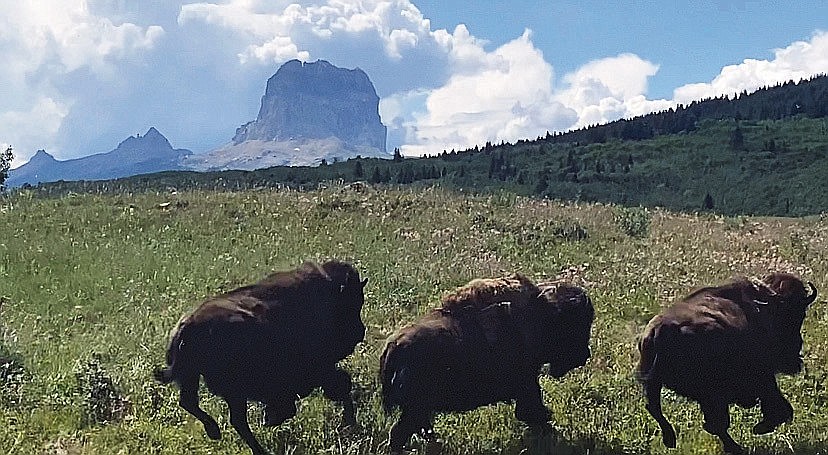
Bison are released near Chief Mountain outside of Glacier National Park. (Photo provided)
REPORTER AND PODCAST HOST Taylor Inman covers Bigfork and the north shore of Flathead Lake for the Bigfork Eagle and the Daily Inter Lake. Her reporting focuses on local government, community issues and the people who shape life in Northwest Montana. Inman began her journalism career at Murray State University’s public radio newsroom and later reported for WKMS, where her work aired on National Public Radio. In addition to reporting, she hosts and contributes to Daily Inter Lake podcasts including News Now. Her work connects listeners and readers with the stories shaping communities across the Flathead Valley. IMPACT: Taylor’s work expands local journalism through both traditional reporting and digital storytelling. | March 5, 2024 11:00 PM
Glacier National Park is receiving over $1.9 million from the Inflation Reduction Act to continue work on bison reintroduction, inventory cultural resources impacted by climate change and to protect and restore whitebark pine.
A majority of the funding at $1.5 million will go toward furthering bison reintroduction on the east side of the park, according to a release.
Glacier Park’s climate-related projects are part of an overall $195 million investment from the act announced last week to prepare parks across the country to be resilient to climate change. Park officials said in the release that these investments are “incredibly timely, as healthy ecosystems, wildlife and native plant habitats, and cultural resources are threatened by climate change and many other environmental challenges. ”
“Glacier is on a lot of people’s minds when thinking about the impacts of a changing climate,” Park Superintendent Dave Roemer said in a statement. “These projects will help us prepare, restore, and preserve key aspects of the park that make Glacier special. What ties these efforts together is the development and use of high-quality information to inform management and the coordination of these efforts with the Blackfeet Nation and the Confederated Salish and Kootenai Tribes.”
President Joe Biden signed the Inflation Reduction Act into law in August 2022. It has been described as the most expansive piece of climate legislation in U.S. history.
Bison reintroduction through the Innii Initiative is a Blackfeet-led effort to bring bison back to the landscape, and the herd is expected to freely roam onto National Park Service lands. Funds will be used to coordinate landscape level ecosystem function and to conduct connectivity studies to gain an understanding of how ungulates like elk and deer forage and habitat in the absence of bison. This project also includes an attempt to obtain a population estimate through pellet analysis.
With these funds, park service personnel are also assessing infrastructure needs and placement to support visitor use, enjoyment, and safety, according to the release.
Glacier was also awarded $200,514 for the inventory as part of a multi-park project to survey the cultural resources in the Intermountain West high-elevation areas impacted by climate change. Other parks awarded additional funding include Yellowstone and Grand Teton.
There are more than 11,000 years of human occupation and Native American cultural heritage documented in Glacier National Park. These resources are experiencing loss through climate change driven impacts such as wildfire and melting ice, according to the release.
Park staff plan to target the most critically affected and threatened non-renewable cultural resources, such as melted ice-revealed organic materials or eroded cut banks impacting ancient campsites. This will be done through an approach that studies climate signals, like frequency of wildland fires and changing weather patterns, and their impacts to cultural resources in high alpine landscapes and non-moving ice patches.
Two areas of research include sites associated with melting stable ice and sites on high elevation landforms in non-ice context, like mountain passes and peaks.
Glacier received $270,000 to continue work on restoring threatened whitebark pine and to implement the National Whitebark Pine Restoration Strategy. The multi-park project builds on 20 years of work at Glacier and within the Greater Yellowstone Ecosystem.
The project includes additional funding awarded to Yosemite, Sequoia, Kings Canyon, Olympic, Mount Rainier, North Cascades, Grand Teton and Yellowstone national parks, totaling $750,000.
The project includes working with partners and tribes to plant blister rust resistant seed and seedlings, identify rust resistant trees, monitor seedling survival and identify climate refugia.
In the release, park officials said the announcement of funding through the act is “a promise to future generations” that the park service will work to address the impacts of the climate crisis, including intensifying drought, wildfires, flooding and legacy pollution in national parks and other public lands.
Through the Bipartisan Infrastructure Law and the IRA, the Department of the Interior is investing more than $2 billion to restore lands and waters across the country. According to the release, the funds given to Glacier are part of work advancing the Biden administration’s America the Beautiful initiative, which hopes to restore and conserve 30% of U.S. lands and waters by 2030.
Reporter Taylor Inman can be reached at 406-758-4433 or by emailing [email protected].
ARTICLES BY TAYLOR INMAN

Plant Land helps customers spring into the gardening season
Heated greenhouses at the Evergreen garden center are filled with pottery, annuals, houseplants and some early season vegetables like onions, lettuces and herbs.

Despite Barnhart objections, county OK’s gravity septics
Flathead County homeowners can now apply to install a gravity septic system for the first time since 2004.

Logan Health physicians raise awareness about colorectal cancer
It’s more important than ever to get screened for colorectal cancer, according to Logan Health gastroenterologist Dr. Kate Wisser, who said catching the disease early saves lives.