
City to revise parking time limits
JOEL MARTIN | Hagadone News Network | UPDATED 2 years, 6 months AGO
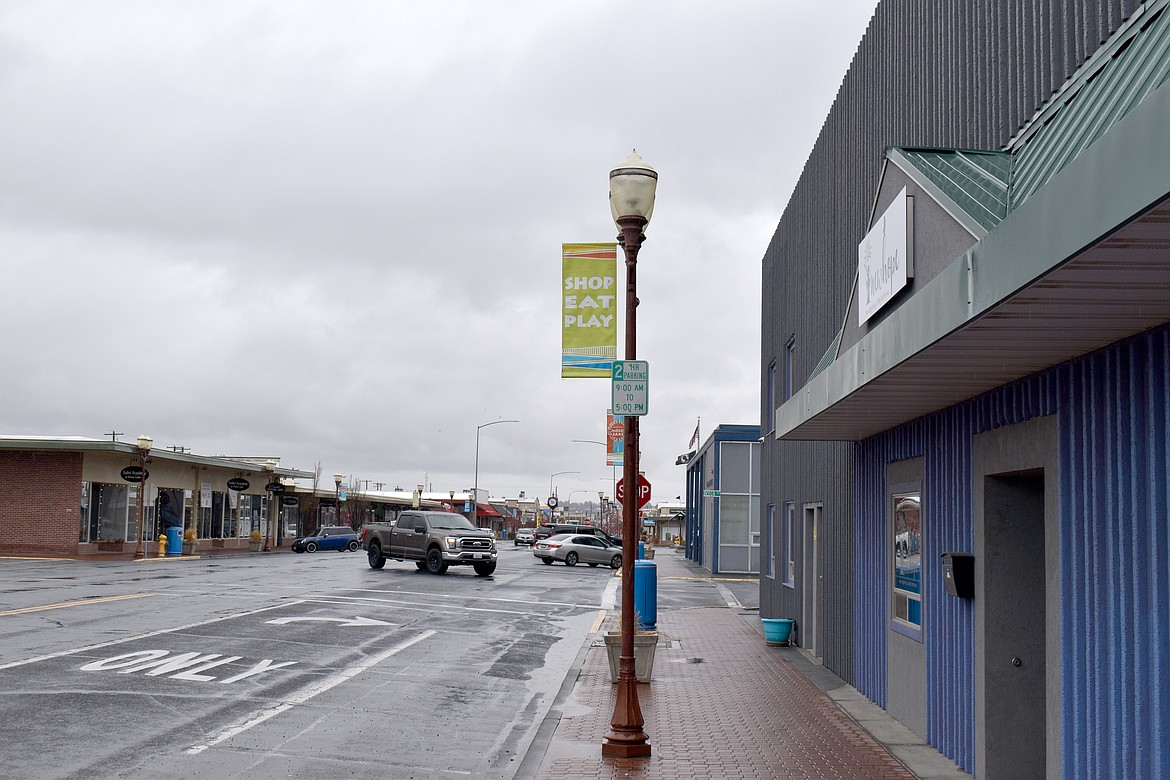
The city of Moses Lake is drafting an ordinance that would expand most of the parking time limits downtown from two hours to four.
Joel Martin/Columbia Basin Herald
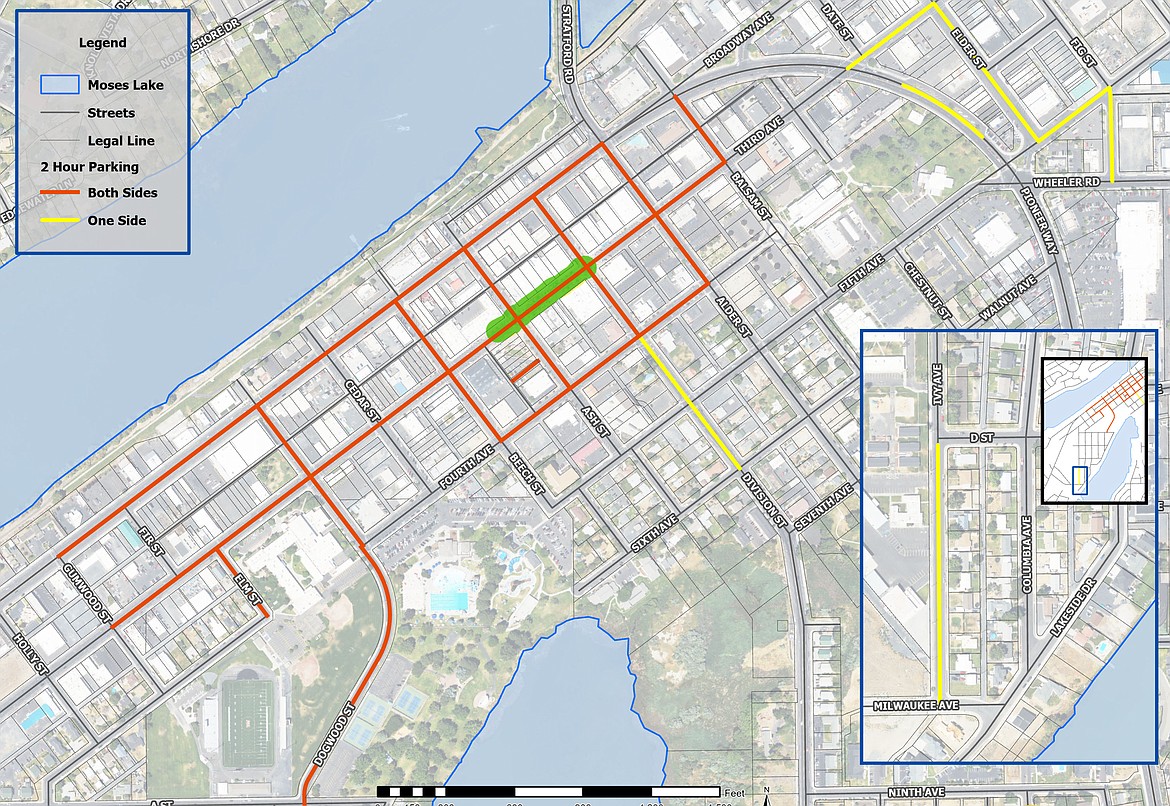
In this map, the orange and red areas show on-street parking in Moses Lake, currently limited to two hours. The city is considering changing all of those areas except the portion marked in green to four-hour parking; the green area would remain at two hours.
Joel Martin has been with the Columbia Basin Herald for more than 25 years in a variety of roles and is the most-tenured employee in the building. Martin is a married father of eight and enjoys spending time with his children and his wife, Christina. He is passionate about the paper’s mission of informing the people of the Columbia Basin because he knows it is important to record the history of the communities the publication serves. | March 28, 2024 7:08 PM
MOSES LAKE — The parking situation in downtown Moses Lake may get a little easier, under new regulations the city is considering.
Some downtown businesses have complained to the city that there’s no place for their employees to park, and others have complained that downtown employees are taking up spaces that customers could be using.
“Customers were saying things to me that they got a good parking spot and they usually don't, or they had to go around the block a couple of times to pull up and find a parking spot, or they had to park (farther away),” said Magen Evans, owner of Hello Nature, which opened in November at 312A S Division St., in the space formerly occupied by Sears. “So I kind of started keeping an eye on the cars out there. But I noticed that all 10 spots (in front of the store) were full, and it seemed to be the same cars every day, and sometimes some would swap out and different ones would come in. And they were here from 10 a.m. to 5 p.m. typically, and they weren’t leaving.”
Officially, on-street parking downtown has a two-hour limit, but the city doesn’t issue parking tickets and has no intention of doing so, Moses Lake City Manager Kevin Fuhr said. A few businesses have their own parking lots, but many of the smaller ones are dependent on city-owned parking for both employees and customers. According to Mallory Miller, director of the Downtown Moses Lake Association, there are 99 off-street parking spaces in the downtown area, 20 of which are in a lot that charges a fee. Another 74 of those are in privately-owned lots attached to particular buildings, whose owners have allowed people to use them freely, but who could limit usage if they chose. There are 25 spaces available at Sinkiuse Square, which is owned by the city.
A survey taken by the DMLA of downtown businesses showed at least 79 employees at downtown businesses that don’t have their own lots. That figure is lower than the actual number, Miller said, because several employers didn’t respond to the survey.
“That’s more parking spaces (needed for employees) than there are in the downtown core area,” Miller said. “So that really puts it in perspective.”
The city also owns two lots across from the Civic Center with 86 spaces between them, but those are often in use by city employees, and have other drawbacks as well.
“City Hall is pretty far away to walk to our downtown businesses for a lot of us,” Alicia West, who works at Settlers Country Market on Third Avenue, told the Moses Lake City Council in February. “And also walking back to our vehicles when it's dark is not a safe option. There's a lot of scary people out there these days.”
On-street parking downtown consists of both parallel and diagonal spaces, but how many vehicles that can accommodate is up in the air, because the parallel spaces are merely long rows, not marked off into spaces.
Changing that is one of the things that Miller and DMLA President Denise Kinder suggested to the City Council in a special study session March 26. Miller and Kinder also recommended expanding the two-hour limit to four hours in the diagonal spaces.
“I think that their requests were very reasonable,” Fuhr said. “Changing the time limit on the parking, I think, will be easy to fix. The only real expense we'll have is, we'll have to create some four-hour signs and then place those around the city in some strategic locations. We've got a lot of two-hour signs already that are up and so we'll move some of those signs.”
Rather than differentiating between parallel and diagonal spaces, Fuhr said, the ordinance he’s drafting will put a four-hour limit on all downtown parking except the stretch of Third Avenue between the post office and Division Street, as well as a small adjacent chunk of Ash Street which will remain at two hours. The city would also mark off individual spaces in parallel parking areas and work with the PUD to improve the lighting downtown, Fuhr added, so people going to their cars after dark can feel safer.
For people who work a full shift downtown, the DMLA is considering working out a permit system, where participating business owners could give their employees a card to put in their window that would exempt them from the four-hour limit. Employees would then be encouraged to avoid parking in the spaces most in demand by customers.
“That would be based on a number system rather than having someone's name on them; we don’t want to cause issues with that. So if there was a complaint, it would be like someone calling us saying, ‘Hey, No. 17 is parked in front of my business when they should be parked in Lot X.’”
The permits wouldn’t carry any legal force, she said, but it doesn’t matter because the city doesn’t anticipate issuing parking tickets anyway. Rather, it would be a way for the businesses to police themselves.
“If there ever comes a time where they do start ticketing people, we would like to have the parking permits in place to show that, ‘Hey, I am here all day because I'm currently keeping this business alive,’” Miller said.
Joel Martin may be reached via email at [email protected].
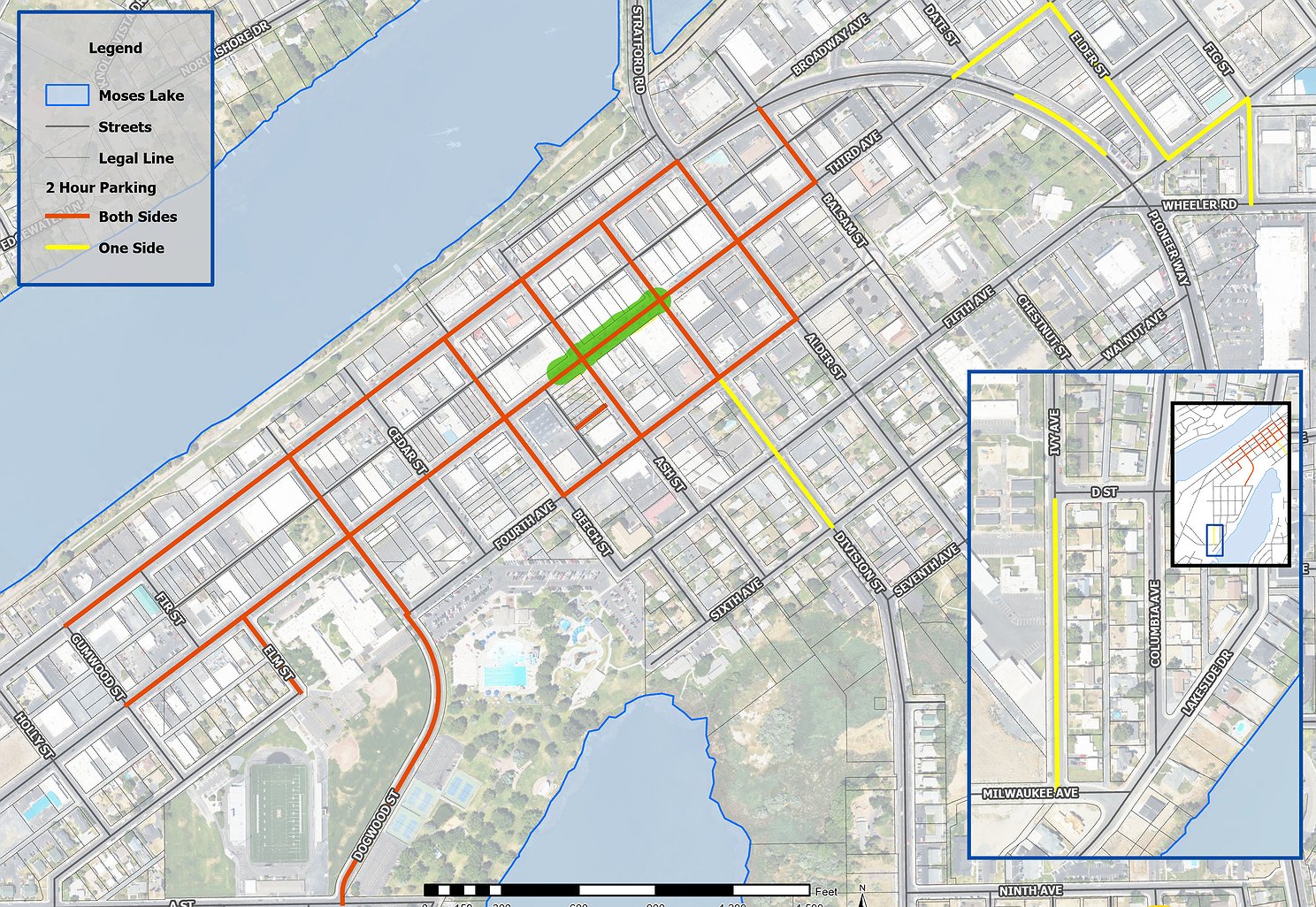 In this map, the orange and red areas show on-street parking in Moses Lake, currently limited to two hours. The city is considering changing all of those areas except the portion marked in green to four-hour parking; the green area would remain at two hours.
ARTICLES BY JOEL MARTIN

Endless battle
Noxious Weed Control Board works to keep invasive plants under control
MOSES LAKE — Some of the nastiest plants in Grant County were the topic of a class led by Jay Johnson, a consultant with the Grant County Noxious Weed Control Board, Tuesday. The Noxious Weed Control Board, as its name would suggest, is tasked with keeping weeds under control in Grant County. That’s not a small job; the board’s website lists 129 species of noxious weeds that are found around Grant County. A noxious weed is defined as an invasive, non-native plant that threatens agricultural crops, local ecosystems or fish and wildlife habitat, according to the Noxious Weed Control Board. Washington state law requires that these weeds be identified and their spread kept to a minimum, if not completely eradicated. “We’re one of those agencies a lot of people don’t really understand,” Johnson said. “We’re a county office and … our funding is tax-based assessment. When you get your tax bill and you look down at all the expenses that you pay for, there we are.”

BASIN EVENTS: Oct. 16-24
COLUMBIA BASIN — Whether you feel like shopping, crafting, learning or seeing a show, there’s something happening for you this week in the Basin. Oct. 16 ‘My Family (Mi Familia)’ screening Spanning three generations, “My Family (Mi Familia)” is a heartfelt drama that follows the Sánchez family as they build their lives in East Los Angeles. Through love, hardship, triumph, and sacrifice, the film explores the immigrant experience, the strength of family bonds, and the traditions that connect one generation to the next. Lowrider show and taco truck before the screening. Sponsored by Columbia Basin Allied Arts, EDUBS C/S and the Moses Lake Creative District. $12 per person. Doors open at 6 p.m., film begins at 7 p.m. at the Moses Lake Civic Center Auditorium, 401 S. Balsam St. Tickets and info: www.cba-arts.org.

Moses Lake author encourages women to look beyond church culture norms
MOSES LAKE — A Moses Lake author’s book, “A Christian Woman Striving to Live Her Faith in a Man-Controlled World,” takes aim at the role to which many churches relegate the female half of their congregations. “It’s to encourage women in the faith,” Linda Curran said. “A lot of churches say, ‘Teach Sunday school, do this, do that, but don’t (evangelize.)’" In her book, Curran recounts a time when she moved to a new community and joined a church there. She was surprised to learn that, as a new female member, she had been automatically assigned church cleaning duties. When she questioned it, she wrote, she was met with condescension and her objections were brushed aside. In other churches, she said, women who were capable of teaching were relegated to “women’s ministry.”