
Historic view: Things have changed a lot over Lillian Tokunaga’s life
CHERYL SCHWEIZER | Hagadone News Network | UPDATED 2 years, 4 months AGO
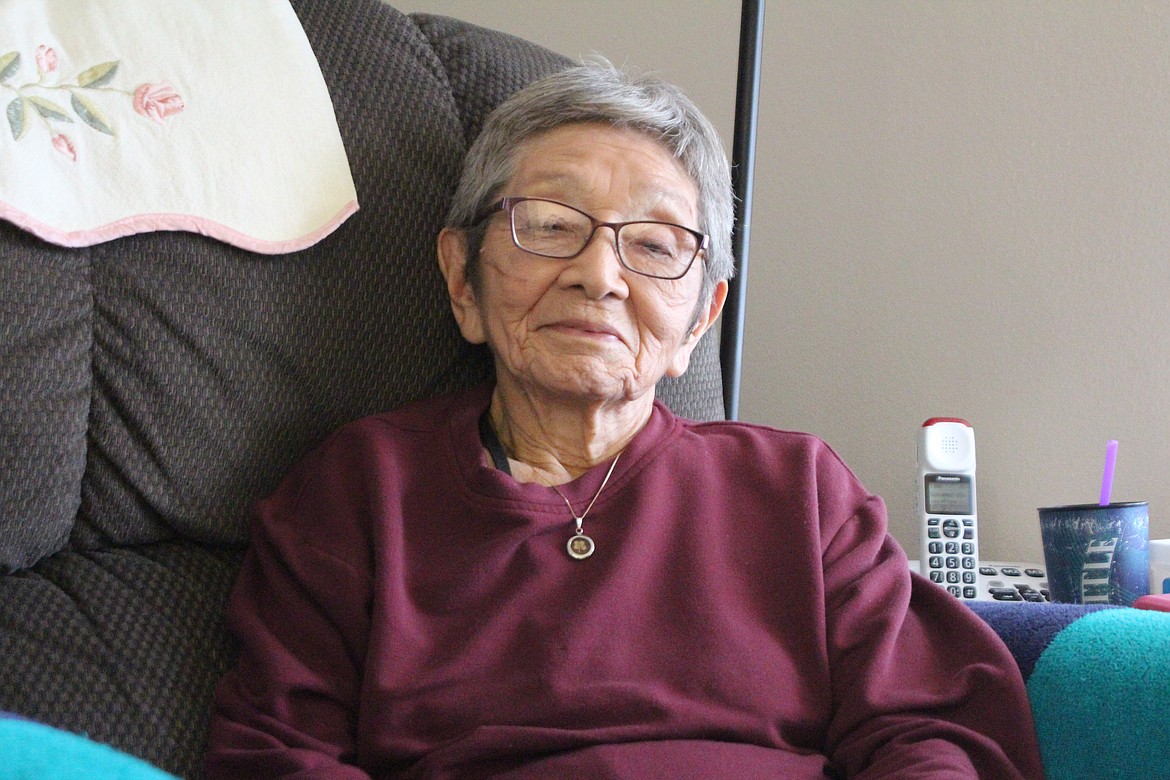
Lillian Tokunaga has seen a century of change. Her life story includes time spent in Japan as a young woman, farming in Washington and enjoying time withy her late husband and children.
CHERYL SCHWEIZER/COLUMBIA BASIN HERALD
Senior Reporter Cheryl Schweizer is a journalist with more than 30 years of experience serving small communities in the Pacific Northwest. She began her post-high-school education at Treasure Valley Community College and enerned her journalism degree at Oregon State University. After working for multiple publications, she has settled down at the Columbia Basin Herald and has been a staple of the newsroom for more than a decade. Schweizer’s dedication to her communities and profession has earned her the nickname “The Baroness of Bylines.” She covers a variety of beats including health, business and various municipalities. | May 1, 2024 2:30 AM
MOSES LAKE — Lillian Tokunaga was born in 1924, into a much different world.
Tokunaga turned 100 last week, and has lived in Moses Lake for 76 years. (She’s always liked Moses Lake, she said.) But before moving to Moses Lake her life took her halfway around the world, into some very challenging places.
Tokunaga spent part of her childhood in Seattle in a family that followed the Japanese traditions of the time.
“My father came over from Japan when he was probably in his late 20s,” she said. “Then he married my mom — she was a picture bride.”
It was a custom for men from a lot of different countries, guys living far away from the place they had grown up, to pick a wife from their old neighborhood with the help of a picture. Tokunaga’s parents were from southern Japan, from one area around a medium-sized city named Hiroshima.
Tokunaga’s parents had never met in person before the wedding. They raised their family in Seattle.
“I was the oldest,” she said. “We had five girls.”
As was traditional, the children learned about the Japan their parents knew.
“When I was in Seattle, after my regular school, they had a Japanese school that I went to,” she said. “At home, my parents didn’t speak English too well, so we spoke in Japanese all the time. So I knew a little about speaking Japanese.”
There was another tradition among Japanese who had moved abroad, and her mom and dad decided to follow it, even in a family of girls. Lillian was to be sent back to Japan to learn about the country, its way of life and how it worked.
“It was the Japanese custom at the time. If there’s a boy, they sent a boy but we didn’t have any boys. So they sent me (because) I was the oldest,” she said.
It was 1939, and Japan was in trouble. A war with China was bleeding the nation dry but the military refused to stop. Tension with other nations around the world. In a memoir written for Monroe House, where she now lives, Tokunaga wrote it was a tough time.
“I kept reminding myself that it was going to be a great adventure,” she wrote, “but the thought of leaving my sisters and parents and going to a foreign land was overwhelming.”
Her grandparents accompanied her to Japan, back to the area where her parents had grown up. The better place for education, however, was high school in Hiroshima.
“They spoke all in Japanese, but they had an English class we took every day. Of course, I spoke English, so I kind of helped the teacher,” she said.
Her grandparents stayed until they thought she was doing okay, she said, and then returned to Seattle. It was 1940. She was still in Japan in December 1941, when the attack on Pearl Harbor catapulted the U.S. into World War II. With war declared she couldn’t get back home.
“Because of the International Red Cross, I was thankfully able to stay in touch with my parents. The letters were few and far between and I treasured each one,” she wrote.
She graduated from high school and then went to work.
“It was hard. I cried all the time,” she said.
Hiroshima was the target of the first atomic bomb, but by that time Tokunaga had been sent away from the city.
“I was away working in an airplane factory,” she said.
Once the war ended she found work with the occupation authorities as a translator, she said, then as a nanny for the family of an American Air Force officer. It took a while for the authorities to sort it all out, but she went home in 1947.
“I came back on a battleship,” she said.
Within a year after her return, she met a young man named Harold Tokunaga.
“I met him at church,” she said. “He was a farmer.”
Irrigation water was arriving in the Columbia Basin, and Harold Tokunaga had plans. He had land in Mae Valley, sagebrush fields at the time, and a house without running water. But with a lot of hard work by the family, it became a farm.
“We grew sugar beets, potatoes, onion, wheat and cattle,” Tokunaga said.
Harold and Lillian Tokunaga had two sons and a daughter. Their son Larry was killed in an accident on the farm during his senior year in high school. Their son, Ron, lives in Wenatchee, and daughter Gail Pinkerton lives in Moses Lake.
Harold Tokunaga passed on in 1987.
Moses Lake was a small town when she moved here, one or two grocery stores and not much else, but she’s glad she’s here because it’s a nice town, she said.
“Everyone is so friendly,” she said.
Cheryl Schweizer may be reached at [email protected]. Cheryl brings decades of experience in reporting to the Columbia Basin Herald and has been with the paper for more than a decade.
ARTICLES BY CHERYL SCHWEIZER
Road projects on hold for Labor Day weekend
MOSES LAKE — With Labor Day weekend dead ahead, drivers will be able to move freely about the state. Most road projects are on hold for the holiday weekend. Nobody will be working on the Hansen Road overpass on Interstate 90, but the lane restrictions that are in effect will continue through the end of the project.

Cost estimates for water source alternatives given to Moses Lake City Council
Protected under the U.S. Endangered Species Act, efforts are ongoing to keep it self-sufficient
MOSES LAKE — It’s going to cost a lot of money to provide alternative water sources for the city of Moses Lake, but some of the possible alternatives will cost more than others. City officials provided the Moses Lake City Council with costs for various alternatives Tuesday.

Dryer vent cleaning is important -- but often overlooked
MOSES LAKE — Not all the maintenance a house needs is visible. Sometimes a potential problem just goes unnoticed until it causes trouble, sometimes serious trouble. But a lot of potential problems give off warning signs. Clothes dryers often do when they need a good cleaning.