
Three honored by Moses Lake Ag Hall of Fame
JOEL MARTIN | Hagadone News Network | UPDATED 1 year, 11 months AGO

Moses Lake farmer Charles Schwab, with his wife Dee at his side and surrounded by family, is inducted into the Moses Lake Agricultural Hall of Fame Oct. 15. At the far left is outgoing Moses Lake Chamber of Commerce Board Chair Jason Avila, and Chamber President and CEO Debbie Doran-Martinez is at the right.
JOEL MARTIN/ BASIN BUSINESS JOURNAL
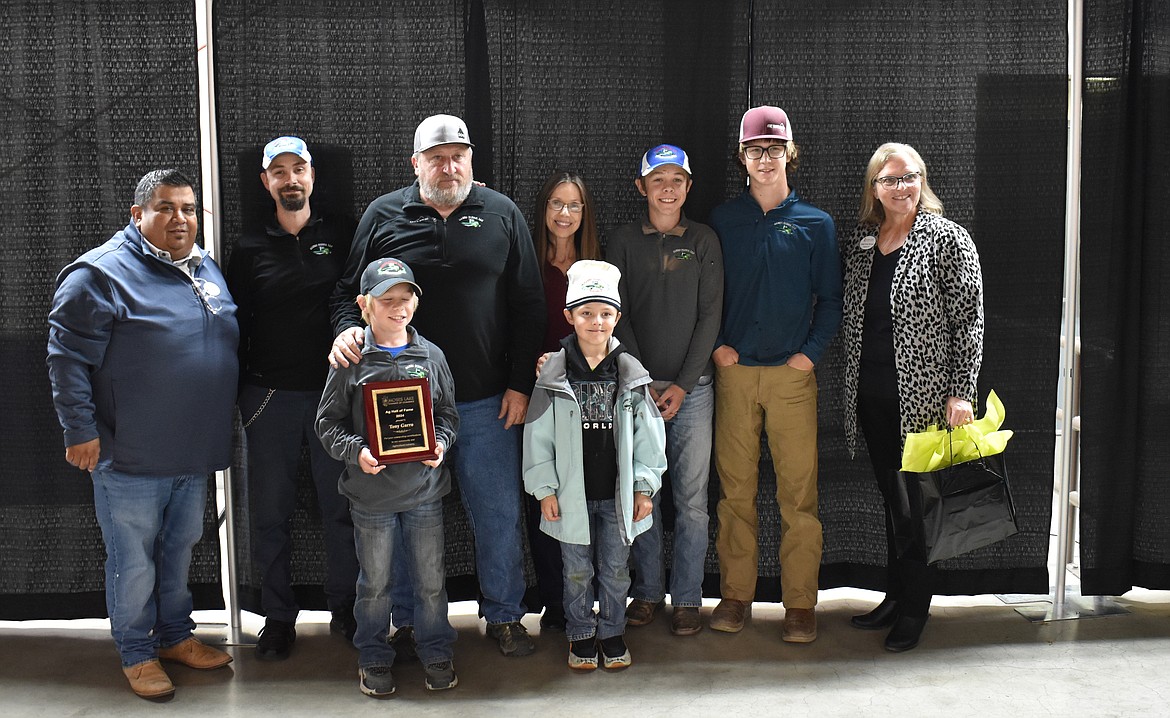
Moses Lake farmer Tony Garro, third from left, was honored Oct. 15 as a member of the Moses Lake Agriculture Hall of Fame. Surrounding Garro are his famikly and Moses Lake Chamber of Commerce Board Chair Jason Avila, far left Chamber President and CEO Debbie Doran-Martinez, far right.
JOEL MARTIN/ BASIN BUSINESS JOURNAL
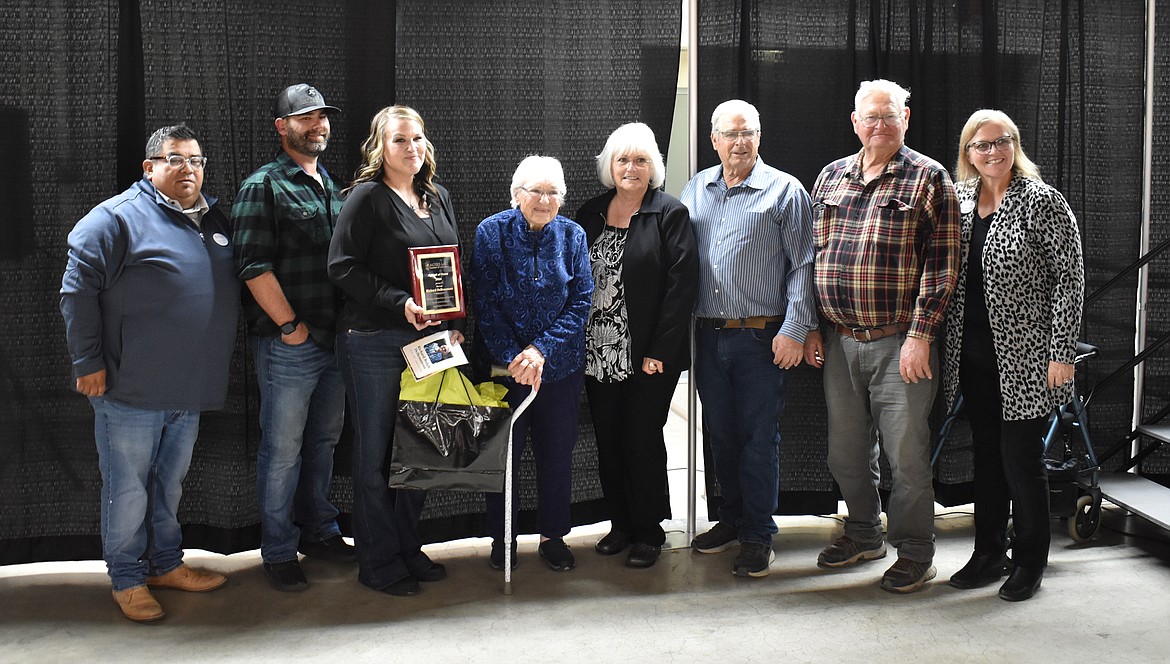
Tara DeBeaumont Zerbo presents her grandmother Mary Eccles DeBeaumont with her late grandfather Richard DeBeaumont’s plaque honoring him as a member of the Moses Lake Agriculture Hall of Fame, flanked by family members and Moses Lake Chamber of Commerce Board Chair Jason Avila, far left Chamber President and CEO Debbie Doran-Martinez, far right.
JOEL MARTIN/ BASIN BUSINESS JOURNAL
Joel Martin has been with the Columbia Basin Herald for more than 25 years in a variety of roles and is the most-tenured employee in the building. Martin is a married father of eight and enjoys spending time with his children and his wife, Christina. He is passionate about the paper’s mission of informing the people of the Columbia Basin because he knows it is important to record the history of the communities the publication serves. | November 7, 2024 1:00 AM
MOSES LAKE — Three local farmers were inducted, one posthumously, into the Moses Lake Agriculture Hall of Fame earlier this month.
The Hall of Fame, a function of the Moses Lake Chamber of Commerce, was started in 2010 to recognize and honor distinguished individuals who have made significant contributions to the agricultural industry, according to chamber President and CEO Debbie Doran-Martinez. The honorees were announced and their awards presented at the chamber’s annual meeting and banquet Oct. 15.
“Candidates are recognized by their peers for not only their dedication, generosity and selflessness, but also their demonstrated achievements, noteworthy expertise and creative innovations that often provide a legacy of impactful results and lasting benefit to the overall enhancement of local agricultural industry and community at large,” Doran-Martinez said. “Farmers, growers, ranchers and owners and employees of agribusiness firms are all eligible for nomination as either individuals or as families.”
Each honoree was given a testimonial from the person who nominated them.
Charles Schwab
“Most people have one great mentor in their life,” said Mike Counsell. “I was fortunate to have two great men in my life to learn from. Last year, I got the privilege to tell you about my father, George Counsell, as he was inducted to the chamber’s Hall of Fame This year, I’d like to tell you about my dad’s partner in farming for 42 years, my uncle Charles Schwab.”
Schwab came from Scottsbluff, Nebraska with his father Alex in 1955 when the Columbia Basin Project brought irrigation to the Moses Lake area,” Counsell said.
“Alex ... heard that the water had come to the Basin and heard the Basin didn’t have any hail,” Counsell said. “His crops had been damaged five out of the last six years he farmed in Scottsbluff.”
The Schwabs settled on 150 acres east of Moses Lake.
Charles graduated from Moses Lake High School and after a four-year hitch in the army, he returned to the family farm. There he met Dee, his wife of 58 years.
“Charlie likes to say he chased her until she caught him,” Counsell said.
Charles and Dee raised four children on the farm, where he and his son Scott still farm today.
“Charlie is out there every single day,” Counsell said. “And I don’t mean out there driving around in a pickup watching Scott work. Charlie is on a shovel (or) on the end of a ladder working on a circle, which he probably shouldn’t be, but he’s out there. He’s an inspiration.”
Schwab could have retired long ago, Counsell said, but he loves farming too much. He’s raised sugar beets, wheat, tea seed, coriander, beans, sweet corn, carrot seed, evening primrose and potatoes.
“(His daughter) Kim asked Charlie a few years ago what the best changes in agriculture in the last 67 years of farming have been,” Counsell said. “Charlie was quick to answer: circle irrigation. Charlie has walked thousands of miles up and down a ditch, changing tubes, before we had circles. Second, he said, was closed-cab tractors with GPS. Sometimes with the GPS, it’s hard not to fall asleep. When you do, you just go home and take a nap.
“We truly owe this generation a huge thank you for paving a way for us younger farmers,” Counsell concluded. “Guys like Charlie and my dad, and their hard work and determination, have allowed me and my cousin Scott to be successful in agriculture today.”
Richard DeBeaumont
The second honoree was Richard DeBeaumont, who passed away in August. His granddaughter Tara DeBeaumont Zerbo presented the award to her grandmother, Mary Eccles DeBeaumont.
Richard DeBeaumont was born in Lewiston, Idaho in 1929, Zerbo said. His father, Ralph, was a sales manager for the Pacific Power Company.
“He (taught) women how to use electric stoves, a new innovation, as well as washing machines and refrigerators,” Zerbo said of Ralph.
Richard DeBeaumont attended school in Walla Walla, and was active in Boys Scouts, achieving the rank of Eagle Scout. He showed a good work ethic early on, Zerbo said, mowing lawns, delivering groceries on his bicycle and driving a wheat truck for the pea harvest.
In 1950 DeBeaumont married Mary Eccles, his high school sweetheart. The two were married for 73 years until his passing. He earned a degree in business administration from Washington State University, but instead of pursuing a business career he accepted a job on his father-in-law Ivan Eccles’ dryland wheat farm on the Touchet River. There he also learned to ride horseback and herd cattle. He started a small but prosperous feedlot during that time and with Ivan’s help, started another south of Moses Lake.
“They made the move … with Mary in the car with kids and Richard in the truck hauling 10 cows at a time, 10 trips total, to being 100 cows from Walla Walla to their forever home in Moses Lake,” she said. “Richard’s plan was to have a combined cow-calf feedlot operation with the cattle to clean up the fields after harvest. Several people scoffed at the idea and said it wouldn’t work, but with hard work and perseverance, he succeeded.”
DeBeaumont also raised peas, wheat, sugar and potatoes, Zerbo said. He thrived on innovation, buying the first irrigation circle in the area and pioneering in the field of artificial cattle insemination. His 320-acre farm grew to 1,200 acres, which his three sons farm today.
Mary Eccles DeBeaumont accepted the award on her husband’s behalf, with their children and grandchildren gathered around her.
Tony Garro
The third inductee, Tony Garro, was introduced by his friend Joe Ketterer.
“Tony recalled laboring from a very young age when his father transitioned from irrigation work to welding,” Ketterer said. “Even at the age of 8, he stabbed pipes together and contributed by killing rattlesnakes as the environment required. At the age of 10, he was running a boom crane, which was right around the time his family moved to Moses Lake with the anticipation of working with irrigation”
When Tony was 12, he was working for his father’s welding business.
“An occupation that Tony was already making up his mind that he wanted to do anything but,” Ketterer said.
During that time Garro was also working for farmers in the McConihe Flats area, Ketterer said, picking up rocks, baling and getting a feel for the work. At the age of 16, Garro bought his first cattle and soon started his own farm. In 1997 he married Lori Renick in Moses Lake.
Garro battled medical problems and financial difficulties in his early years of farming, Ketterer said, and when his father died in 1995, his workable land dwindled to a quarter its previous size as partners and landowners pulled out of deals they had made with the elder Garro.
A few clients maintained their contracts and some rented him more land to help him rebuild Garro Farms, Ketter said. Millions of dollars in debt with more land to work, Garro began farming alfalfa in the Frenchman Hills area, and his farm has grown ever since.
“(Garro) maintains to this day that the Pacific Northwest is the best farming area in the entire world, and he believes farmers from other states move here to work land for that very reason,” Ketterer said. “… Money has never meant much to him, and he’s always very protective and proud of the things he’s built and keeping them nice. To Tony, even if it’s hillbilly, if you build something, that’s important.
“Tony Garro is changing the world by making one friend at a time and drinking one drive-thru coffee at a time,” Ketterer concluded. “He’s usually doing it while wearing a hoodie and a smile.”
Nominations are now open for the 2025 Agriculture Hall of Fame, Doran-Martinez said after the ceremony, and can and can be submitted at the chamber’s website, www.moseslake.com.
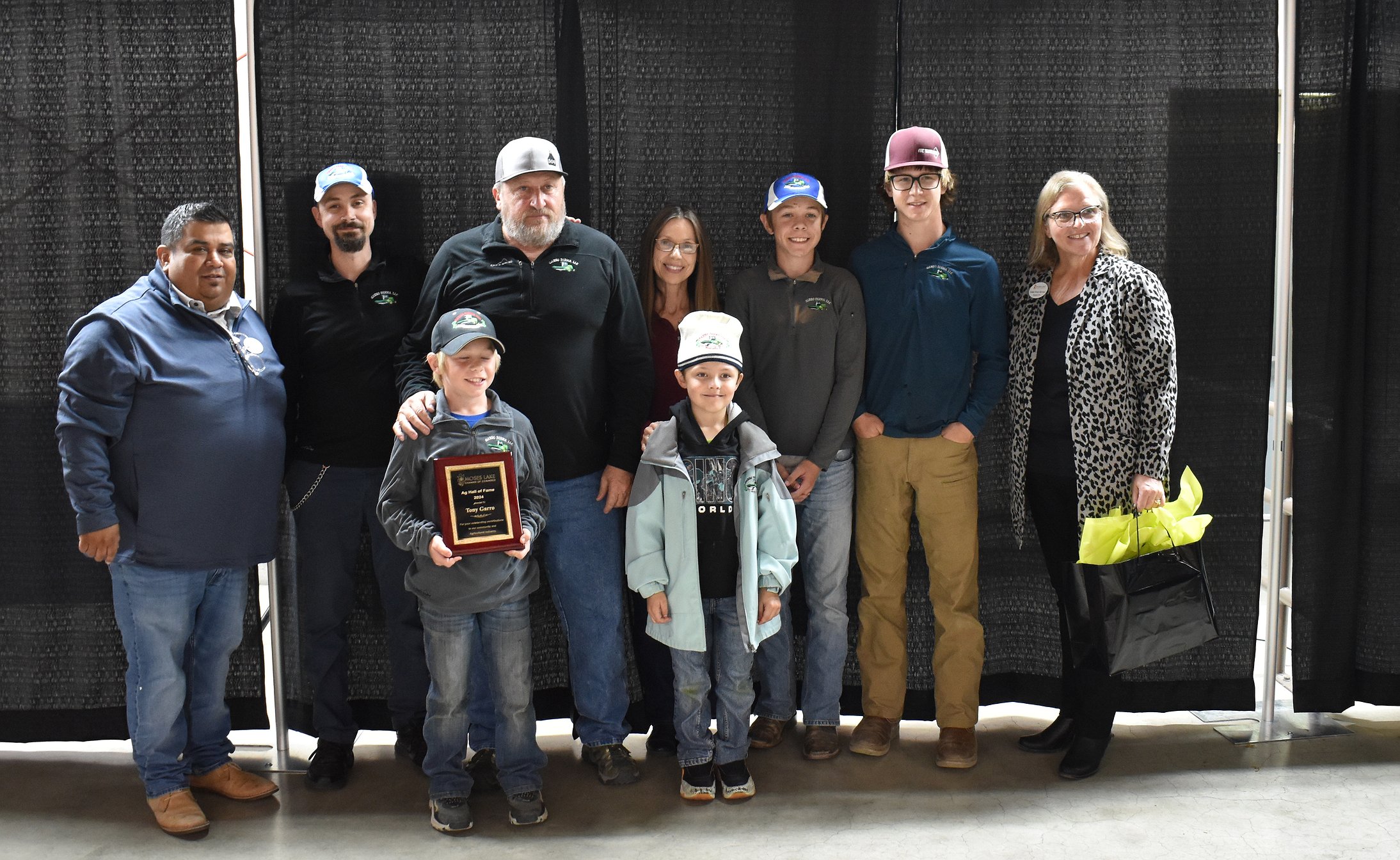 Moses Lake farmer Tony Garro, third from left, was honored Oct. 15 as a member of the Moses Lake Agriculture Hall of Fame. Surrounding Garro are his famikly and Moses Lake Chamber of Commerce Board Chair Jason Avila, far left Chamber President and CEO Debbie Doran-Martinez, far right.
JOEL MARTIN/ BASIN BUSINESS JOURNAL
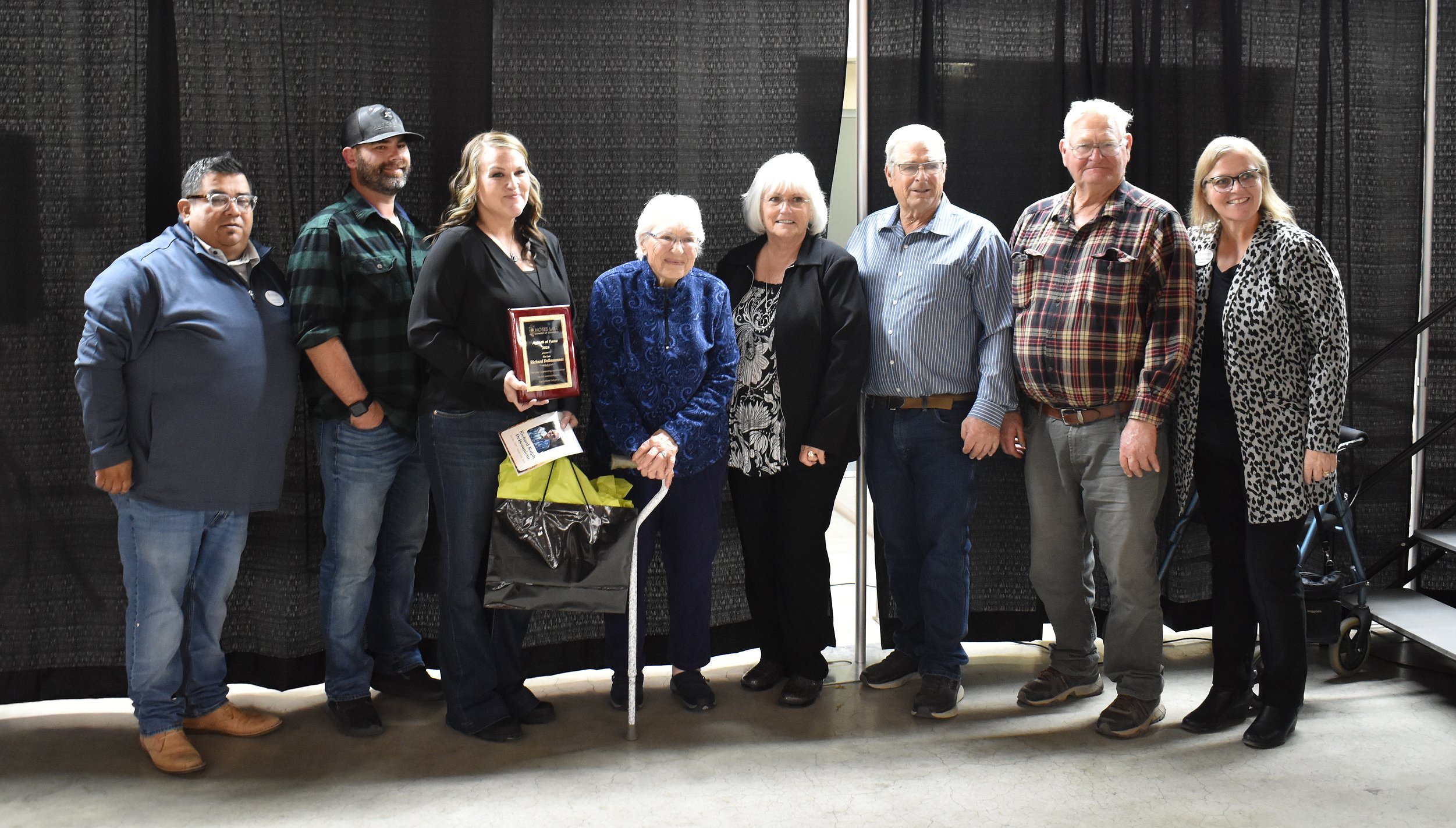 Tara DeBeaumont Zerbo presents her grandmother Mary Eccles DeBeaumont with her late grandfather Richard DeBeaumont’s plaque honoring him as a member of the Moses Lake Agriculture Hall of Fame, flanked by family members and Moses Lake Chamber of Commerce Board Chair Jason Avila, far left Chamber President and CEO Debbie Doran-Martinez, far right.
JOEL MARTIN/ BASIN BUSINESS JOURNAL
ARTICLES BY JOEL MARTIN

Endless battle
Noxious Weed Control Board works to keep invasive plants under control
MOSES LAKE — Some of the nastiest plants in Grant County were the topic of a class led by Jay Johnson, a consultant with the Grant County Noxious Weed Control Board, Tuesday. The Noxious Weed Control Board, as its name would suggest, is tasked with keeping weeds under control in Grant County. That’s not a small job; the board’s website lists 129 species of noxious weeds that are found around Grant County. A noxious weed is defined as an invasive, non-native plant that threatens agricultural crops, local ecosystems or fish and wildlife habitat, according to the Noxious Weed Control Board. Washington state law requires that these weeds be identified and their spread kept to a minimum, if not completely eradicated. “We’re one of those agencies a lot of people don’t really understand,” Johnson said. “We’re a county office and … our funding is tax-based assessment. When you get your tax bill and you look down at all the expenses that you pay for, there we are.”

BASIN EVENTS: Oct. 16-24
COLUMBIA BASIN — Whether you feel like shopping, crafting, learning or seeing a show, there’s something happening for you this week in the Basin. Oct. 16 ‘My Family (Mi Familia)’ screening Spanning three generations, “My Family (Mi Familia)” is a heartfelt drama that follows the Sánchez family as they build their lives in East Los Angeles. Through love, hardship, triumph, and sacrifice, the film explores the immigrant experience, the strength of family bonds, and the traditions that connect one generation to the next. Lowrider show and taco truck before the screening. Sponsored by Columbia Basin Allied Arts, EDUBS C/S and the Moses Lake Creative District. $12 per person. Doors open at 6 p.m., film begins at 7 p.m. at the Moses Lake Civic Center Auditorium, 401 S. Balsam St. Tickets and info: www.cba-arts.org.

Moses Lake author encourages women to look beyond church culture norms
MOSES LAKE — A Moses Lake author’s book, “A Christian Woman Striving to Live Her Faith in a Man-Controlled World,” takes aim at the role to which many churches relegate the female half of their congregations. “It’s to encourage women in the faith,” Linda Curran said. “A lot of churches say, ‘Teach Sunday school, do this, do that, but don’t (evangelize.)’" In her book, Curran recounts a time when she moved to a new community and joined a church there. She was surprised to learn that, as a new female member, she had been automatically assigned church cleaning duties. When she questioned it, she wrote, she was met with condescension and her objections were brushed aside. In other churches, she said, women who were capable of teaching were relegated to “women’s ministry.”