
A family of service
JOEL MARTIN | Hagadone News Network | UPDATED 1 year, 11 months AGO
Joel Martin has been with the Columbia Basin Herald for more than 25 years in a variety of roles and is the most-tenured employee in the building. Martin is a married father of eight and enjoys spending time with his children and his wife, Christina. He is passionate about the paper’s mission of informing the people of the Columbia Basin because he knows it is important to record the history of the communities the publication serves. | November 11, 2024 1:20 AM
MOSES LAKE — Dietrich and Emma Thiesfeld’s 14 children could just about constitute an army in themselves.
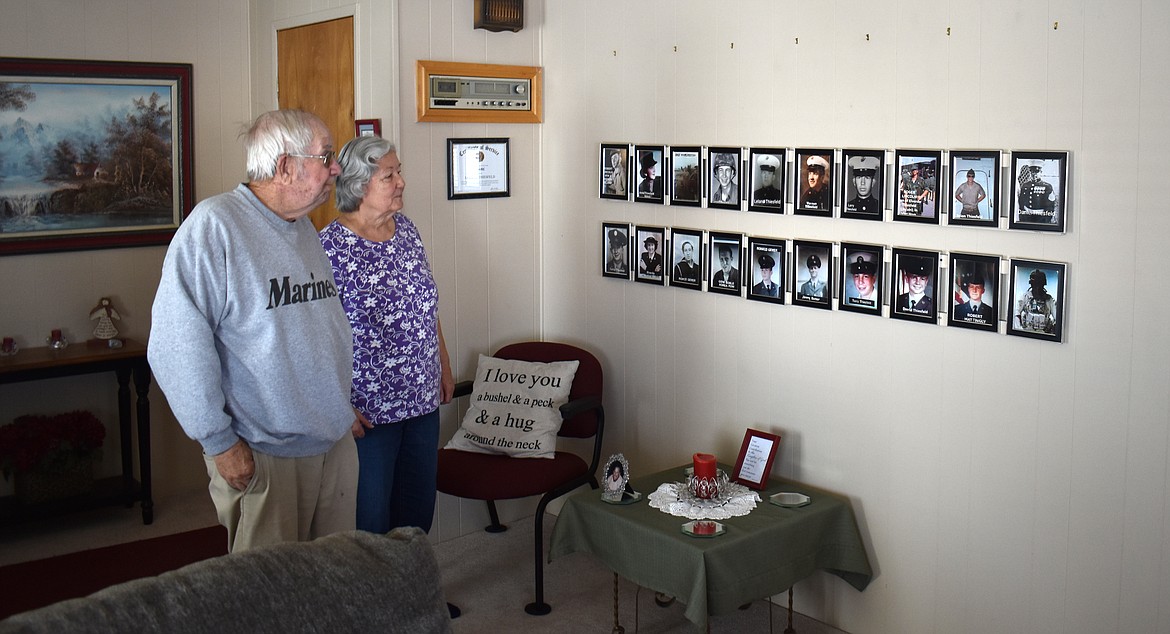
“Seven of them are or were veterans, and the other seven married veterans,” said Leland “Lee” Thiesfeld, 84 and the 10th of those children, who served in the Marine Corps in the early 1960s.
Lee and his wife Charlene live in Moses Lake, where they raised their four children, one of whom followed his father into the USMC.
Some of those overlap, like Lee’s oldest sister Elverda, who both served in the Navy and married a Marine, he said. Between the siblings and their children, the Thiesfeld family tree holds 24 military vets.
Ironically, their father Dietrich never served, Lee said.
“In the First World War, he got an exemption for farming,” he said. “He had to help on the farm. In those days, 60%, 70% of the population was farmers. Nowadays it isn’t even 10%.”
(In fact, farm and ranch families comprise less than 2% of the U.S. population, according to the American Farm Bureau.)
The Thiesfelds migrated from Minnesota to Washington in the 1940s, Lee said. Dietrich worked at the Hanford nuclear plant during World War II, and the family lived in the Yakima Valley, moving on to the Quincy area when the water came.
“There was a guy … who had several sections of land out here that was being broken out of sagebrush for irrigation,” Lee said. “He hired my dad, and we moved out on a place that was about half-done. My dad was a farmer and a carpenter, so we moved out there and started farming, picking rocks, cutting sagebrush.”
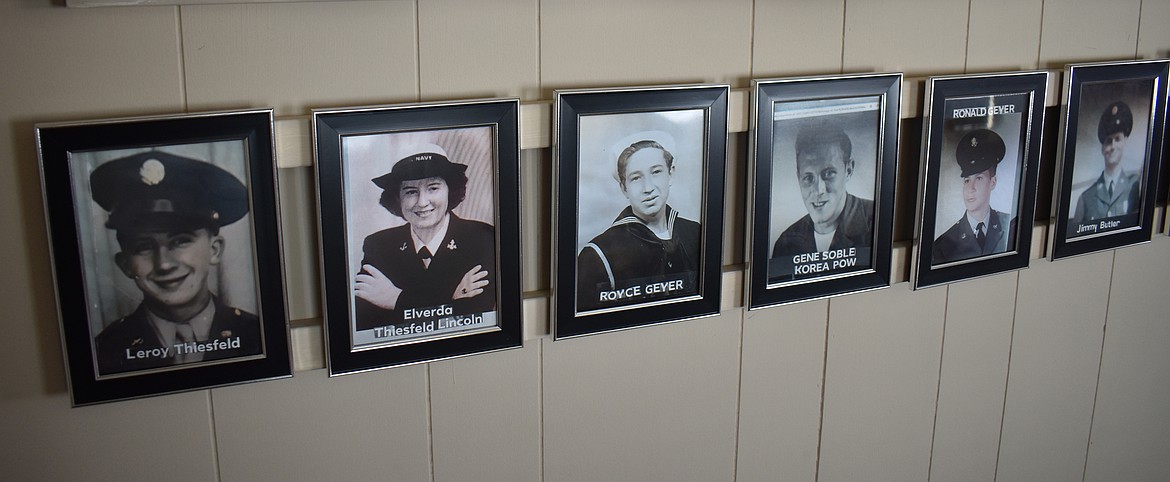
The first to leave the farm was Elverda. About six months after the attack at Pearl Harbor, President Franklin D. Roosevelt created a women’s reserve for the U.S. Navy called Women Accepted for Volunteer Emergency Service, or WAVES. Elverda saw a recruitment poster at the post office and decided to join up, according to Alaska State Sen. Dan Sullivan, who honored Elverda at the state senate last year on her 100th birthday.
“She aided in modifying, updating and correcting naval communications manuals,” Sullivan said. “She helped to code a great deal of radio signals and manuals that were used in battles like the Battle of Iwo Jima and were also used in the invasion of the Aleutian Islands by Japan.”
After the war, Elverda married Bob Lincoln, a Marine, and the two homesteaded in Alaska. She passed away in January.
Because the family was so large, Lee said, he wasn’t as close to his oldest siblings as to the later ones. He, his older brother Glenn and his younger brother Vernon were all close in age.
“They were known as the Three Musketeers,” Charlene said. “Once one was in trouble, they all were.”
All three joined the Marine Corps, Lee said. He served from 1960 to 1964.
“I was in Okinawa, Hong Kong, Japan, the Philippines – I spent over a year there. That was prior to the Vietnam War.” Lee said. “My brother, Vernon, he came over there before I left. We were on what they call a floating battalion in the (Gulf of Thailand), off of Vietnam, because there were tensions there. When we got relieved, it was him with the 9th Marine (Regiment) that relieved us. (That) was the first regular unit to go into Vietnam.”
The Marine Corps figures prominently in the Thiesfeld family’s history. One prominent Marine was Ron Delabarre, who was married to Lee’s older sister Bernice and passed away in 2015, according to his obituary.
“He had joined when he was 17, and by the time he made staff sergeant, he was the youngest staff sergeant in the Marine Corps,” Lee said. “Then he made gunnery sergeant, and then he got a commission and retired a major. A mustang, they called him.”
Only one of Lee’s brothers didn’t serve; he was turned down due to bad eyesight and flat feet. But that brother had four sons, all of whom served in the Army, Lee added.
All of the veterans in the family came back alive and mostly well, Lee said, but Gene Soble, who was married to Lee’s sister Anne and who also was Charlene’s uncle, was captured in December 1951 in Korea and spent 33 months as a prisoner of war.
“The first switch they made in the prisoner (exchange), he was in that,” Lee said.
“I grew up right by (Gene and Anne), long before I ever met (Lee),” Charlene said. “I remember Gene’s legs were permanently bruised.”
“He was captured when he was 17, and when he was released after three years, he couldn’t even go in the bar (to celebrate),” Lee said. “He never would eat fish and rice again.”
Lee and Charlene’s son Daniel also served seven years in the Marine Corps, they said, as did many of their nephews.
“I wouldn’t do it again for nobody,” he said. “But it was a great experience. You get to travel, learn to get along with other people and take care of yourself. I would recommend that when (young people) are ready to go from the nest. Go into the service, and then you feel good about yourself and you think you can do it all.”
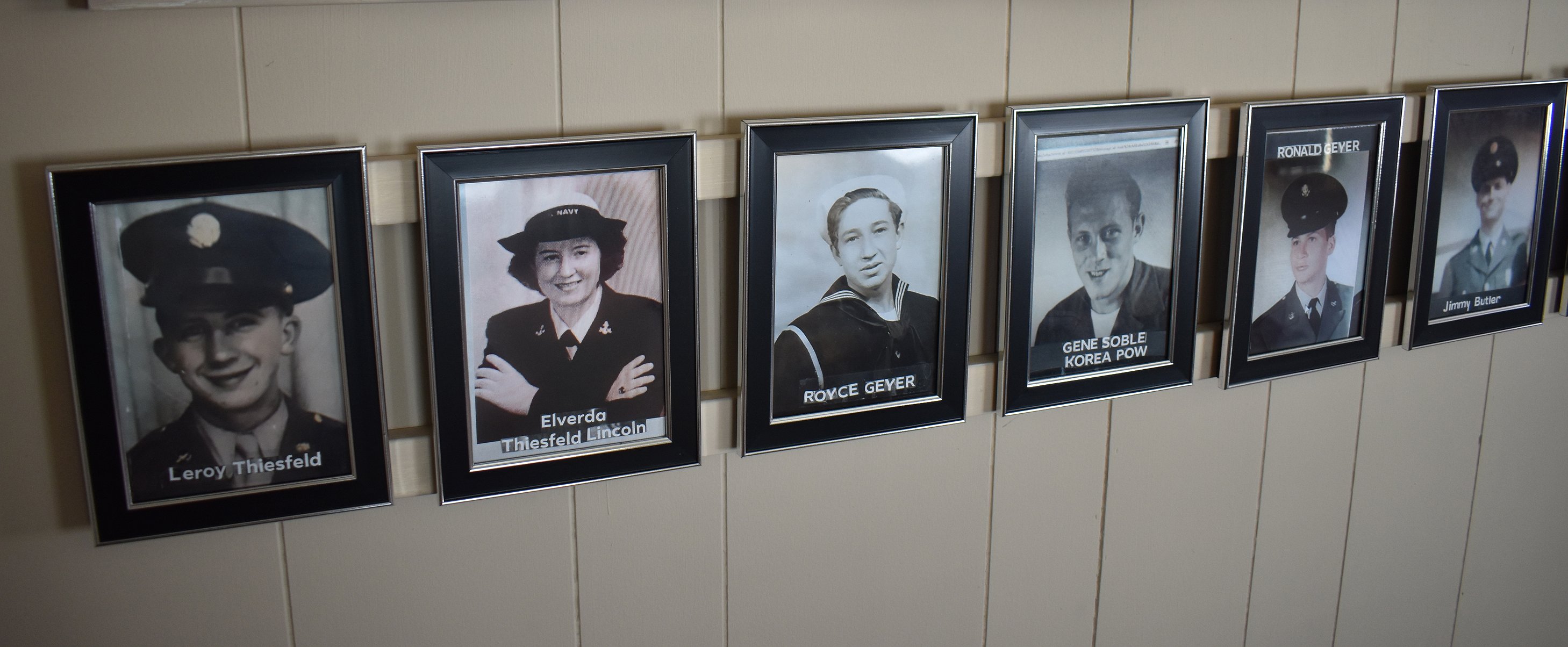 The Thiesfeld family legacy of service began in World War II and continues to the present generation.
ARTICLES BY JOEL MARTIN

Endless battle
Noxious Weed Control Board works to keep invasive plants under control
MOSES LAKE — Some of the nastiest plants in Grant County were the topic of a class led by Jay Johnson, a consultant with the Grant County Noxious Weed Control Board, Tuesday. The Noxious Weed Control Board, as its name would suggest, is tasked with keeping weeds under control in Grant County. That’s not a small job; the board’s website lists 129 species of noxious weeds that are found around Grant County. A noxious weed is defined as an invasive, non-native plant that threatens agricultural crops, local ecosystems or fish and wildlife habitat, according to the Noxious Weed Control Board. Washington state law requires that these weeds be identified and their spread kept to a minimum, if not completely eradicated. “We’re one of those agencies a lot of people don’t really understand,” Johnson said. “We’re a county office and … our funding is tax-based assessment. When you get your tax bill and you look down at all the expenses that you pay for, there we are.”

BASIN EVENTS: Oct. 16-24
COLUMBIA BASIN — Whether you feel like shopping, crafting, learning or seeing a show, there’s something happening for you this week in the Basin. Oct. 16 ‘My Family (Mi Familia)’ screening Spanning three generations, “My Family (Mi Familia)” is a heartfelt drama that follows the Sánchez family as they build their lives in East Los Angeles. Through love, hardship, triumph, and sacrifice, the film explores the immigrant experience, the strength of family bonds, and the traditions that connect one generation to the next. Lowrider show and taco truck before the screening. Sponsored by Columbia Basin Allied Arts, EDUBS C/S and the Moses Lake Creative District. $12 per person. Doors open at 6 p.m., film begins at 7 p.m. at the Moses Lake Civic Center Auditorium, 401 S. Balsam St. Tickets and info: www.cba-arts.org.

Moses Lake author encourages women to look beyond church culture norms
MOSES LAKE — A Moses Lake author’s book, “A Christian Woman Striving to Live Her Faith in a Man-Controlled World,” takes aim at the role to which many churches relegate the female half of their congregations. “It’s to encourage women in the faith,” Linda Curran said. “A lot of churches say, ‘Teach Sunday school, do this, do that, but don’t (evangelize.)’" In her book, Curran recounts a time when she moved to a new community and joined a church there. She was surprised to learn that, as a new female member, she had been automatically assigned church cleaning duties. When she questioned it, she wrote, she was met with condescension and her objections were brushed aside. In other churches, she said, women who were capable of teaching were relegated to “women’s ministry.”