
EPA grant funds program to monitor pesticides in water
KRISTI NIEMEYER | Hagadone News Network | UPDATED 2 years, 1 month AGO
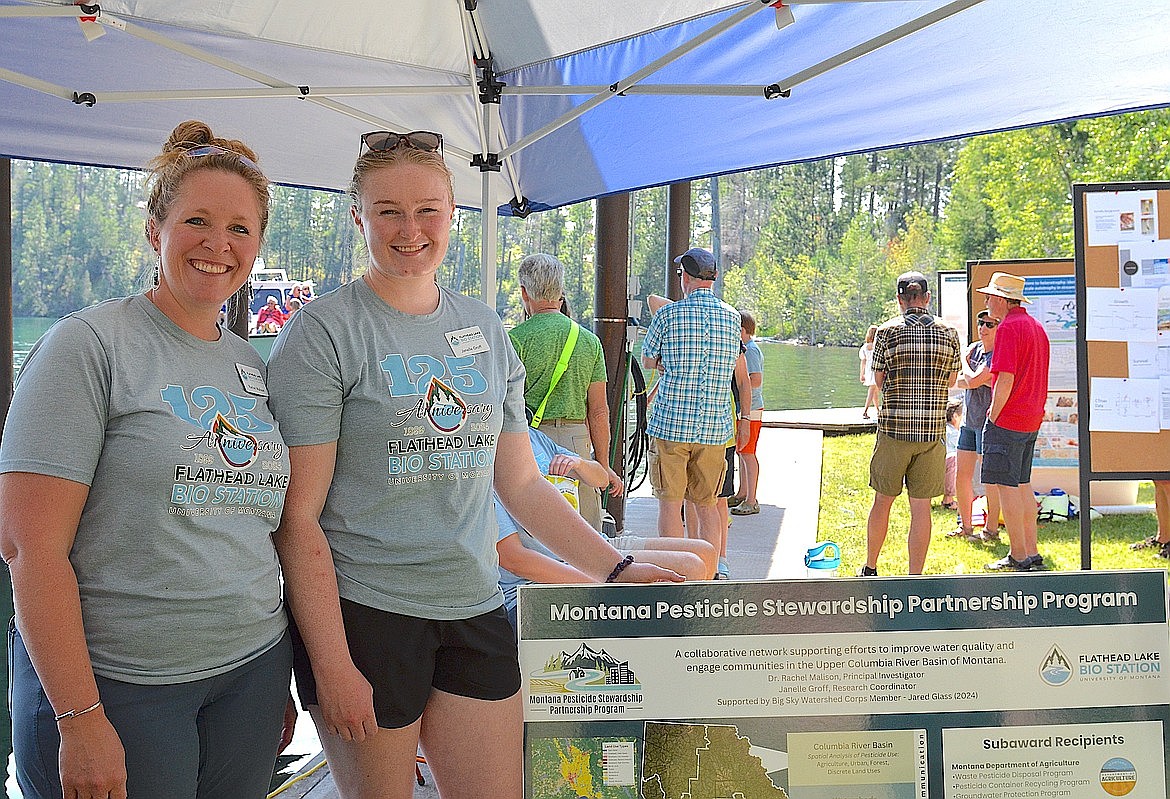
Rachel Malison, assistant research professor at Flathead Lake Biological Station, and her research assistant Janelle Groff are hard at work on a pesticide exposure project funded by a grant from the Environmental Protection Agency. (Kristi Niemeyer/Leader)
Kristi Niemeyer learned her newspaper licks at weekly newspapers, beginning at the Mission Valley News in 1981, then at the helm of the Ronan Pioneer and, eventually, as co-editor of the Lake County Leader until 1993. She launched and co-published Lively Times, a statewide arts and entertainment monthly, before returning to the Leader in 2022, and serving as its editor until July 2026. Reach her at [email protected] | September 4, 2024 12:00 AM
Pesticides and herbicides are readily available and widely used by everyone from homeowners to the ag industry to municipalities. They keep golf courses green and help knock back invasions of knapweed – Montana’s “other” state flower.
But what’s the impact of these chemicals on our water? Rachel Malison, an assistant research professor at the Flathead Lake Biological Station, has received a $6.6 million grant from the Environmental Protection Agency to help answer that question.
She, along with research coordinator Janelle Groff, are nine months into the five-year grant and have started to build the framework for the Pesticide Stewardship Partnership Program, which is funded through the EPA’s Columbia River Basin Toxics Reductions program.
They’ve recruited project partners, including the Confederated Salish and Kootenai Tribes and the Kootenai Tribe of Idaho, the Montana Department of Agriculture and the Department of Environmental Quality, Montana State University Extension, and the Montana Watershed Coordination Council.
Currently, “We have almost no data of what's in our water” in terms of pesticide residue, says Malison.
“We know pesticides are widespread – they're widely used from individuals to municipalities. If you walk into Lowe's or Home Depot you see three rows of all the different types of chemicals you can readily buy and apply without reading the label,” she said.
While the label is the law, people often don’t follow those instructions. “So there's overuse and misuse of pesticides very commonly.”
She hopes the Pesticide Stewardship Partnership Program can help users and communities in the western part of the state, the headwaters of the Columbia River basin, learn more about use and abuse of pesticides.
The PSPP will award “seven big sub-awards to fund action on the landscape.” An example, she says, was a grant to the City of Missoula to create green infrastructure at a city park.
In addition to building a network, Malison’s team is also creating a website to help disperse information and developing a monitoring system for pesticides, which doesn’t currently exist in Montana.
Malison is also the founder of the Bio Station’s Monitoring Montana Waters program, which provides scientific, technical and financial support to citizen-science watershed groups in Montana. Although she’s well-versed in the intricacies of monitoring water quality, she says testing water for pesticide residue is both expensive – around $1,200 for just one water sample – and complicated.
“It’s analytically very difficult because there's so many different types of pesticides that are going to be looked for,” Malison said.
A monitoring system that targets pesticides will help establish baseline data and enable the project team to figure out whether the changes they implement are affecting the outcome. Malison added that Washington and Oregon are well-ahead of Montana and Idaho in monitoring water for pesticides and says both states are providing useful information.
She also noted that tribal communities, including CSKT and the Kootenai Tribe of Idaho, are interested in the potential impacts of pesticides on human health.
“So they'll be doing fish tissue sampling to help us try and understand if pesticides are possibly being consumed,” she said.
Malison has made a presentation to the Cherry Growers Association and noted that some members “are already doing really good practices to try and limit the use of pesticides.”
“I always try to make it very clear we're not out to get agriculture,” she added, noting that urban communities are often bigger polluters than ag users. “We don't argue that pesticides will go away or should completely go away.”
Instead of adding new regulations, the PSPP aims to bring users and impacted communities to the table to explore “what can we do together, how can we have best practices.”
For more information, contact Malison at [email protected] or head to flbs.umt.edu/newflbs/monitoring/mt-pspp/montana-pesticide-stewardship-partnership-program/.
ARTICLES BY KRISTI NIEMEYER

Polson Farmers Market takes break after productive season
“My body’s ready for a break, but it’s been a good year,” said Eric Gedenk between sales at the Ploughshare Farm stand. The organic farm in Moiese is a regular vendor at the Polson Farmers Market, which wrapped up for the season last Friday morning.

The Ripple Effect: Poolside party raises more than $20,000 for aquatic center
The Ripple Effect, a fundraiser for Mission Valley Aquatics and Fitness in Polson, drew nearly 200 supporters to the poolside Saturday night for games, drinks, appetizers and auctions.

Incumbent Shelly Fyant faces Republican Charles Headley in HD 91 race
Incumbent Democrat Shelly Fyant is running for a second term in the House of Representatives against Charles Headley.