
10 years of fine cuts
JOEL MARTIN | Hagadone News Network | UPDATED 1 year, 5 months AGO

Pure Country Harvest owners, staff, family members and representatives from the Moses Lake Chamber of Commerce held a ribbon cutting Thursday celebrating the shop's 10-year anniversary and its membership in the chamber.
R. HANS MILLER/COLUMBIA BASIN HERALD

From left: Pure Country Harvest Plant Manager Andy Huff, Linda Suksdorf, HR and Administration Manager Laura Klingeman Smith, Rosie Bolivar and Plant Operations Manager Sarah Furve stand behind the retail counter at Pure Country Harvest. Suksdorf and Bolivar assist retail customers and take orders from stores and customers, Smith said.
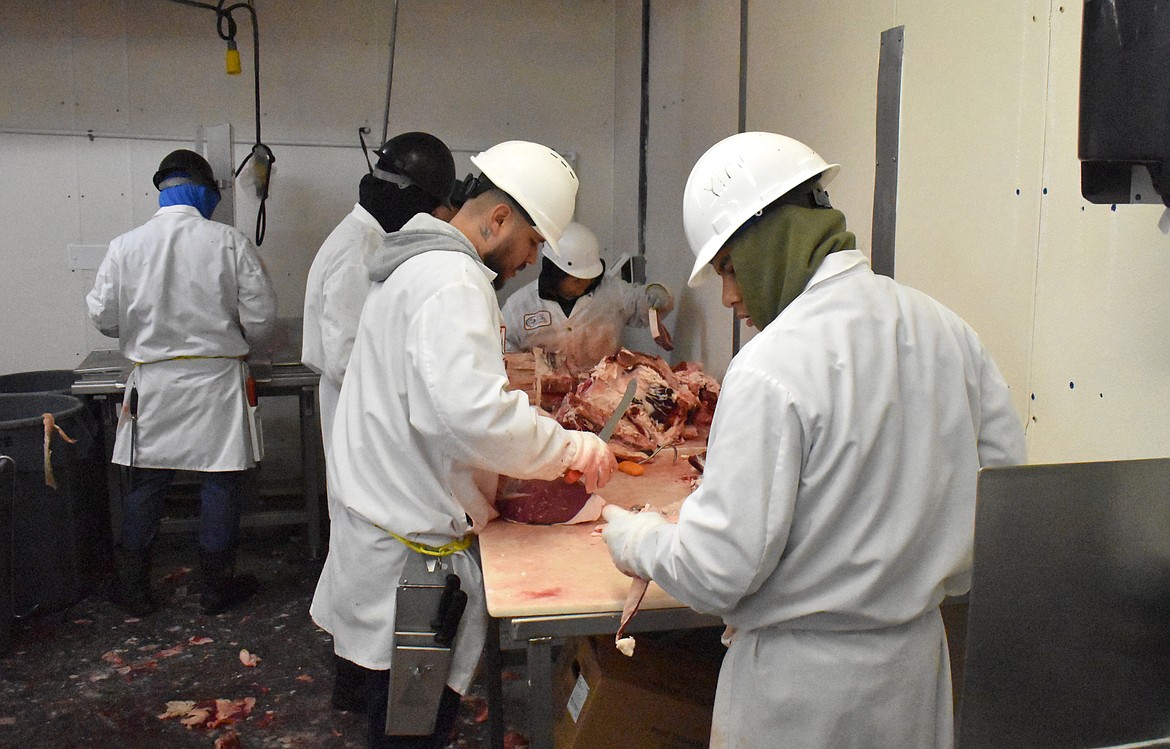
Pure Country Harvest workers cut up meat into large pieces called primals before they’re cut down into steaks, roasts or chops.

Employees at Pure Country Harvest feed meat into a grinder. With attachments that form patties or stuff the meat into sausage casings, employees can turn out more than 500 pounds of ground meat in an hour.

A wagyu beef rib hangs in the aging room at Pure Country Harvest before being cut into steaks.
Joel Martin has been with the Columbia Basin Herald for more than 25 years in a variety of roles and is the most-tenured employee in the building. Martin is a married father of eight and enjoys spending time with his children and his wife, Christina. He is passionate about the paper’s mission of informing the people of the Columbia Basin because he knows it is important to record the history of the communities the publication serves. | April 8, 2025 3:50 AM
MOSES LAKE — With grilling season beginning, it’s time to start thinking about the meat you’re fixing to cook. Did it come from across the country, or across town?
“There are a lot of small (meat) producers in Washington that produce a quality product, but don't have a place to take it to be processed,” said Andy Huff, plant manager at Pure Country Harvest in Moses Lake. “That's what we're here to do, is not only provide high-quality protein for the local community but also to provide a service for the small producers, so that they can get their products out.”
Pure Country Harvest just reached its 10-year mark as a butcher facility. It started as an outgrowth of Pure Country Farms, the small hog farm owned by the Klingeman family in Ephrata. When the owner of Vern’s Meats in Moses Lake decided to retire, the Klingemans bought the facility and began processing their own pork to save the money of paying a processor. From there it was a short step to processing pigs and cattle for other small local growers.
Pure Country Harvest sends most of its own meat to a natural food cooperative in the Puget Sound area, said Laura Klingeman Smith, the plant’s human resources and administration manager, but the shop also has a retail counter where it offers steaks, roasts and sausage made in-house. The prices are fairly comparable to what a supermarket charges for meat that’s not on a special sale, Huff said.
“Because we own the farm and we own the processing facility, we're cutting out a lot of middlemen,” he said. “All the meat that goes into the grocery store is handled probably 10 times before it actually hits the shelf, and everybody who touches that (adds a markup).”
Processing meat locally makes sense quality-wise as well, Huff explained.
“If you go to the grocery store, that (beef) was birthed in whatever state, maybe even in Canada, and then it was raised till it got hit a certain age,” he said. “And then it's put into a feed lot, wherever that feed lot is, and then it's trucked somewhere to a processing facility. Then they process it on a huge scale, and then it's put into a box, and that box is warehoused somewhere, and then it’s shipped somewhere else, and then it’s shipped somewhere else (again).”
Besides the markups that are added every time the beef changes owners on the way to the consumer, every step in that chain adds to the risk that the meat could be contaminated or allowed to get too warm, or something else that would affect the quality, Huff explained.
“From birth to package, we can ensure that the chain in which it travels is secure and there's transparency,” he said. “We have our hands on all aspects of it.”
Transport and handling can also be detrimental to the animals, Huff explained, which is a negative both for the quality of the meat and a matter of simple humanity.
“Animal welfare is an advantage of choosing a local producer,” Huff said. “Animals aren't put in huge feed lots that have 60,000 head in them, in horrendous conditions. Because of the sheer volume and size of the feedlot, (the nationwide meat companies) are not able to provide the same level of attention and detail to the pens themselves, which causes stress to the animal. And then shipping the animals sometimes hours to a processing facility … because they do so much volume adds more stress to the animal.”
The U.S. Department of Agriculture has standards for the humane treatment of meat animals, Huff explained, and then it’s possible to go above and beyond by creating what’s called a robust humane handling program. Every step in the process is carefully scrutinized to minimize distress, from the misters in the corrals to keep the animals cool in the Basin heat, to the point when they’re killed using an electrical method that immediately renders the animal insensitive to pain.
The majority of the pork that Pure Country Harvest processes comes from the Klingeman family farm, Smith said. The pork they produce is certified organic and non-GMO, which Huff said is a very involved process.
“It’s not just the animal that’s certified non-GMO,” he explained. “If I take a rib-eye primal, a whole piece, I have to pay for that to be certified non-GMO. Then if I take that and cut a bone-in rib steak off it, I have to certify that non-GMO. And if I take the bone out of that I have to certify it.”
A third-party auditor comes to inspect the farm annually as well, he said, and make sure that the animals aren’t being fed any hormones or antibiotics.
“Year from year, we raise about 75-85% of the grains that our animals are fed,” Smith said. “And then we partner with other local farmers in Washington state that are non-GMO verified as well, so they're getting all non-GMO feed.”
Pure Country’s value to the food chain made itself obvious during the COVID-19 pandemic, Huff said.
“There was a huge shift that people wanted local because they knew where their stuff was coming from,” he said. “If you went into (the supermarket) to buy meat, the shelves were empty. So people started looking at other places and alternatives.”
Because of its location within the city limits, Pure Country Harvest has just about filled up its space and doesn’t have any prospect of expansion, Huff said. Which is fine, he explained, because getting big isn’t the focus.
“We've geared our business to help these small producers process their animals,” he said. “And not just process them and slap them in a package but do it right. Do it clean, present it right.”
Pure Country Harvest
2721 W Peninsula Dr.
Moses Lake, WA 98837
purecountry.us
509-765-5671
Mon.-Fri. 10 a.m. - 5 p.m.
Sat. 9 a.m. - Noon
Closed Sundays
 From left: Pure Country Harvest Plant Manager Andy Huff, Linda Suksdorf, HR and Administration Manager Laura Klingeman Smith, Rosie Bolivar and Plant Operations Manager Sarah Furve stand behind the retail counter at Pure Country Harvest. Suksdorf and Bolivar assist retail customers and take orders from stores and customers, Smith said.
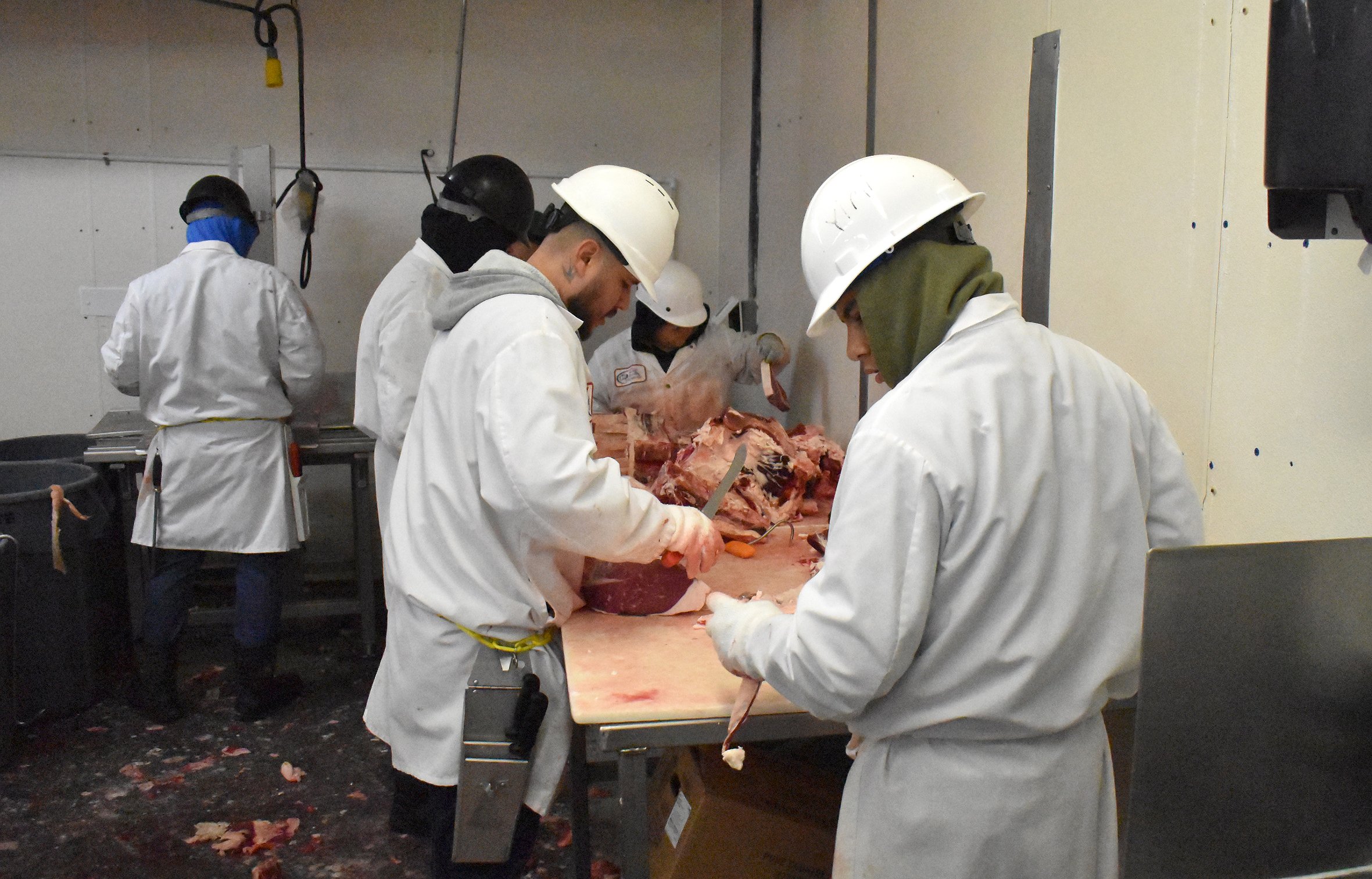 Pure Country Harvest workers cut up meat into large pieces called primals before they’re cut down into steaks, roasts or chops.
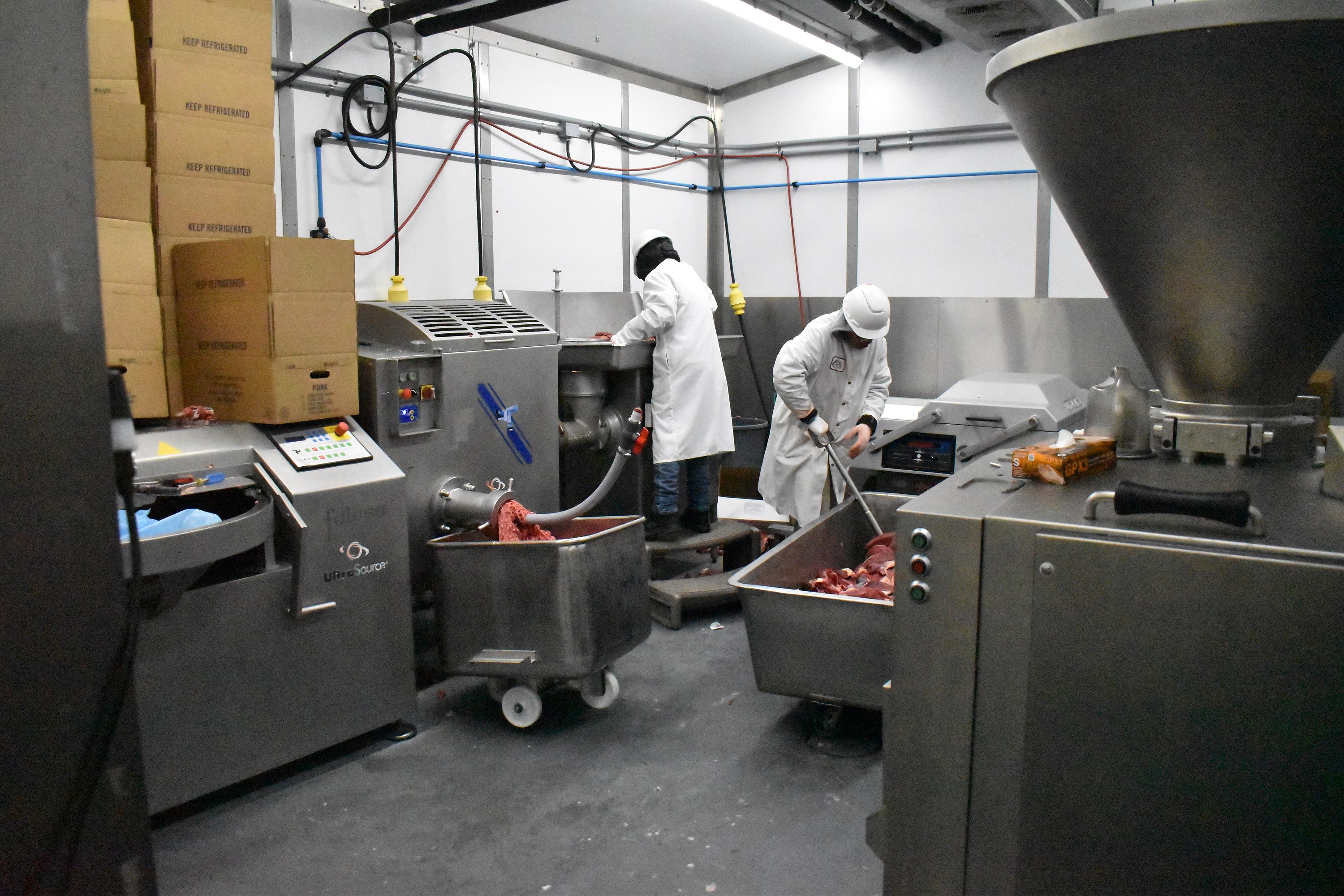 Employees at Pure Country Harvest feed meat into a grinder. With attachments that form patties or stuff the meat into sausage casings, employees can turn out more than 500 pounds of ground meat in an hour.
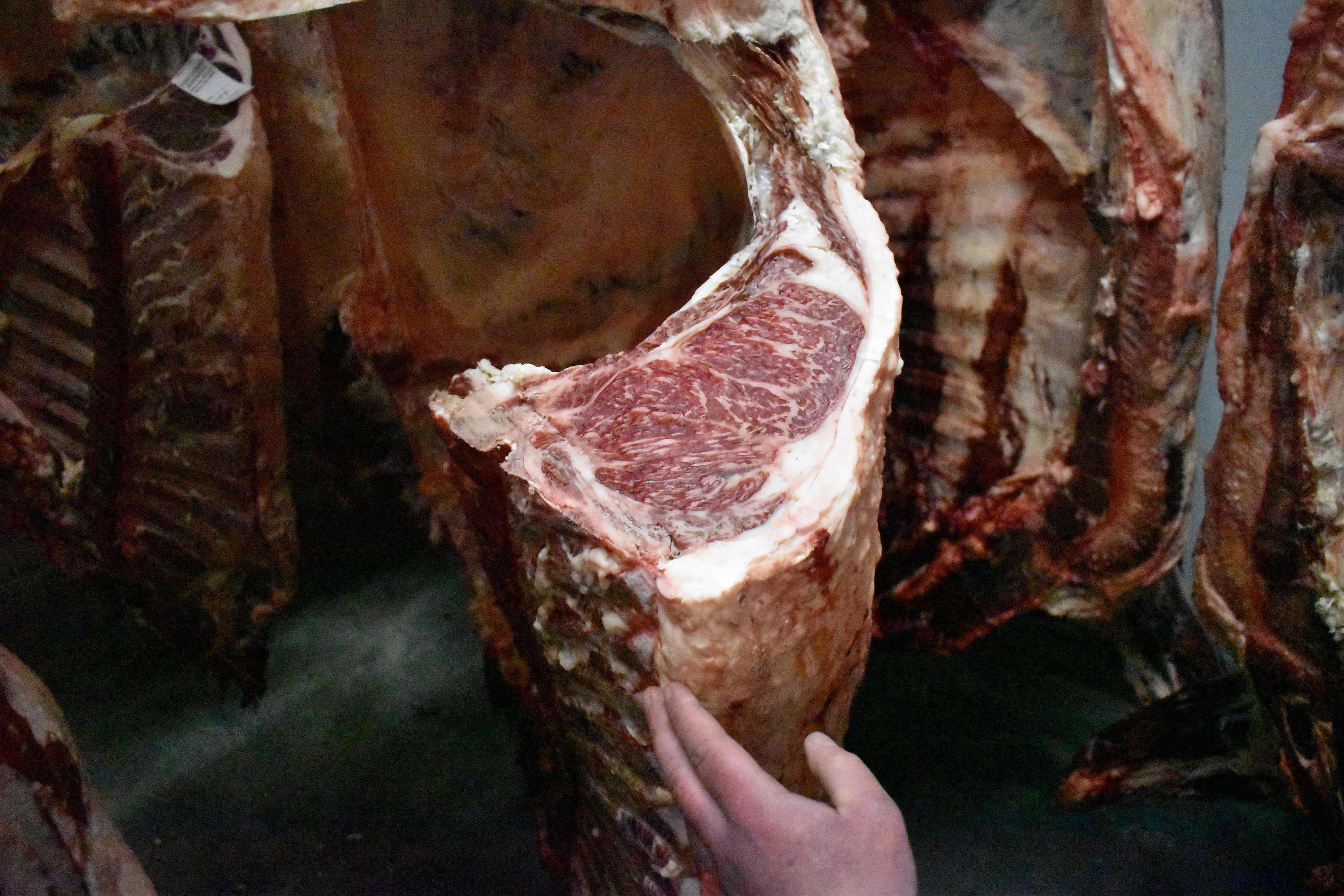 A wagyu beef rib hangs in the aging room at Pure Country Harvest before being cut into steaks.
ARTICLES BY JOEL MARTIN

Insurance rates won’t go up in wake of 2026 wildfires
MOSES LAKE — Almost three-fifths of American homeowners have concerns about their insurance rates going up due to wildfires, according to a study by the insurance website LendingTree.com. But Moses Lake insurance agent Chris Arnberg said we don’t have much to worry about in the Columbia Basin. “I don't think we’ll see rates going up,” said Arnberg, who represents American Family Insurance. “If you're purchasing a home that's nowhere near any kind of potential wildfire, then your rates shouldn't go up more than inflation.”

‘All in for Moses Lake’
School Resource Officer Cpl. Ray Lopez retires from MLPD
MOSES LAKE — The Moses Lake Police Department waved a regretful goodbye to Cpl. Ray Lopez Wednesday. “He’s a great ambassador for this organization in the community,” said MLPD Chief David Sands. “He’s all in for Moses Lake.” “Ray is Moses Lake,” said MLPD Public Information Officer Capt. Mike Williams. “He grew up here, he knows everyone and he is absolutely passionate about the community.” Lopez retired Wednesday after a career that spanned 40 years, first in the U.S. Army and then at Connell Police Department and the Chelan County Sheriff’s Office before coming home to Moses Lake in 2001, according to an announcement from the MLPD.

BASIN EVENTS: October 2026
COLUMBIA BASIN — The days are getting shorter and the eerie time of year is creeping up on us. Here are a few things happening in October.