
Cell tower decision unanimously reversed
CHLOE COCHRAN | Hagadone News Network | UPDATED 11 months, 3 weeks AGO

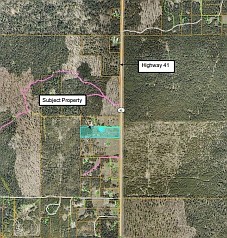
SANDPOINT — County commissioners voted unanimously last Thursday to reverse the approval of a conditional use permit near Oldtown for a communication tower.
The decision came after a two-and-a-half-hour meeting where a 3-0 vote denied the permit. Commissioners agreed that the permit was in conflict with the Bonner County Comprehensive Plan, was not in accord with Bonner County Revised Code and had the potential to create a hazard and pose danger to the neighboring property.
On Jan. 15, the Bonner County Hearing Examiner approved the CUP for a cell tower. On Feb. 18, a letter of appeal was submitted to the planning department requesting that the file be sent to county commissioners for review.
After a quick staff report by Assistant Planning Director Alex Feyen, Steve Kennedy, radio frequency design engineer advocating for the project, presented the board with charts and maps to build an argument for the necessity of Verizon coverage and capacity for cell service in the Oldtown designated use area. Kennedy created maps from data that was backed up by a self-reported scanner drive test to show limited cell service. Cell phone service, according to Kennedy, is based on signal level when you’re outdoors, indoors and in a vehicle.
“I would say a reasonable expectation in rural areas, if I'm indoors, I should be able to make the call or do whatever I want to on the phone. If I'm in a vehicle, I should be able to keep the phone call up, and if I'm outdoors, I should be able to do the same. That's a reasonable expectation of service,” said Kennedy.
Kennedy’s map showed a lack of coverage for the Oldtown area where the cell tower would be. Commissioner Asia Williams raised concerns about the maps presented by Kennedy, comparing his maps with the coverage map on Verizon’s website. According to Verizon, the parcel that was approved for a cell tower already had 5G Ultra-Wideband, 5G and 4G LTE coverage.
After Kennedy’s presentation on coverage and capacity, applicant representative Josh Leonard responded to objections raised by the appealing party.
“The first objection they raised was that it would obscure their view or damage their view. Our response to this was that there's no right to a view in Idaho ... that's based on Idaho case law,” said Leonard.
He then went on to discuss the effect of property value, citing studies done in Australia, Boston, Dallas, Phoenix and Raleigh. After showing a brief of the studies, Leonard went on to agree that the cities were not comparable to Oldtown, but that the studies still found that there was no devaluation of real estate located closely to cell towers.
Leonard finished his testimony by suggesting that there were three different ways to access the cell tower, offering that the applicant can obtain the necessary access permit for the CUP.
Morgan Hepler of Hepler Law & Consulting represented the appellants of the file. Hepler presented concerns raised by the appellants, specifically that the application was approved without a recorded easement, there was no provided access point and the tower could negatively impact neighboring property value.
“We are in a very rural area where it's heavily forested, low population density. Houses are generally far apart from each other. Just kind of looking at the context here, where you have, all of a sudden, a tower being placed within a very close distance, less than 300 feet from your house, and arguing that that's not going to devalue the property is a little bit of a leap for me,” said Hepler.
Hepler went on to explain that it wasn’t about the obstruction of view the tower would cause, but the drop of property value if a 135-foot-tall tower were to be constructed less than 300 feet away from the appellant’s property line. He explained that the case studies presented by the applicants were all based on highly populated urban areas, not accounting for rural areas.
Hepler also brought up the lack of a recorded easement, saying that the applicant’s easement options were “irrelevant and speculative.” The applicants provided three alternative easements to access the cell tower parcel, none of which were approved by Idaho Department of Transportation.
“As you'll see in the responses from the Idaho Department of Transportation, there hasn't been any access, and you don't know whether the access will be granted or not. So, the approval, or even conditional approval, of this permit is really premature,” said Hepler.
During a short deliberation, it was determined by the board that decision on the cell tower CUP should be reversed. Commissioners Ron Korn and Brian Domke both felt that a cell tower in a rural area would conflict with rural character. They also agreed that the permit was in violation of Title 12 of Bonner County Code because there was not an approved safe access to the designated cell tower location.
Williams was also in agreement, questioning the need for a cell tower in an area that Verizon showed as “high coverage.”
 Vicinity map of project location
ARTICLES BY CHLOE COCHRAN
Armstrong addresses Careywood closure, wildfire deployment concerns
Misinformation and criticism surrounding local fire services were the subject of Tuesday’s “community chat” as Bonner County Commissioner Asia Williams hosted Northside Fire Chief Jeff Armstrong at the event.

Guzzi enters county clerk race
Long-time public servant JoAnne Guzzi has announced her candidacy for Bonner County Clerk.

Williams addresses jail roof, path forward
During a recent Tuesday business meeting, Commissioner Asia Williams provided clarity on long-standing discussions surrounding repairs to the Bonner County jail’s leaking roof.