
Residents updated on Lightning Creek Fire
CAROLINE LOBSINGER | Hagadone News Network | UPDATED 4 months, 1 week AGO
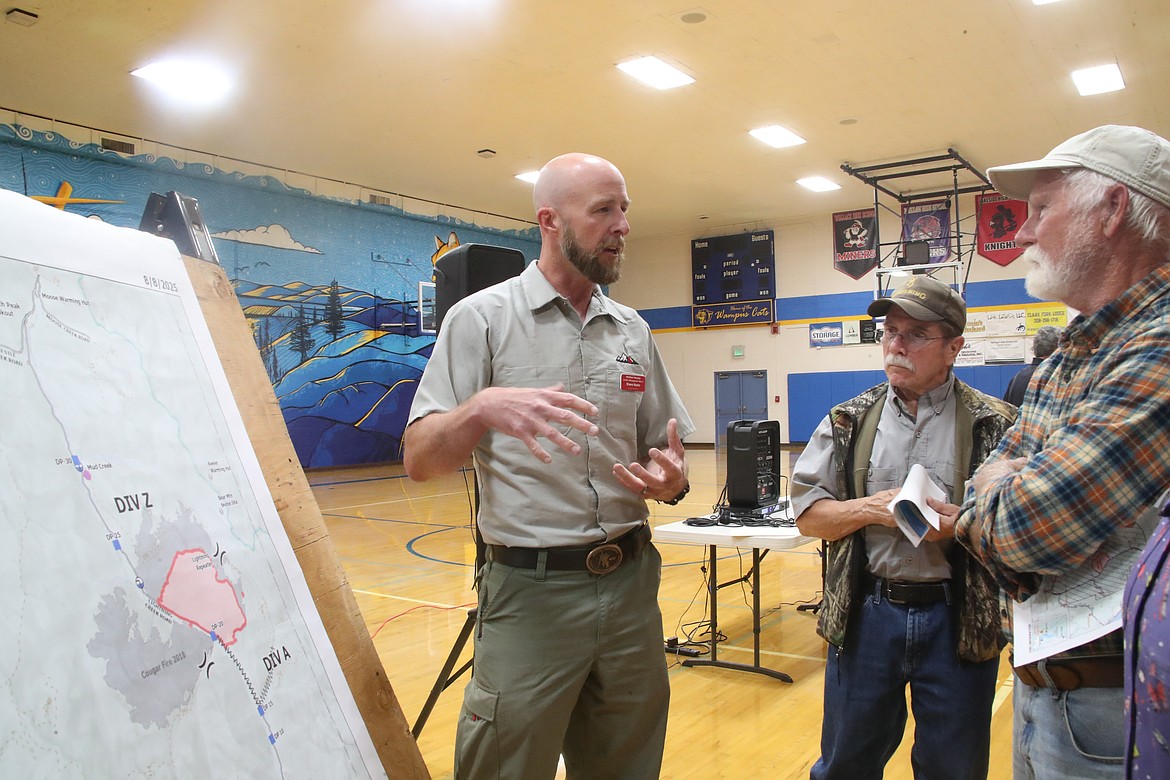
Shane Martin, incident commander for the Northern Rockies Incident Management Team 9, listens to residents' concerns about the Lightning Creek Fire at a community meeting Friday.
Photo by CAROLINE LOBSINGER
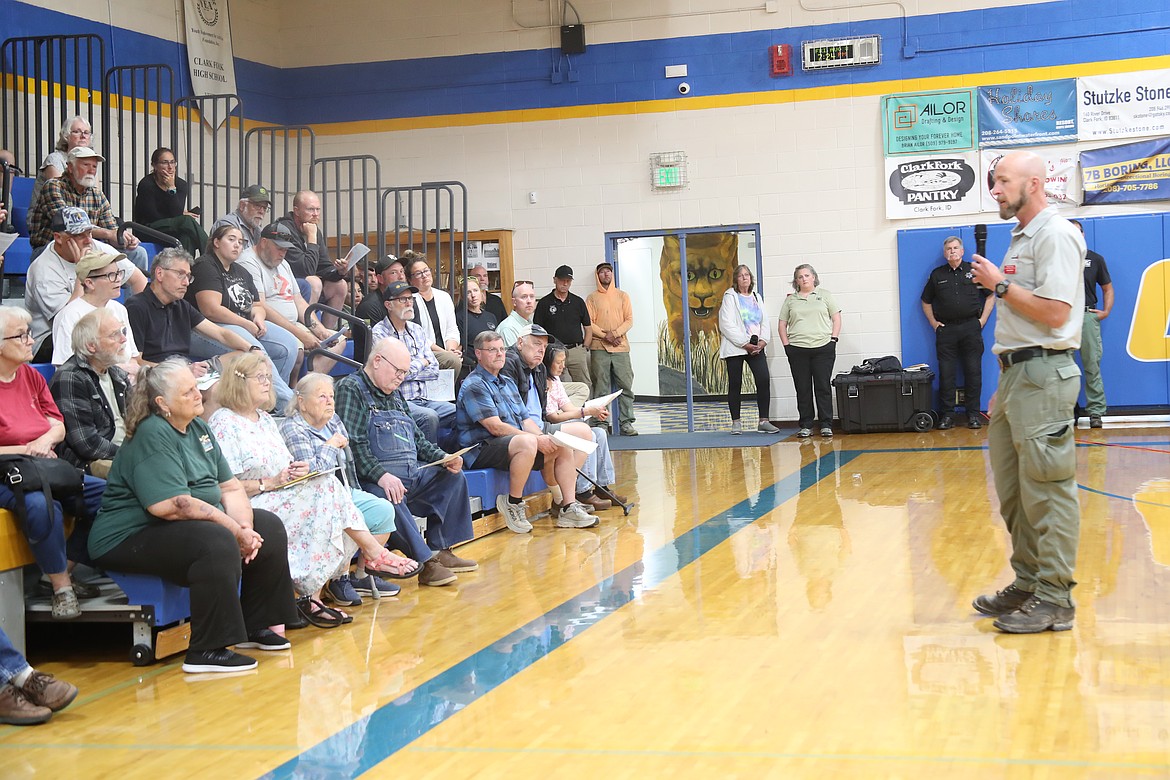
Shane Martin, incident commander for the Northern Rockies Incident Management Team 9, talks to area residents at a community meeting Friday to address concerns about the Lightning Creek Fire.
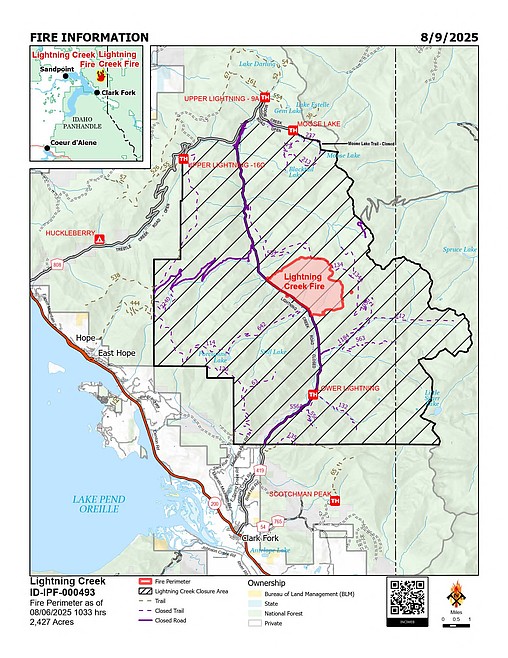
A map showing the outline and location of the Lightning Creek Fire.
I grew up in the Tri-Cities, Wash., and have always loved to write. I attended the University of Washington, where I earned a double major in journalism and political science, with an area of emphasis in history. I am the fifth out of six kids — don't believe any of the stories that my siblings tell. To be able to tell others stories and take photos for a living is a dream come true — and I considered myself blessed to be a community journalist. When I am not working, I enjoy spending time with family and friends, hiking and spending time outdoors, genealogy, reading, and watching the UW Huskies and the Seattle Seahawks. I am a servant to my cat, Frankie, who yes, will eat anything and everything in sight … even wedding cookies. | August 10, 2025 1:00 AM
CLARK FORK — It's not the first time the Northern Rockies Incident Management Team has fought fires in Bonner County.
The team, led by Shane Martin, fought the Bee Top Fire in the Lightning Creek drainage in 2023.
Friday, Martin and the Northern Rockies IMT 9 returned to the area to lead the effort to fight the Lightning Creek Fire.
Martin and a host of area officials spoke to about 100 residents from the Hope and Clark Fork area as part of a community meeting to update them on the fire, efforts to battle the large wildfire and potential risk to the community.
Questions ranged from smoke concerns to where they could find information on air quality to where residents could go in the event of an emergency and what was the status of timber sales that could minimize fuel load in the event of a wildfire.
After the formal presentation ended, dozens of residents gathered around Martin and other fire officials peppering them with questions, some pointing to maps showing where the fire is burning.
For the third straight day, growth of the fire has been minimal, holding steady at 2,427 acres. Located nine miles north of Clark Fork, it is at 0 percent containment. Fire behavior is minimal with some creeping and smoldering seen.
"What we've been seeing is inside the old (Cougar Fire) burn scar is where it's been actively burning," Martin said. "When it gets out of there, the fuels are still pretty green, still pretty wet."
Cooler temperatures headed into the weekend minimized the fire's growth, giving IMT crews a chance to explore the best way to fight the fire.
"We're looking at some options where we can keep this fire as much as we can to where it's at," Martin said. "There's a good chance there could be some growth but right now, things are looking pretty positive for the features we have in the area."
However, Martin cautioned that there is "plenty of fire season left" in this part of the country. As they fight the fire, they also are laying in the groundwork for roads and access points that may be needed in future fires.
Community, partnerships drive response efforts
Key partnerships and collaboration with local agencies have helped shape the response and identify critical values to protect, the local, state and federal fire officials said. Among them are the communities of Clark Fork, Hope, Rapid Lightning and Star Lane as well as state and private land holdings, recreation areas such as warming huts and a recently planted whitebark pine plantation.
"These obviously are your homes, your properties, places you've grown up and lived. They are the most important things out there and that is driving the strategy here for the incident," Chris Noyes, Sandpoint District ranger, said.
The process allows all agencies and officials involved to strategize about critical values and possible actions. It helps get everyone on the same page, Noyes said.
"It sounds complicated but it's just a conversation we've always had," he added. "It's just a formalized thought out, well done plan of 'Hey we're here. What are we doing? What are we going?' It's basically that conversation but gets you thinking deeper and gets everyone on the same page faster because time is not really on our side on most fires."
At a recent meeting among community leaders and fire crews, officials discussed where the fire was burning, what areas were important to protect and what was important to the community.
"The biggest takeaway is we were all pretty much in alignment," said Tim Gilloon of the Idaho Panhandle National Forest. "We left there feeling good. Everybody was moving in the same direction."
Lightning strike sparks fire
Bryce Barth, acting U.S. Forest Service North Zone fire management officer, said a lightning strike in the Lightning Creek drainage resulted in the fire, with a confirmed sighting at about 10:30 p.m. on July 30.
"The duty officer at the time decided not to commit resources due to the risk of exposure associated with suppressing a fire inside of a fire scar in the evening," Barth said. "It's an area twice compromised by fire, a very unstable environment with the overhead hazards and the mitigations that need to take place."
By waiting until morning, Barth said the view was that firefighters could be safely committed without endangering crews. The fire did not grow during the night and both an engine and initial attack modules responded as well as two helicopters that provided water support.
"Progress was very slow and cumbersome due to the amount of standing dead and compromised trees on fire," Barth said. "We had to mitigate those before we could safely engage folks and also begin line progression for fire."
By the end of the day, a second storm rolled over the area and grounded the planes, and pushed fire growth to about 1.5 acres. About 40 personnel attacked the fire, including a Type 1 Hotshot crew, the engine and initial attack crews, a water tender, four water scooper planes and a helicopter, Barth said.
"Folks were feeling pretty good out there and once again, it was 'Ground Hog Day' and a small disturbance tracked over the Lightning Creek drainage," he said.
Winds again grounded aviation assets and encouraged fire growth. By 7 p.m. Aug. 1, the fire had grown to 6 or 7 acres, and it was actively backing down toward the road in a southerly progression down the drainage. By morning, the fire had grown to about 40 acres and was "very active."
By Saturday, aerial assets were again able to assist in fighting the fire as crews worked to tamp down fire activity with a big air campaign, working to keep the fire on the east side of Lightning Creek Road.
Once again, weather hampered efforts, pushing the fire's growth. By 1:30 p.m., it had grown to 65 acres. An hour later, it was about 250 acres.
"By 3:30 that afternoon, we had a pretty substantial smoke column visible from Sandpoint and the outlying areas as the Lightning Creek Fire got in alignment with the slope and made a pretty significant run up toward the ridgeline," Barth said.
As the fire grew, a request was put in for a Type 3 incident management team, which allows for an extended attack and a greater level of resources. Heavy equipment and additional crews were also requested with the number of personnel assigned to the fire now sitting at 131, including three engines and a water tender, two excavators, a feller buncher, a hand crew and a Panhandle Hotshot team.
"We hung onto it successfully for about five days, keeping it on the east side of the Lightning Creek drainage," Barth said. "On the west side, we were successful engaging folks and containing it and controlling it."
Martin said incident management teams such as his are tasked with helping manage firefighting efforts.
"The folks from the local district here did a great job getting things set up but they have to deal with other fires happening in their district," he told those gathered.
Much of the work now being done is taking place along Lightning Creek Road, working to clear any snags and trees falling onto the road, both to prevent the fire's spread but also to keep fire crews safe. Crews are also working in the Mud Creek and Rattle Creek areas, looking for opportunities to limit or halt the fire's growth.
With the fire nine miles north of Clark Fork and burning away from town, there is little likelihood that the "Ready, Set, Go" evacuation procedures will be needed, Bonner County Sheriff Daryl Wheeler said.
Safety measures in place
If that were to change, Wheeler said his department would notify area residents of potential threats, from Nixle alerts to messages on its new app. A few years ago when a fire threatened the Blanchard area, law enforcement and emergency personnel went door to door, alerting roughly 450 homes that they needed to evacuate.
Under the "Ready" status, the first of three stages under the Ready-Set-Go evacuation protocol, residents are advised to have a plan to evacuate if necessary. Under the "Set" status, residents are advised to begin putting their plan into place. Under "Go" status, residents are told to leave immediately due to an imminent threat.
"It's not creating an imminent danger to our community or any houses in our area so they're doing a great job of keeping that fire away from homes in the event that it does move down," the sheriff said.
Information: bit.ly/4l5NhIB
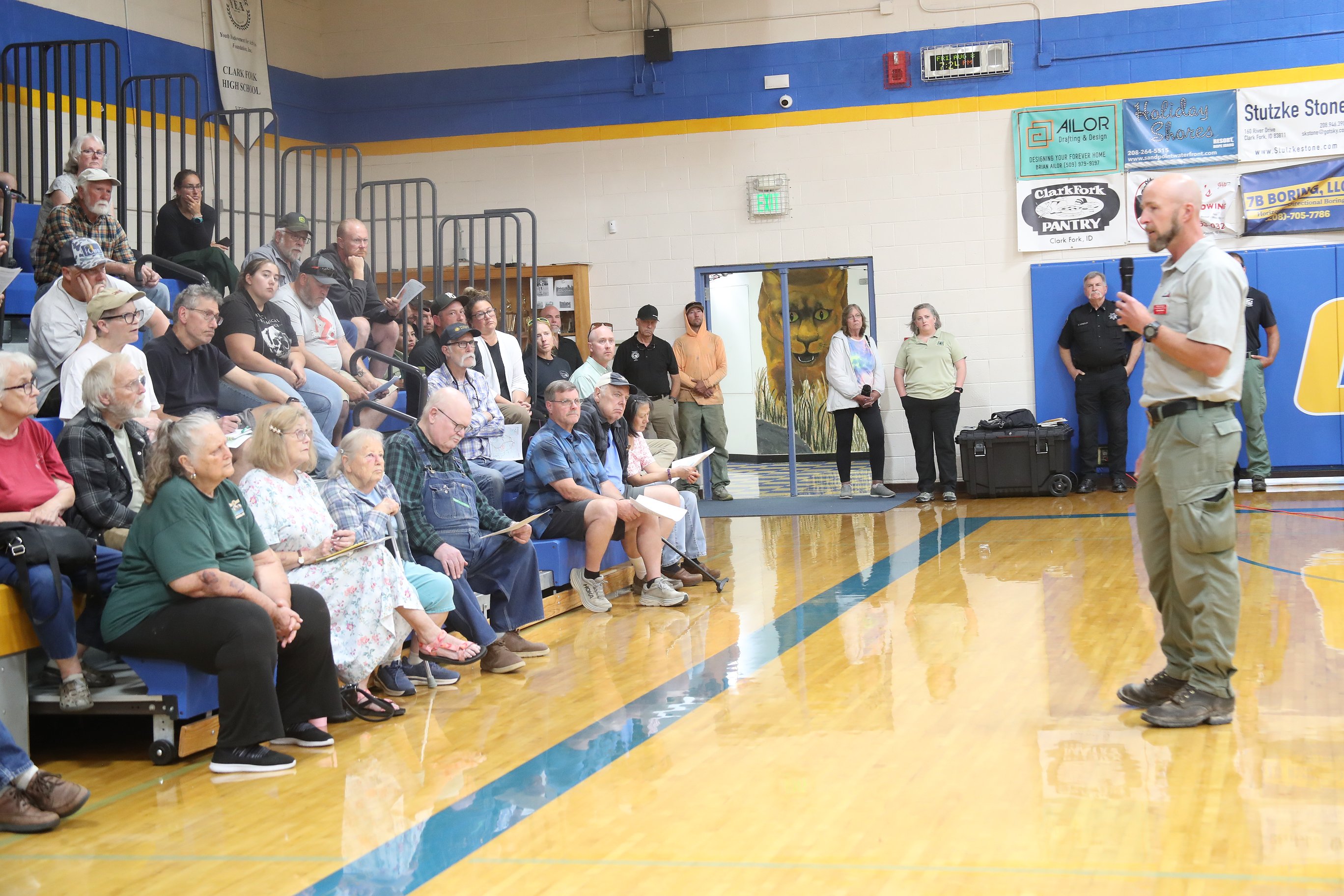 Shane Martin, incident commander for the Northern Rockies Incident Management Team 9, talks to area residents at a community meeting Friday to address concerns about the Lightning Creek Fire.
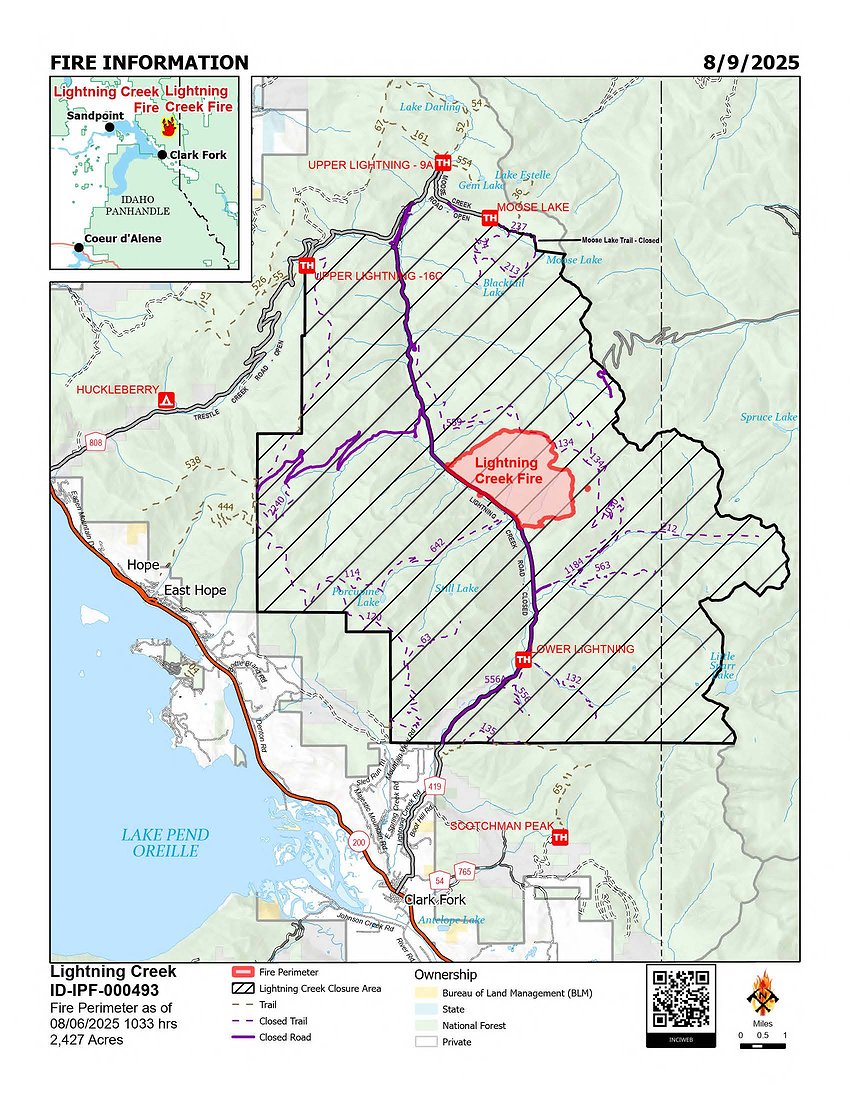 A map showing the outline and location of the Lightning Creek Fire.
ARTICLES BY CAROLINE LOBSINGER

'Tots' drive nears halfway point
Help the Sandpoint Lions reach their $75,000 goal for Toys for Tots.
'Tots' creates sweet Christmas memories
Help the Sandpoint Lions reach their $75,000 goal for Toys for Tots.
'Tots' seeks help to make Christmas merry
Help the Sandpoint Lions reach their $75,000 goal for Toys for Tots.