
Flathead Lake Biological Station touts new modular wastewater treatment plant
TAYLOR INMAN | Hagadone News Network | UPDATED 7 months, 2 weeks AGO
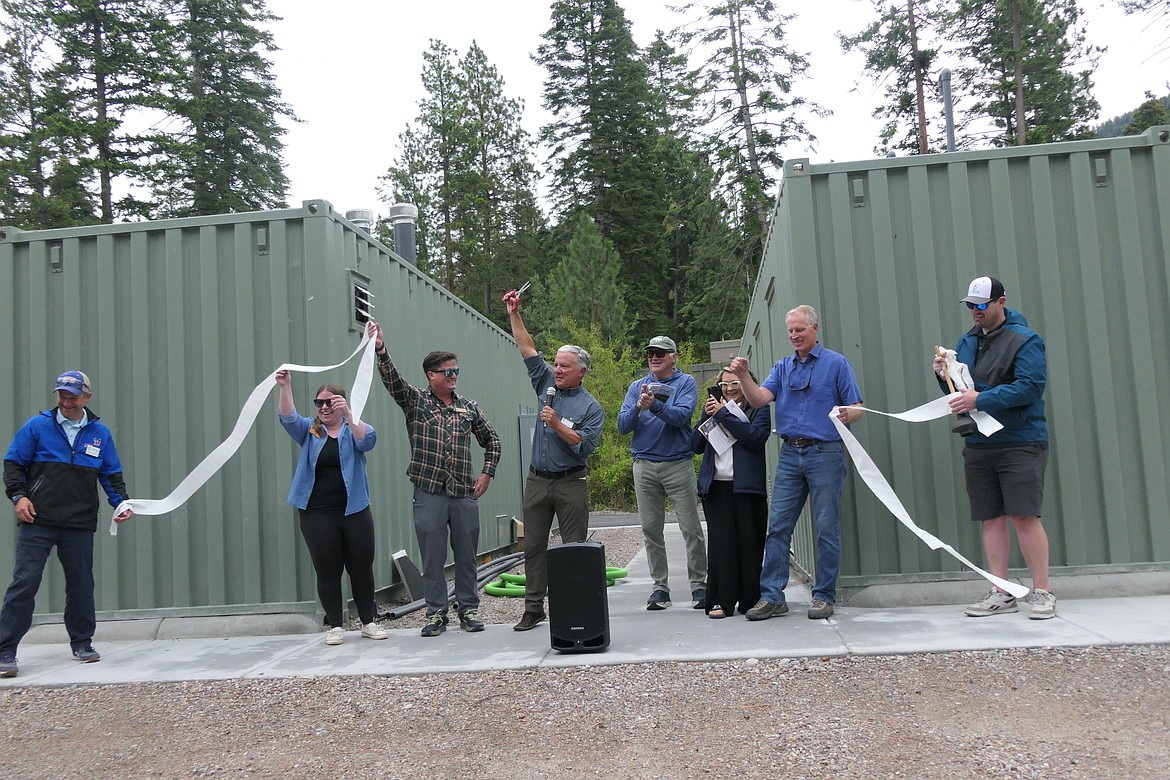
Flathead Lake Biological Station Director Jim Esler is joined in a ribbon cutting by representatives from their board, the Confederated Salish and Kootenai tribes, the Whitefish Lake Institute, the Western Montana Conservation Commission and FLBS staff. The Bio Station unveiled their new wastewater treatment plant at their annual open house on Friday, Aug. 8, 2025. (Taylor Inman/Bigfork Eagle)
REPORTER AND PODCAST HOST Taylor Inman covers Bigfork and the north shore of Flathead Lake for the Bigfork Eagle and the Daily Inter Lake. Her reporting focuses on local government, community issues and the people who shape life in Northwest Montana. Inman began her journalism career at Murray State University’s public radio newsroom and later reported for WKMS, where her work aired on National Public Radio. In addition to reporting, she hosts and contributes to Daily Inter Lake podcasts including News Now. Her work connects listeners and readers with the stories shaping communities across the Flathead Valley. IMPACT: Taylor’s work expands local journalism through both traditional reporting and digital storytelling. | August 13, 2025 12:00 AM
Flathead Lake Biological Station unveiled its new modular wastewater treatment plant Friday, which will serve the research station and Yellow Bay State Park.
During the ribbon cutting, which was swapped for toilet paper, Bio Station Director Jim Esler didn’t waste an opportunity to get in some “potty puns.”
“Our old plant was pretty pooped out, so I can't tell you how relieved I am to wipe the past clean and open this new plant,” he joked with attendees at the annual open house.
The $2.1 million StreamGo plant, built in modular shipping containers, was critical to continuing the Bio Station’s mission of reducing nutrient discharge in Flathead Lake. Esler said their previous plant was 20 years past its engineered lifespan.
Following signs that the lake was experiencing water quality deterioration in the late 1960s and early 1970s, the Bio Station received funds from the Environmental Protection Agency to construct a demonstration wastewater treatment plant to prove that removal of phosphorus to low levels was possible.
The sequencing batch reactor plant was state-of-the-art for the era, and the first tertiary treatment plant in the Flathead Watershed, according to the Bio Station.
Although staff have kept it afloat since, it was clear there would need to be a new plant in the future. Bio Station staff began working with the University of Montana and the state of Montana to replace the aging system in 2015.
A preliminary engineering study was conducted to explore replacement options — everything from implementing a giant septic system to repairing the existing plant — but the Bio Station once again looked to the future with modern and cutting-edge technology.
“They wanted to put a sewage lagoon on the property, and I said, ‘If you do that, you're going to be finding a new director’ ... that was a non-starter. Instead, we came upon the decision to install a modular membrane bioreactor,” Esler said.
Membrane bio-reactor treatment technology is the same used in most modern municipal wastewater treatment plants, including those in Whitefish, Bigfork and Polson.
Esler said a membrane bioreactor is advanced wastewater treatment that uses microorganisms to break down and move fluids to waste waters, then using very fine membranes to separate the bacteria and other particles from the effluent that's discharged.
The modular unit cost $750,000, and after adding necessary infrastructure and installation cost, the project totaled $2.1 million. A traditional plant would have cost upward of $10 million, according to theBio Station. Funds came from the federal government, the state of Montana and grants from several different foundations.
In addition to the benefit of it being modular, the plant also provides the option of scalability. If the Bio Station was to grow significantly, additional treatment technology and capacity could be added through the addition of more pre-assembled containers.
Esler said the new plant has already shown promising results. Although the Bio Station was always discharging phorphorus within EPA regulations, water quality tests show the new membrane bio-reactor discharges 1/10 of the phosphorus that was going into the water from their old plant.
Esler, who recently co-authored a book on phosphorus sustainability, said the plant offers a small-scale approach to aging septic systems, particularly for a booming Flathead Valley.
“So instead of just building more septic systems, maybe we need to do something different? We know a lot of our wastewater infrastructure is at capacity and can't deal with extra septic. So, I'm of the opinion that maybe this is good technology that we can be considering at local or county level, or in the tribal investments as well,” he said.
An expanded wastewater treatment plant expected to serve Flathead County is getting underway in Lakeside, but the Bio Station's new modular plant is unrelated, according to Bio Station Media and Information Specialist Ian Withrow. He added that it took “about a decade of pretty extensive research, funding and construction efforts” to get them where we they today.
Ahead of the ribbon cutting, Esler gave a presentation about the new plant at the Bio Station’s open house. The event took place all-day and included boat rides, informational booths about ongoing projects and science activities for kids.
Esler said the event is a chance to share the work they’ve been doing.
"Folks in the community will often say, ‘Oh yeah, I've never been in there. I always drive past I wonder what it's like.’ So this is our chance to satisfy people's curiosity about what goes on back here. And most people are very impressed by the size and scale of the operation,” he said.
To learn more about the Bio Station, visit their website at flbs.umt.edu/.
Taylor Inman may be reached at 758-4440 or [email protected].
ARTICLES BY TAYLOR INMAN

Plant Land helps customers spring into the gardening season
Heated greenhouses at the Evergreen garden center are filled with pottery, annuals, houseplants and some early season vegetables like onions, lettuces and herbs.

Despite Barnhart objections, county OK’s gravity septics
Flathead County homeowners can now apply to install a gravity septic system for the first time since 2004.

Logan Health physicians raise awareness about colorectal cancer
It’s more important than ever to get screened for colorectal cancer, according to Logan Health gastroenterologist Dr. Kate Wisser, who said catching the disease early saves lives.