
In Glacier Park house case, a familiar argument from owners
CHRIS PETERSON | Hagadone News Network | UPDATED 4 months, 1 week AGO
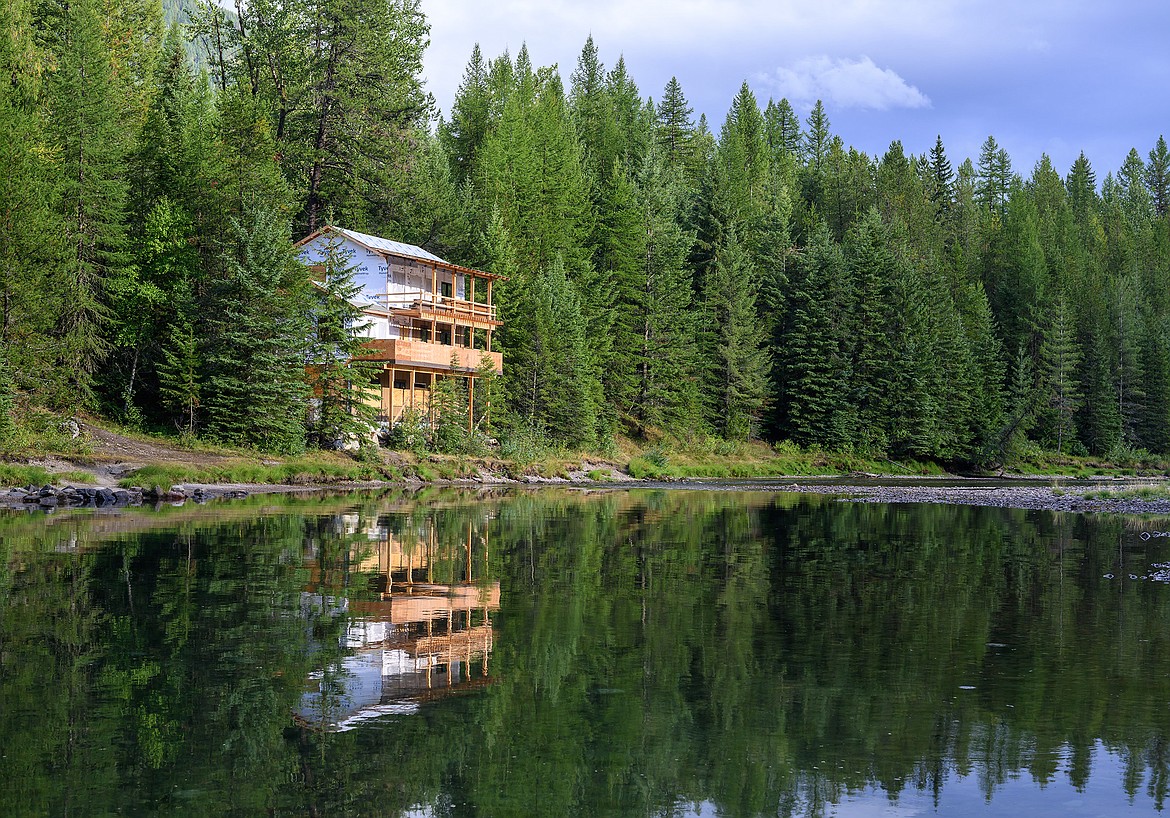
The Ambler House along McDonald Creek. (Chris Peterson photo)
Chris Peterson is the editor of the Hungry Horse News. He covers Columbia Falls, the Canyon, Glacier National Park and the Bob Marshall Wilderness. All told, about 4 million acres of the best parts of the planet. He can be reached at [email protected] or 406-892-2151. | August 13, 2025 8:00 AM
A couple accused of building a home on the banks of McDonald Creek in Glacier National Park without the proper state permits claim the state of Montana has no jurisdiction in the matter.
It’s a familiar argument that worked in the lower federal court.
Trent Baker, the attorney for homeowners John and Stacy Ambler in late July filed his opening brief in the case, which was appealed earlier this year to the Ninth Circuit Court of Appeals by the Flathead Conservation District and Friends of Montana Streams and Rivers.
In February, U.S. Magistrate Kathleen DeSoto ruled in favor of the Amblers.
Her ruling, in short, agreed with Baker that Flathead Conservation District didn’t have authority to enforce the Montana Streambed Protection Act, which allows the state to regulate development near waterways in the Montana, because the state ceded authority to the federal government over most matters of private property inside the park’s boundaries, save for criminal acts and taxation of private property and businesses, back in 1914, four years after the park was established.
Furthermore, the Streambed Protection Act doesn’t apply, Baker argued, because it wasn’t law prior to Glacier becoming a park in 1910. The Streambed Act was passed in 1975.
“When a state cedes exclusive legislative jurisdiction over a federal enclave, only state laws existing at the time may be assimilated into federal law applicable to the enclave,” Baker argues. “There are exceptions to this rule which allow for assimilation of some later-enacted state laws, such as criminal laws and extensions of a regulatory scheme in effect at the time of cession, though none apply in this case. Montana’s Streambed Act was enacted long after Montana ceded legislative jurisdiction over Glacier to the United States. It was not subject to any reservation of jurisdiction and it is not a criminal law or part of any ‘same basic scheme’ of regulation in effect at the time of cession. Neither FCD nor FMSR argued below that any of these specific exceptions apply and they should not be allowed to do so on appeal.”
The district at one point ordered the Ambler’s home, which is perched on a small piece of land over the creek, removed. That order set in motion a series of hearings and the lawsuit, with the state and the Amblers at odds over the matter.
Shortly after DeSoto’s ruling, attorneys for the Conservation District and the Friends of Montana Streams and Rivers filed an appeal to the Ninth Circuit.
Baker, in his brief, noted the Ninth Circuit has already ruled on a similar case years ago, which established Glacier’s jurisdiction.
The case, Macomber v. Bose, was a dispute over whether a private landowner could divert water from a stream in Glacier.
While the subject matter differs, the legal arguments were the same. At that time, the lower court found the state did still have jurisdiction, but the appeals court said it didn’t.
On August 22, 1914, by Act of Congress, the federal formally accepted the cession by the state to the federal government, which reads: “Sole and exclusive jurisdiction is assumed by the United States over the territory embraced within the Glacier National Park, saving, however, to the State of Montana the right to serve civil or criminal process within the limits of the aforesaid park in suits or prosecution for or on account of rights acquired, obligations incurred, or crimes committed in said State but outside of said park, and saving, further, to the said State the right to tax persons and corporations, their franchises and property, on the lands included in said park.”
“It is the Act of 1914 that defines the area over which the United States assumed dominion ... That area is described as ‘the territory embraced within the Glacier National Park.’ Such language includes not only the public lands dedicated to park purposes by the United States but all privately owned lands within the described park boundaries,” the appeals court found in Macomber v. Bose.
But the Conservation District and the Friends group claim in their appeal that there’s a larger issue at stake, however — protecting waterways from private development in Glacier National Park.
“This case is about protecting the integrity of Montana’s natural streams, not just about land use or jurisdiction. It is about whether Montana can enforce the Natural Streambed and Land Preservation Act to prevent the piecemeal destruction of streambanks like those of McDonald Creek. Construction on or adjacent to these waterways — especially on private property within a national park — poses serious environmental risks including erosion, sedimentation and long-term hydrological damage downstream. These risks are precisely why the Act requires local review and permitting,” argued Friends of Montana Streams and Rivers attorneys David K. Wilson and Robert Ferris-Olson in their opening briefs of the appeal filed earlier this year.
They claim the lower court simply erred when it found Glacier has complete jurisdiction over the Ambler home. Glacier has no regulations concerning building close to streams and waterways on private property; Park Superintendent David Roemer may have conceded as much when he previously told the Hungry Horse News that the federal jurisdiction in the Ambler case was at the high-water mark.
Glacier did, however, allow the Amblers to hook up to the park’s sewer and water system. Without that, the home couldn’t be built, the property is too small to accommodate a septic system.
But Baker also rejects the notion there are no federal laws available to regulate water quality on private lands in Glacier. He points to the Clean Water Act and federal laws regarding sewer and water systems on private lands in national parks.
Baker also notes the Amblers had an environmental study done of the property, which determined that the house is above the 100-year flood plain.
That may be true, but longtime residents also noted there used to be a home where the Ambler’s home sits today.
In June 1964, McDonald Creek flooded, severely undercutting the bank of that home to the point where it was in danger of falling into the creek. It was then torn down.
One subject that hasn’t come up in the case is condemnation.
The federal government does have the ability to condemn private property inside Glacier National Park and has threatened to do so in the past.
In June, 1975, Glacier instituted “a request for condemnation and declaration of taking” to Congress against landowner James Duncan.
Duncan was proposing building a 40-foot high home at Kelly Camp, which is near the head of Lake McDonald. He wanted a permit from the Park Service to run electrical lines either across the lake or down the North Lake McDonald Road.
The Park Service objected to the height of the building and the hookup of electricity. (Kelly Camp has electricity today). It also raised concerns about the sewage system for the large home.
But the condemnation process is acutely political. Montana Sen. Lee Metcalf was involved at the time and Duncan, in turn, had Congressman Mark Hannaford of California involved.
The Hungry Horse News asked the Park Service if it would consider condemnation in the Ambler case, but did not receive a reply by presstime.
ARTICLES BY CHRIS PETERSON
Columbia Falls concerned sewer system could be bottleneck for growth
The City of Columbia Falls could see a significant bottleneck in future growth due to its sewage treatment plant, depending how the city and the state calculate the sewage treatment plant’s maximum treatment capacity without a major upgrade.
Columbia Falls City Council tables e-bike law
The Columbia Falls City Council last week voted to table a city ordinance that would restrict e-bikes and e-motorcycles along with other electrically powered vehicles on its sidewalks and city parks.
Oh, Christmas tree!
I usually talk to my mother on the phone once a week or so. She lives alone in Florida and works for a church doing funerals part-time.