
THE FRONT ROW with MARK NELKE: Big Sky commish on adding conference games, adding members ... and the quest for the elusive FCS title
Coeur d'Alene Press | UPDATED 7 months, 3 weeks AGO
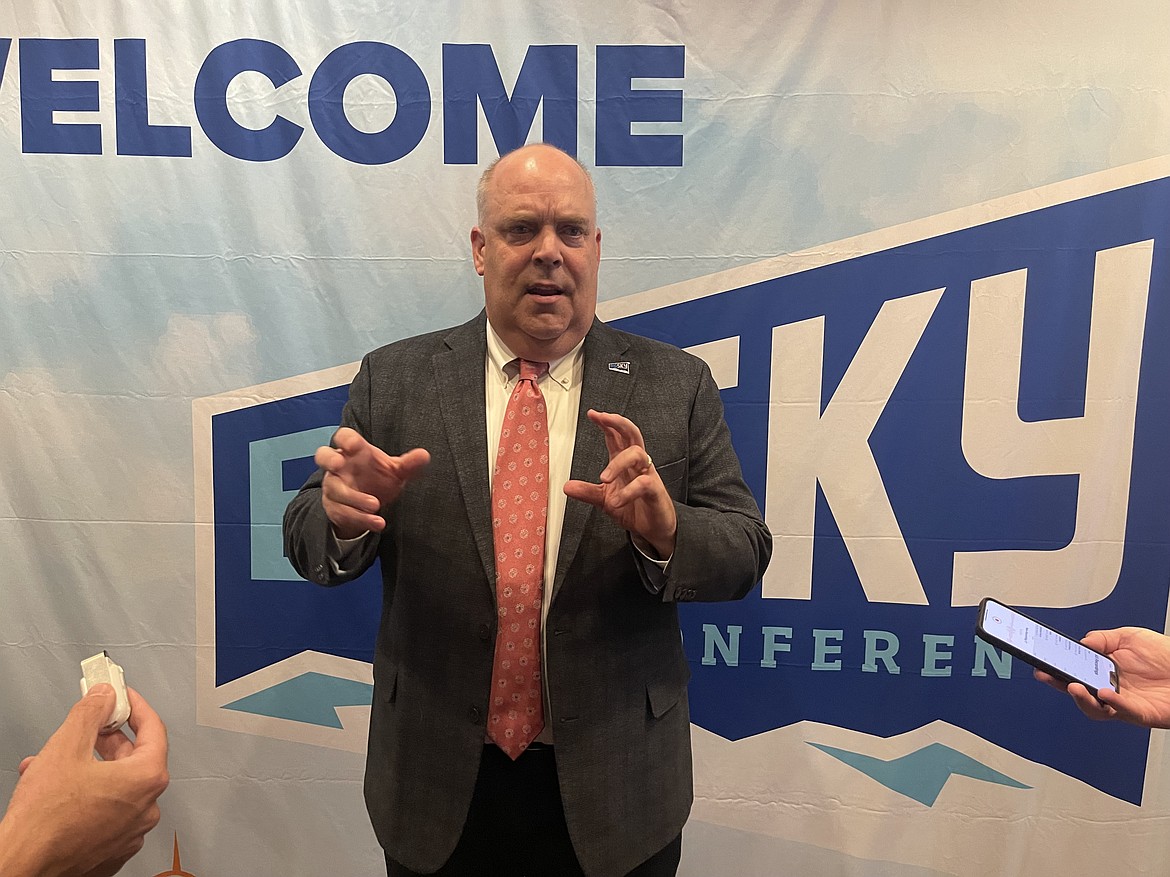
MARK NELKE/Press Big Sky Conference commissioner Tom Wistrcill speaks with media members at the Big Sky Football Kickoff last month in Airway Heights.
If there’s anything that we know from recent years, it’s that the college football landscape could change any day.
At least for today — hopefully — the Big Sky Conference is on solid ground.
Sacramento State is falling out of the Big Sky after the 2025-26 school year, but two other schools who make geographic sense — Southern Utah and Utah Tech — are joining the conference in 2026.
Big Sky teams have played in three of the last four FCS title games, and four of the last seven. And while none of them — Montana State twice, Montana and Eastern Washington — have won, you have to make it to the title game to have a chance to win it, right?
The last Big Sky team to win a national title was EWU, in 2010.
"It’ll happen,” Big Sky Conference commissioner Tom Wistrcill said last month, in a meeting with reporters at the Big Sky Football Kickoff in Airway Heights. “I think we have a great chance this year. I think the FCS is wide open this year, just like the Big Sky is wide open.”
Six of the Big Sky schools opted in to the House settlement, which allows conferences to directly pay athletes for their NIL rights, and six did not for various reasons, some of it financial, some of it becuase of the short amount of time they had to decide.
“And that’s also not a place we want to be long-term,” said Wistrcill, the Big Sky commissioner since 2018. “We'll talk to our schools about hopefully all getting opted in for 2026. I liken it to, we’re building the plane as we fly it with this new system, and we’ll wait and see.”
WISTRCILL TOUCHED on other topics during the media briefing, including:
THE BIG SKY GOING TO A NINE-GAME CONFERENCE SCHEDULE IN 2026
Recently, the NCAA allowed FCS teams to play a 12-game schedule every year.
In recent years, it depended on how the calendar fell — some years FCS teams could play 11 games, other years 12.
“The reason the NCAA was always against it was because we had such a long playoff system (24 teams, with a team possibly playing as many as five playoff games), we shouldn’t be playing so many football games,” Wistrcill said. “All of a sudden the CFP (College Football Playoff) brought a playoff in, they’re playing extra games (a 12-team playoff, for the second straight year, meaning a school could play up to four playoff games).”
So the Big Sky had to figure out what to do with its extra game.
“We have trouble getting teams to come out and play us at home,” Wistrcill said. “So we made a decision, if we’re going to play this 12th game, let’s add a conference game.”
Since Big Sky teams already have nonconference games scheduled over the next several seasons, some adjustments may have to be made.
Sam Herder, an FCS insider, posted last week the Big Sky teams plan to play conference games during Week 0, the new opening week, when they can.
Then, if it works out for those teams, they could play three nonconference games, then the remainder of their league games.
Because of the math in a 13-team league, one team will have to play eight conference games instead of nine.
Wistrcill said one of the two new teams coming in, Southern Utah and Utah Tech, will play play one less league game than the others.
“We didn’t put a time frame on that ... who knows what the future holds,” Wistrcill said.
ONE REASON FOR MAKING THE ADDITIONAL GAME A CONFERENCE GAME ...
It’s hard for Big Sky teams to find games against FCS foes.
Most of the FCS teams are in the midwest, east and south, so they can find opponents who are a lot closer.
So Big Sky teams, if they can’t convince a team from those regions into playing a home-and-home, have to pay them to come West.
“The other thing is, we just have to show them a map,” Wistrcill said. “They think Kansas is the West.”
Also ...
“I think what they found over time, when they come to our venues, they don’t win very often,” Wistrcill added. “And so they don’t feel very incentivized to make the trip out here. So then we end up having to pay for them to come, which is fine as well.”
In any event ...
“Our best teams (which these days includes Montana State, Montana and Idaho) need to play great FCS opponents,” he said. “Other teams, we need to schedule wins, because ultimately, it’s how many teams can we get in the playoffs.”
ANNUAL OPPONENTS
The Big Sky used to call them “protected rivals.”
Each school has two teams they were guaranteed to play every year.
Idaho’s two are Idaho State and Eastern Washington.
Eastern’s other one is Portland State.
So, for example, Idaho is not guaranteed to play Montana or Montana State each year.
This year, the Vandals miss Montana State. Last season, Idaho did not play Montana.
“We’ve asked schools to send in four preferred annual opponents,” Wistrcill said. “Some of them will get more than others, because of how the math works. But we’re trying to get everybody as many annual opponents as they want. Some of them want them for rivalry purposes, some of them want them for travel distances, or for recruiting purposes. (But) not everybody’s getting everything they want.”
Wistrcill didn’t know how many annual opponents each school would get.
“Other conferences around the country have an imbalance there — some people get three, some people only get one, so it’s not uncommon for us to do that,” he said. “Obviously there are some rivalries in our league that have to happen, and have to happen at a certain time in the schedule, and we’re going to protect those. But part of being in a conference is, you don’t get everything you want. For the good of the whole, some things have to give.”
SACRAMENTO STATE’S DEPARTURE
Wistrcill said Sacramento State’s president, Dr. Luke Wood, let him know nearly a year ago of his school’s plans to move up to FBS.
The NCAA denied Sac State’s attempt to move up, citing the lack of an invitation from an FBS conference. So the Hornets will play football as an FCS opponent for the foreseeable future.
And allowed the Big Sky time to work on adding Southern Utah and Utah Tech (formerly Dixie State) in 2026.
“We need schools because we need to have a certain number of schools per sport; we have softball and men’s golf that were in trouble of losing their AQ (automatic qualifier bid to the NCAAs) if we didn’t replace them,” Wistrcill said. “Geography matters in our league, even though we’re spread out, to have two schools in Utah that wanted to come in. They’ve talked to us for years about wanting to come into the Big Sky Conference.
“We’re familiar with Southern Utah (which was a Big Sky member from 2012-22), and we knew Utah Tech was up and coming. There was an opportunity for us from a timing standpoint. Also, with the WAC dissolving, they had a need for a home. While the decision happened quickly, the discussion had been going on for a long time.”
Mark Nelke is sports editor of The Press. He can be reached at 208-664-8176, Ext. 1205, or via email at [email protected]. Follow him on X (formerly Twitter) @CdAPressSports.