
Kootenai County organizations look to legislators to help with housing
Coeur d'Alene Press | UPDATED 7 months, 3 weeks AGO


Those working to increase affordable housing in North Idaho are turning to legislators for help.
“If we want to stay a healthy state and a robust state, we must address this issue,” said Maggie Lyons, executive director of the Panhandle Affordable Housing Alliance.
The Legislature’s joint Land Use and Housing Study Committee recently met in Sandpoint to hear from officials, nonprofits and others regarding Panhandle housing.
Coeur d’Alene City Councilor Kiki Miller, founder of the Housing Solutions Partnership, said legislative changes could bolster the partnership’s efforts to increase affordable, local worker housing.
In talking with developers, Miller said she learned that inconsistencies from one jurisdiction to the next are one of the largest costs in time and money for housing projects.
"There is also a need for consistency in how inspectors and other building officials interpret codes and rules," Miller said.
James Casper, executive director of Habitat for Humanity of North Idaho, said he was born and raised in Idaho Falls and bought his first house for $71,000 when he was 19.
“That is not available today for young kids trying to move on, start a family and start a life," he said.
Only 20% of county residents can afford to buy homes in Kootenai County, Casper said, putting homeownership out of reach for most local workers, especially single-income households.
The partnership’s recommendations included:
Allowing construction of two living units on one lot, such as two single-family homes, a single-family home plus accessory dwelling unit, multigenerational housing, a duplex or a single-family home with housing for a farmhand.
Expanding use of twin homes in lower-density zones and on lots zoned for duplexes. Miller said that twin homes share a common wall like duplexes, but the lot and homes are divided and can be sold separately.
Prohibiting cities from banning accessory dwelling units and restricting the ability of homeowner’s associations to ban detached accessory dwelling units. Miller said state law could grant some exceptions, like requiring compliance with existing homeowner’s association regulations, meeting short-term rental codes and complying with existing zoning.
Adding language to the state’s statutes governing development agreements to allow jurisdictions to defer impact fees for projects that include deed-restricted affordable housing.
Allowing Urban Renewal Agencies to participate in efforts to increase affordable housing within the agency’s boundaries.
Adding a tax credit category to allow deductions for donations toward affordable housing projects and housing support organizations.
Providing one-time funding for an organization within each county or region to launch homesharing programs. HomeShare Kootenai County is a nonprofit that connects homeowners with extra space to rent with homeseekers. It provided homes for 65 individuals in its first year.
Relaxing mixed-use zoning code to remove restrictions that prohibit residential developments in commercial zones.
Lyons told legislators about the success of PAHA’s Miracle on Britton — a housing development with homes priced below market and deed-restricted to ensure the homes remain affordable for future owners.
It’s a solution, Lyons said, that is “scalable and replicable” and can be a blueprint for other developments in the county and throughout the state.
Bob Seale, community development director for the city of Post Falls, showcased code changes the city has made to increase affordable housing, like allowing tiny homes and cottage homes and relaxing restrictions on accessory dwelling units.
The Land Use and Housing Study Committee is comprised of three senators and three legislators, along with 14 other stakeholders in the housing and land use arena.
Its next meeting is set for Sept. 26.
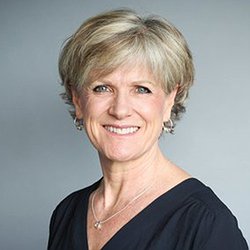 Lyons
Lyons