
Ritzville’s new chief has spent a lifetime in the police arena
JOEL MARTIN | Hagadone News Network | UPDATED 1 year, 1 month AGO
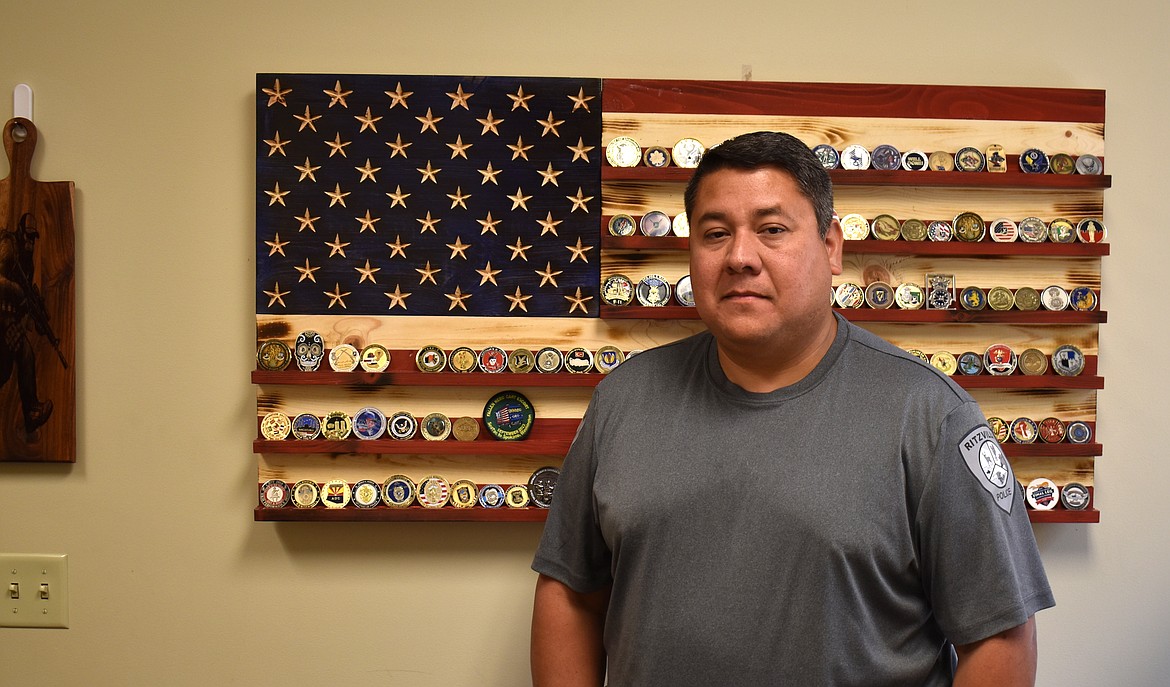
Ritzville Police Chief Mike Suniga stands in his offce , backed by a collection of his military medals and memorabilia.
JOEL MARTIN/COLUMBIA BASIN HERALD
Joel Martin has been with the Columbia Basin Herald for more than 25 years in a variety of roles and is the most-tenured employee in the building. Martin is a married father of eight and enjoys spending time with his children and his wife, Christina. He is passionate about the paper’s mission of informing the people of the Columbia Basin because he knows it is important to record the history of the communities the publication serves. | August 20, 2025 3:00 AM
RITZVILLE — On the wall behind Ritzville Police Chief Mike Suniga’s desk, there’s a quote from Theodore Roosevelt.
“It is not the critic who counts; not the man who points out how the strong man stumbles, or where the doer of deeds could have done them better,” it reads in part. “The credit belongs to the man who is actually in the arena, whose face is marred by dust and sweat and blood; who … does actually strive to do the deeds.”
That has a lot of bearing on the work of a small-town police officer, said Suniga, who took the reins at RPD in April.
“We deal with all types of problems,” he said. “It's just a matter of frequency. We get domestic violence, we get stolen vehicles, we get drug calls, all the same things that a bigger city would get, just not as frequent. And we were grateful for that.”
Suniga, 44, has been in law enforcement pretty much his entire life, he said. An Air Force brat whose parents retired to Medical Lake when he was in seventh grade, Suniga was able to take part in the local police department’s Explorer program for teenagers.
“I did my first ride-along and I was hooked,” he said. “I volunteered there as an Explorer until I turned 21, and after I turned 21, I became a reserve officer there. I worked there for a couple of years, and then moved to Airway Heights, where I did 15 years.”
Suniga then served three years as chief in Rearden, just west of Spokane, before leaving there to come to Ritzville, he said.
At the same time, he also served 22 years in the Air Force National Guard. He enlisted in April of 2011, he said.
“I graduated basic training at the end of August, and then 9-11 happened,” he said. “So after I went to my technical training, (my unit was) activated and deployed for two years … I've deployed multiple times, sometimes three months, sometimes being 6, 8, 9 months long, where I was gone.”
The departments he worked for were very accommodating of his military service, he said.
“When you transitioned back, you’d get in a car with somebody to make sure you were safe again, and then you’d go do your police work,” he said.”I … got better leadership experience, better leadership training. So I think it was a really good balance.”
As soon as Suniga arrived in Ritzville, he confronted what is still his toughest problem: staffing. The department is allowed five positions, he said, and two of them are vacant. It’s a common problem with small-town police forces, he said.
“The challenge that we have right now is, younger officers want to go to a busier place,” he said. “They want to go and do their profession, their skill craft, and there's nothing wrong with that. And when you get older, you kind of want to slow down a little bit. The problem is when they go to those other agencies, the pay is not comparable to what we can pay. So they're a little shy to come back to those smaller agencies.”
One thing that hasn’t been an issue for Suniga is the city that employs him, he said.
“The City Council is very pro-police,” he said. “They want to have a dedicated and professional agency, and they're willing to invest in those resources, which is amazing. Sometimes you don't get that in the smaller communities. Sometimes you have to explain why you have to spend $1 to save $2, or change that perception of ‘Well, that's the way we've always done it, so we should just keep doing that.’ They've been appreciative of the feedback that we are giving to them to work on ways to bring more officers into our community. It’s been an amazing experience.”
The council has been supportive in particular of Suniga’s efforts to upgrade the technology the department uses, he said. He’s been allowed to buy new computers that will last another five to seven years, and he’s preparing to upgrade body cameras as well.
Suniga and his wife live in Medical Lake with an indeterminate number of dogs, cats and chickens, he said. His wife works for Whitworth University in Spokane, so they both have about the same distance to commute to work. They’ve managed to make themselves part of the community despite living in another town, Suniga said.
“The last couple of years she's come out to where I worked on Halloween, and we passed out candy,” he said. “Last year, she helped us with National Night Out by making popcorn, because we have our own popcorn machine, and I brought it in.”
All in all, Suniga believes he’s landed in a good place.
“The community has been amazing,” Suniga said. “They have a really good, tight-knit community. The downtown core here is amazing. The vision for how the city wants to look is awesome, and I'm just glad to be a part of it.”
ARTICLES BY JOEL MARTIN

Endless battle
Noxious Weed Control Board works to keep invasive plants under control
MOSES LAKE — Some of the nastiest plants in Grant County were the topic of a class led by Jay Johnson, a consultant with the Grant County Noxious Weed Control Board, Tuesday. The Noxious Weed Control Board, as its name would suggest, is tasked with keeping weeds under control in Grant County. That’s not a small job; the board’s website lists 129 species of noxious weeds that are found around Grant County. A noxious weed is defined as an invasive, non-native plant that threatens agricultural crops, local ecosystems or fish and wildlife habitat, according to the Noxious Weed Control Board. Washington state law requires that these weeds be identified and their spread kept to a minimum, if not completely eradicated. “We’re one of those agencies a lot of people don’t really understand,” Johnson said. “We’re a county office and … our funding is tax-based assessment. When you get your tax bill and you look down at all the expenses that you pay for, there we are.”

BASIN EVENTS: Oct. 16-24
COLUMBIA BASIN — Whether you feel like shopping, crafting, learning or seeing a show, there’s something happening for you this week in the Basin. Oct. 16 ‘My Family (Mi Familia)’ screening Spanning three generations, “My Family (Mi Familia)” is a heartfelt drama that follows the Sánchez family as they build their lives in East Los Angeles. Through love, hardship, triumph, and sacrifice, the film explores the immigrant experience, the strength of family bonds, and the traditions that connect one generation to the next. Lowrider show and taco truck before the screening. Sponsored by Columbia Basin Allied Arts, EDUBS C/S and the Moses Lake Creative District. $12 per person. Doors open at 6 p.m., film begins at 7 p.m. at the Moses Lake Civic Center Auditorium, 401 S. Balsam St. Tickets and info: www.cba-arts.org.

Moses Lake author encourages women to look beyond church culture norms
MOSES LAKE — A Moses Lake author’s book, “A Christian Woman Striving to Live Her Faith in a Man-Controlled World,” takes aim at the role to which many churches relegate the female half of their congregations. “It’s to encourage women in the faith,” Linda Curran said. “A lot of churches say, ‘Teach Sunday school, do this, do that, but don’t (evangelize.)’" In her book, Curran recounts a time when she moved to a new community and joined a church there. She was surprised to learn that, as a new female member, she had been automatically assigned church cleaning duties. When she questioned it, she wrote, she was met with condescension and her objections were brushed aside. In other churches, she said, women who were capable of teaching were relegated to “women’s ministry.”