
Roemer touts infrastructure investments to federal lawmakers
HAILEY SMALLEY | Hagadone News Network | UPDATED 1 year, 2 months AGO
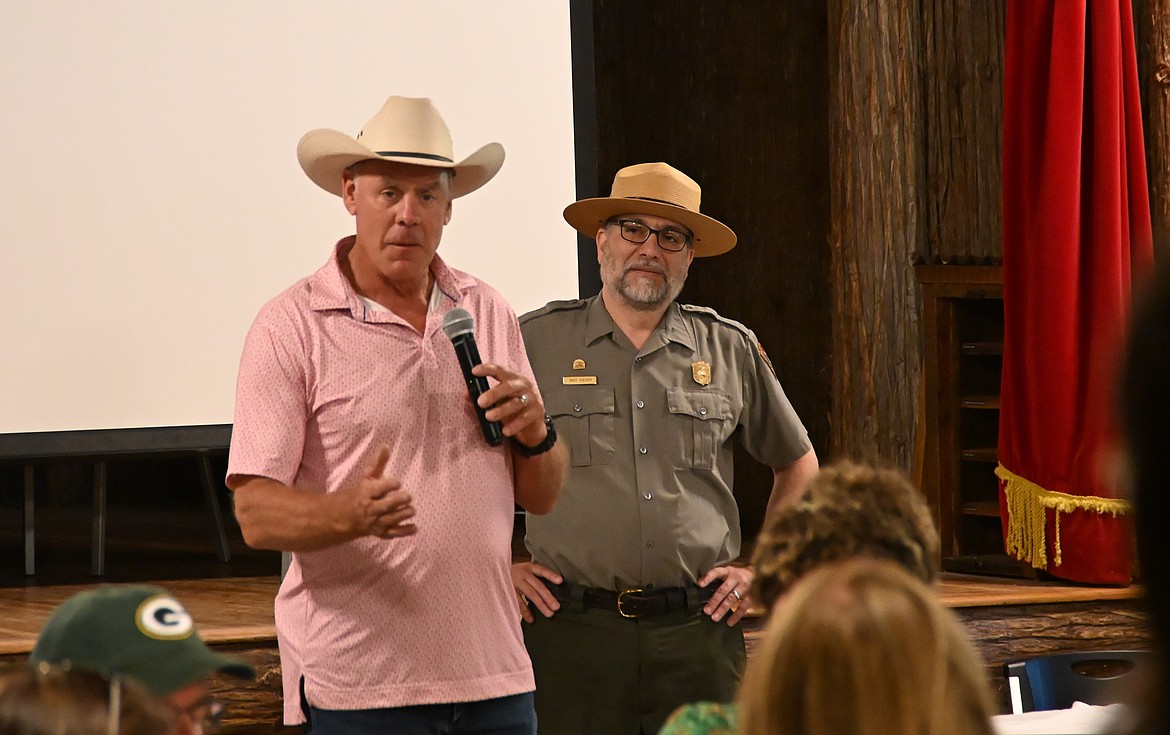
Rep. Ryan Zinke introduces Glacier National Park Superintendent Dave Roemer at a summer policy meeting hosted by the Western Caucus Foundation at Lake McDonald Lodge on Aug. 20, 2025. (Hailey Smalley/Daily Inter Lake)
Recent infrastructure improvements to Glacier National Park were on display during the final day of the Western Caucus Foundation’s summer policy meeting.
The three-day event brought representatives and senators from across the United States to Northwest Montana to discuss issues related to public land management, ranging from grizzly bears to timber harvest to wildfire prevention.
During an Aug. 20 presentation to the foundation, Glacier National Park Superintendent Dave Roemer offered members a more “behind-the-scenes" look at what it takes to manage public lands by highlighting several recent infrastructure repair projects funded through the Great American Outdoors Act.
Passed in 2020, the act allocates $1.6 billion each year toward projects that chip away at the growing deferred maintenance portfolio in national parks, forests and other federal lands. Since 2021, Glacier National Park has received more than $86 million in Great American Outdoors Act funds to repave a 9.3-mile section of the Going-to-the-Sun Road and replace the Upper McDonald Creek Bridge as well as replace outdated wastewater, water and utility systems throughout the park.
“The Great American Outdoors Act has been really essential for our strategy of maintaining infrastructure for the public,” Roemer said.
More than 3.2 million people visited Glacier National Park last year, adding strain to infrastructure systems that, in many cases, were built more than 50 years ago.
As of 2024, the National Park Service reported that Glacier National Park had accumulated about $134 million in deferred maintenance costs, including about $111 million in deferred maintenance on paved roads, $11 million on buildings and $2.9 million on water systems, campgrounds, trails and unpaved roads.
But Roemer said that, while a project to replace wastewater systems in the park may be “absolutely necessary,” it was “not the sexiest project [and] not one that we could easily go to philanthropic partners for.”
The Great American Outdoors Act helps fill that gap, ensuring the park remains safe and accessible into the coming years.
The park has already identified several future projects to prioritize, including replacing the parkwide communications infrastructure and the Many Glacier wastewater treatment plant, rehabilitating the Many Glacier Road and constructing an emergency operations center, four-season comfort stations and a curatorial storage facility. In total, those improvements are estimated to cost between $101 million and $131 million.
Roemer suggested that some of the proposed improvements could be eligible for funding through the Great American Outdoors Act if Congress extends the program past its original 2025 deadline.
“We want to make sure that that funding and that program remains healthy,” said Republican U.S. Rep. Ryan Zinke, who serves as a vice chair on the Congressional Western Caucus.
The caucus often advocates for greater state control of federal lands and what it terms “optimistic self-reliance,” but Zinke asserted that the federal funding provided by the Great American Outdoors Act was imperative to address what he considered to be Glacier National Park’s biggest issues.
In May, Republican U.S. Sen. Steve Daines introduced the America the Beautiful Act, which would increase the allocations made to national agencies for deferred maintenance to $2 billion a year through 2033. The act introduces some modifications to the current selection criteria by adding prioritization for projects that provide at least a 15% match in funds.
A hearing has yet to be scheduled for the bill, which was assigned to the Senate Committee on Energy and Natural Resources, but the measure has already garnered the support and co-sponsorship of 23 senators, including fellow Republican Sen. Tim Sheehy.
President Donald Trump has also expressed support for sustaining the funding stream, despite proposing widespread cuts to other areas of the Department of the Interior’s budget.
Reporter Hailey Smalley can be reached at 758-4433 or [email protected].
ARTICLES BY HAILEY SMALLEY

Trump stumps for Flint in Kalispell as Election Day nears
President Donald Trump, wearing a dark suit, red tie and red USA cap, ambled into the Majestic Valley Arena to the raucous roar of a crowd.
Flathead National Forest greenlights Swan Valley timber project
A 2,307-acre timber project is now under way in the Swan Valley.
Flathead National Forest greenlights Swan Valley timber project
A 2,307-acre timber project is now under way in the Swan Valley.