
Best Night Sky Events for December 2025
JOHN TAYLOR / Press Contributor | Coeur d'Alene Press | UPDATED 4 weeks AGO
While December is a month of extremes — it's both cold and dark, and because of its lengthy nights, it’s also one of the best months of the year for amateur astronomers and stargazers.
December 2025 is a busy month in the night sky — there’s arguably the best meteor shower of the year, there’s Mercury showing its mercurial nature, a close Saturn-moon conjunction, Jupiter surrounded by the Pleaides and we have the December Solstice, which marks the beginning of winter. In short, there’s no shortage of reasons to bundle up and head out under the cold and the few clear night skies this month.
Dec. 1 — The Orion Nebula
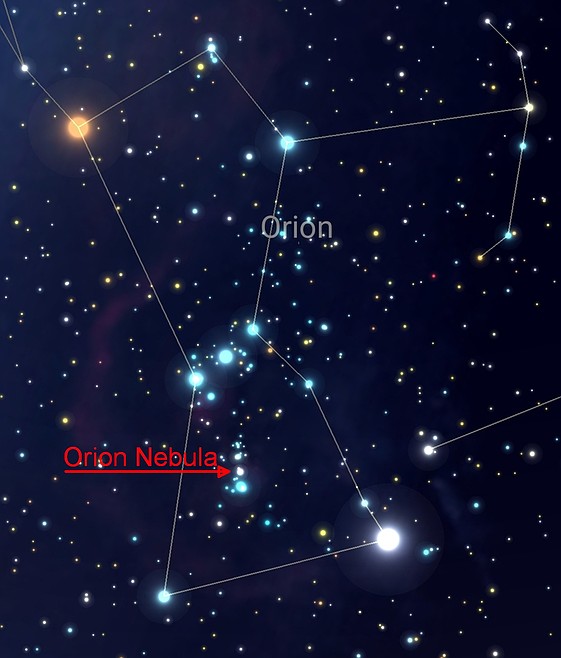
Any clear night this month is the perfect time to pull out those binoculars or your telescope to observe the Orion Nebula. The nebula is, to the naked eye, the middle star in the “Sword” of Orion. Look to the southeast at 9 p.m. to see this easy-to-spot constellation.
 Graphic courtesy of John Taylor and SkySafari Pro 6.
Dec. 3 — The moon in front of the Pleiades (M45)
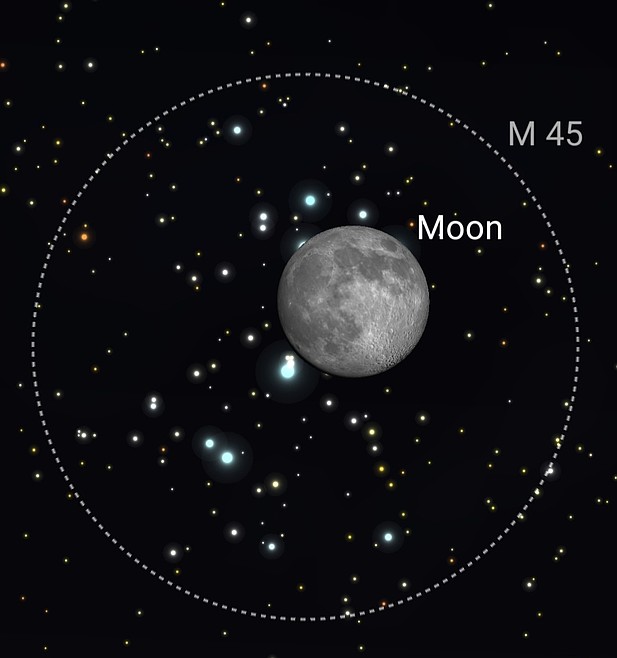
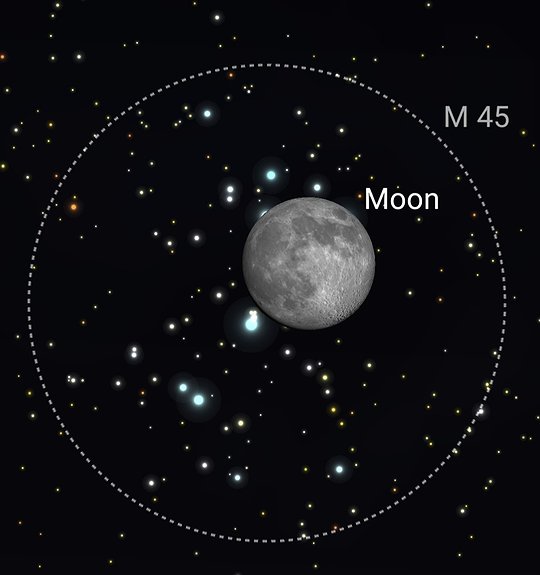
On this night, look to the east at 6 p.m. (local) to see the moon fully immersed in the Pleiades star cluster. The moon is one night away from being full, so it will hide some of the fainter stars in that cluster. A pair of binoculars should help, but beware that the moon’s brightness may be uncomfortable for your eyes.
Dec. 4 — The full moon — the cold moon — The last super moon of the year
The moon is now located on the opposite side of the Earth from the sun and its face will be fully illuminated. This phase occurs at 3:14 p.m. (local). This full moon was known by early Native American tribes as the cold moon — for obvious reasons. This moon has also been known as the long nights' moon and the moon before Yule (which it is). And this is the last super moon of the year. This moon will appear around 10% larger and nearly 20% brighter than a “normal” full moon.
Dec. 7 — Mercury at its morning peak
Since Mercury is so close to the sun, we can only observe it when it reaches its “highest” point in the sky. This morning, look to the southeast at 6:45 a.m. and you’ll be able to see Mercury at 10 degrees (two fist widths at arm’s length) above the southeastern horizon. Start looking for it around 6:30 a.m. (local). This is a great opportunity to head out and try to spot the smallest, yet still quite bright, planet.
Dec. 9 — The moon and the bright star Regulus close conjunction
Look to the east at 11 p.m., just after moonrise, to see a close conjunction of the moon and the bright star Regulus, Leo’s brightest star. These two objects will be half a degree apart (one finger width at arm’s length).
Dec. 11 — Third quarter moon
At its third (or last) quarter phase at 12:52 p.m. (local), the moon appears half-illuminated on its left side, which is its western, sunward side. It rises around midnight local time and then remains visible until it sets in the western daytime sky in the early afternoon. The dark, before moonrise, moonless evening skies that follow this phase are best for observing deep sky objects like the Andromeda galaxy, the brightest one in our sky, which, at 7:30 p.m. (local), is directly overhead.
Dec. 13-14 — Peak of the Geminid meteor shower
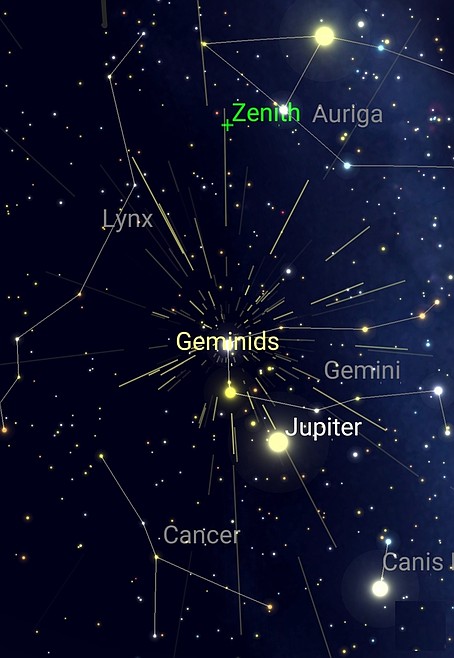
Dec. 13-14 are the nights for this grand meteor shower! On the nights of the 13th and 14th, the Geminid meteor shower will peak with up to 120 meteors per hour — but we most likely won’t see that many because of the moon’s interference after midnight. This shower is produced by debris left behind by an asteroid known as 3200 Phaethon, which was discovered in 1982. The meteors seem to emanate from the constellation of Gemini. Use the bright stars of Castor and Pollux to spot this constellation in the northern sky. These meteors can appear anywhere in the sky. Meteor visibility will be aided in the evening because the moon won’t yet be in the sky; it rises well after midnight (2:18 a.m.). This meteor storm is expected to peak around sunset on the 14th, so you can potentially see meteors on the night of Dec. 13-14.
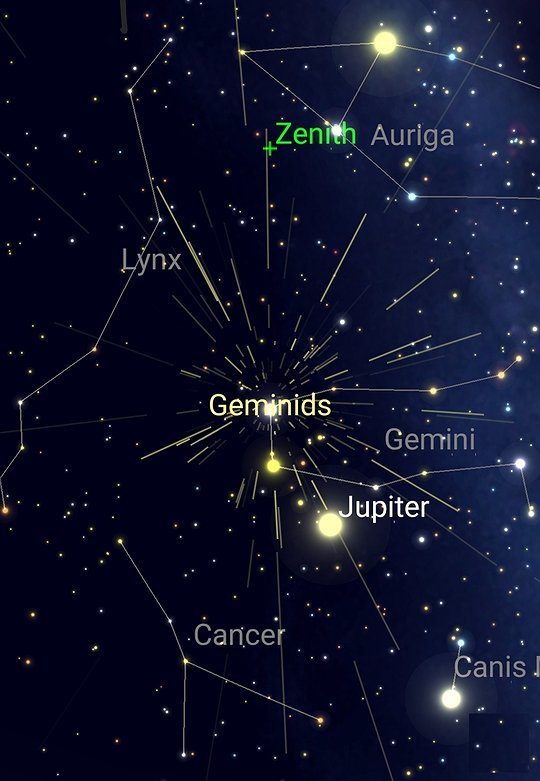 Image courtesy of John Taylor and SkySafari Pro 6
Dec. 19 — The new moon
The moon is now located on the same side of the Earth as the sun and so it will not be visible in the night sky. This phase occurs at 5:43 p.m. (local). This is the best time of the month to observe faint objects such as galaxies (Andromeda), nebulae (Orion), and star clusters (like the Pleaides) because there is no moonlight to interfere. A nice pair of 10x50 binoculars is a great tool to observe these objects.
Dec. 21 — Winter solstice
For us Northern Hemisphere residents, Dec. 21 marks the winter solstice (at 7:03 a.m.). For those of us who love the night sky, this day is not only the shortest day of the year, but also the longest night of the year! A full 12 hours and 10 minutes of darkness (if you exclude civil, nautical, and astronomical twilights), leaving only a mere 8 hours and 24 minutes of daylight.
Dec. 26 — Moon and Saturn in close conjunction
On this evening, the waxing crescent moon will pass close to Saturn in the constellation Aquarius, making them close to each other to the naked eye or with binoculars. The pair will be visible in the southern sky after sunset, around 5 p.m., and will set around 11:15 p.m. (local). These two objects will be less than 3 degrees apart (three fingers at arm’s length), making this event an appulse. The moon will appear to pass just north of Saturn.
Dec. 27 — The first quarter moon
When the moon completes the first quarter of its journey around Earth at 11:10 a.m. (local). Its 90-degree angle away from the sun will cause us to see the moon half-illuminated on the right side, which is its eastern side. In the first quarter, the moon always rises around midday and sets around midnight, so it is also visible in the daytime sky. The evenings surrounding the first quarter are the best ones for seeing the lunar terrain when it is dramatically lit by low-angled sunlight, especially along the terminator, the pole-to-pole boundary that separates the light from the dark hemispheres.
See you next year!
• • •
John Taylor is an amateur astronomer who lives in Hayden.