
Plan early for dementia care
JOEL MARTIN | Hagadone News Network | UPDATED 10 months AGO
Joel Martin has been with the Columbia Basin Herald for more than 25 years in a variety of roles and is the most-tenured employee in the building. Martin is a married father of eight and enjoys spending time with his children and his wife, Christina. He is passionate about the paper’s mission of informing the people of the Columbia Basin because he knows it is important to record the history of the communities the publication serves. | December 3, 2025 1:00 AM
MOSES LAKE — Having dementia can seem like the end of everything. But in some ways, it’s only the beginning.
“The most important thing (for) people with dementia is planning for the future,” said Dr. A. Carroll Hayman, a Seattle physician who specializes in Alzheimer’s and other dementias, at a symposium in Pasco in October. “In fact, if we can do an early diagnosis that gives people an opportunity to plan (and) also allows the patient themselves to be involved in some of that planning. If we wait too long, they can’t say what they want anymore, then we’re just sort of guessing what they wanted rather than involving them.”
As much as we might wish otherwise, dementia isn’t going to go away, and it isn’t going to be cured. How long it could last varies widely from one patient to the next. The patient will have medical, legal and social needs to work out, and they can’t do it alone. Starting early is key, Hayman said.
“Alzheimer’s, like any other chronic disease, occurs in stages,” she said. “There’s a preclinical phase where there are those pathological changes happening in the brain. You can see the proteins building up and the neuron signs, but the patient is not having any symptoms. Then there’s a period of mild cognitive impairment where somebody’s starting to have some impaired cognition they can test for, but it’s not really yet affecting the function … And then once we’re into dementia, we have both cognitive and functional (decline).”
The early stages, or as early as can be managed, are the time to talk about it, according to the Washington State Department of Health. Pick a quiet and calm place and time to talk it over, when neither of you will feel rushed. Ask the person how they feel and what they want to do, rather than just making plans and telling them about it. Above all, keep it positive.
“Your loved one might be worried about losing their independence,” the DOH wrote on its website. “Talk about a visit to their health care provider as a way to help them stay independent. Remind them the goal is to understand what’s causing their memory loss – and to make things better.”
Once the diagnosis is made, medical treatment becomes a team operation, Hayman said.
“The concept of the patient-caregiver dyad (is) similar to pediatrics,” she said. “I wouldn’t see a 5-year-old in the office without a parent and just assume I could tell them the plan … Similarly, we really shouldn’t be caring for people in health care systems with dementia without somebody with them.”
The term “care partner” is better than “caregiver” at this stage, Hayman said.
“People have an early phase where they don’t need a caregiver,” she said. “They don’t need somebody feeding them their meals, but they do need somebody to follow them to the doctor’s office or for help with driving or to help them pay their bills or oversee their medicines.”
An important step at the early stages is planning for the later ones, according to the National Institute on Aging. Important papers should be gathered up and put in a safe place, where at least one trusted person can find and access them easily. Keep those documents updated as situations change.
Getting legal protection in place is vital, according to the Washington Department of Social and Health Services.
“Without early planning, other people in your life – family members, medical providers, or even a judge – may need to make decisions for you,” DSHS wrote in its Dementia Legal Planning Toolkit. “In some cases, these decisions may not be the choices you would have made for yourself.”
Two of the most important documents are a living will and a durable power of attorney, according to the NIA. The durable power of attorney names another person as a proxy to make health care decisions if the patient is unable to make rational decisions on their own. A living will gives doctors instructions as to what treatment they do or don’t want when they are near the end or are permanently unconscious.
“For example, in the later stages of Alzheimer’s disease, people may have trouble swallowing, which can bring food or liquid into the lungs and cause pneumonia,” the NIA wrote. “Doctors may recommend a feeding tube connected from the nose to the stomach for nutrition, a ventilator to help with breathing, and antibiotics to fight the lung infection to help with recovery. However, some people may want to focus on comfort rather than recovery if the illness occurs near the end of life.”
There are also financial matters to be nailed down. The obvious one is to make out a will if you haven’t already, to make sure your assets are handled the way you want them to be after you die. But with a dementia diagnosis, a durable power of attorney for finances is important, too. Much like the medical power of attorney, it enables a trusted person to make financial decisions when you can’t. Finally, a living trust lets someone else manage any property you have.
The key is to do the planning early, Hayman said.
“Some people are committed to keeping their loved one at home,” she said. “Some people want to bring in caregivers. Some people are looking at facilities. But the thing you can’t do is be at two o’clock in the morning in the emergency room trying to figure it out.”
For guides to planning for dementia care, visit the National Institute on Aging at www.alzheimers.gov. The state of Washington’s Dementia Legal Planning Toolkit can be found at https://bit.ly/DementiaLegalToolkit.
The January edition of Senior News will look at how dementia patients and caregivers can cope as the disease progresses.
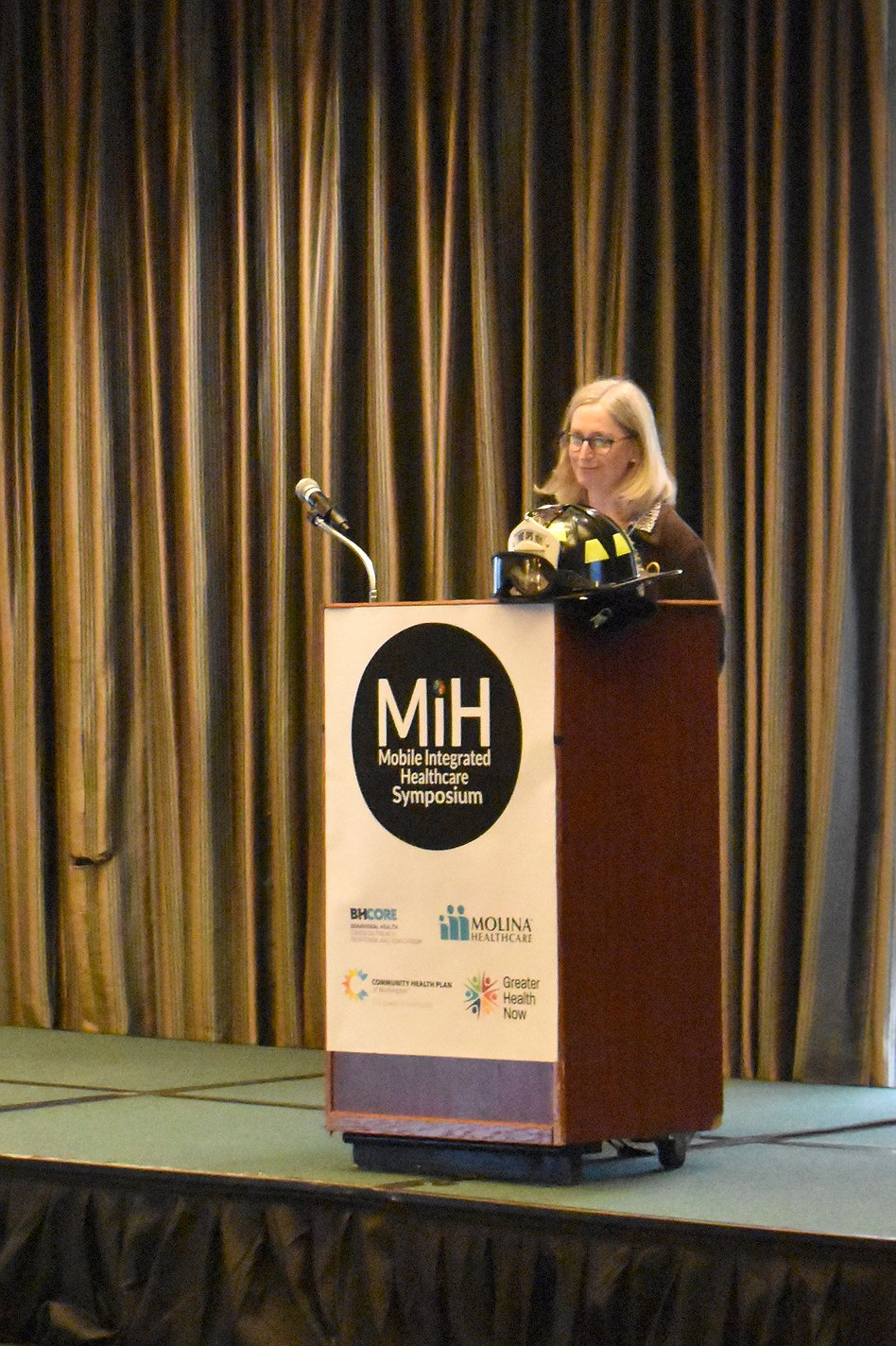 Dementia specialist Dr. A. Carroll Hayman speaks at the Mobile Integrated Health Symposium in Pasco.
ARTICLES BY JOEL MARTIN

Klompen Farms named Hay King and Queen at Grant County Fair
MOSES LAKE — Klompen Farms of Royal City is the 2026 hay-growing champion of Grant County. Owners Bob and Anne Wieldraayer were named Hay King and Queen at the Grant County Fair Aug. 18, winning both first and second place for export alfalfa with Alforex AFX 439. The first-place ribbon was for the farm’s first cutting, which the Wieldraayers did on April 26. It was very early in the year to cut, Bob said, but he wasn’t going to be available for a while after that and wanted to get the cutting out of the way. The second-place entry was from the fourth cutting, which the Wieldraayers, with help from their daughter Erin Wieldraayer, baled Aug. 15. That was also a little early, Bob said.

Calm under pressure
Quick-thinking CBTECH students save life in Sinkiuse Square
MOSES LAKE — Some Columbia Basin Technical Skills Center students saved a life Sept. 19. “We were there volunteering with the (Walk to End Alzheimer’s), and we were pulling up the back end,” said CBTECH Medical Assistant Instructor Rachael Buchanan. “One of our welding students tapped me on the shoulder and said, ‘Nurse Rachael, I think someone needs help.’ And there was a guy lying in the grass at Sinkiuse Square, very gray, in an unnatural position.” Buchanan had a contingent of about 35 students, she said, two of whom had been in her class the year before and were now in the certified nursing assistant program.
'This is where I want to be'
New CEO excited by Boys & Girls Club mission
MOSES LAKE — The Boys & Girls Clubs of the Columbia Basin’s new leader has found her happy place, said Jill Smith, who took over as CEO Sept. 1 “What really sealed the deal for me was touring the clubhouse for the first time and meeting some of the team members,” said Smith. "They were amazing. People came up and introduced themselves to me; they weren’t expected to, they were just that kind. My first day of work, two people brought me flowers. How cool is that?”