
Small fire departments battle big equipment costs
EMILY MESSER | Hagadone News Network | UPDATED 3 months AGO
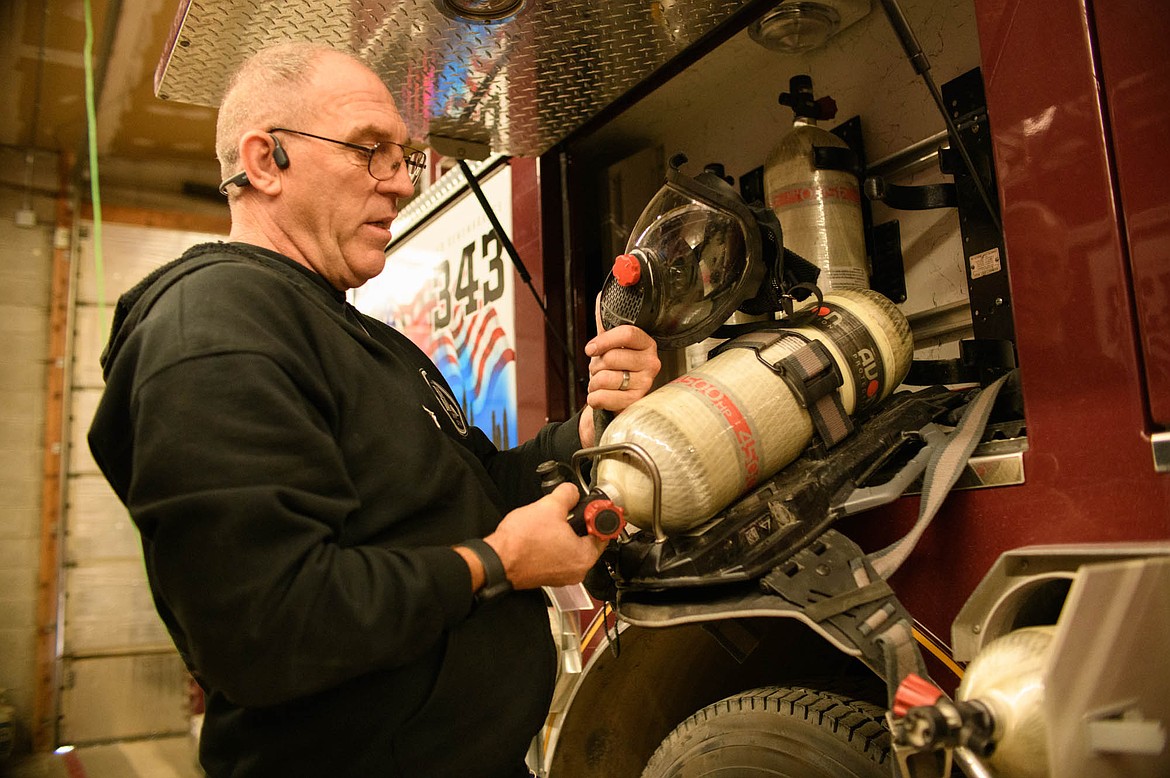
Paul Adams pulls out the old self-contained breathing apparatus from the St. Ignatius fire truck. (Emily Messer/Leader)
Emily Messer joined the Lake County Leader in July of 2025 after earning a B.A. degree in Journalism from the University of Montana. Emily grew up on a farm in the rolling hills of southeast Missouri and enjoys covering agriculture and conservation. She's lived in Montana since 2022 and honed her reporter craft with the UM J-School newspaper and internships with the RMEF Bugle Magazine and the Missoulian. At the Leader she covers the St. Ignatius Town Council, Polson City Commission and a variety of business, lifestyle and school news. Contact Emily Messer at [email protected] or 406.883.4343 | December 3, 2025 11:00 PM
As firefighting equipment jumps in price, small departments such as those in Ronan, Arlee, Charlo and St. Ignatius struggle to find funding, navigate the cost and look for other resources.
Local fire chiefs have seen the prices skyrocket in the past 25 years. St. Ignatius Volunteer Fire Chief Paul Adams reports that the cost of firetrucks has risen from $200,000 in 2000 to $700,000; Self-Contained Breathing Apparatus (SCBA) have increased from $3,000 or $4,000 in the early 2000s to $7,500 each; and turnout sets have increased to $10,000 apiece.
SCBA are personal protective devices that provide clean air to firefighters in hazardous environments. The St. Ignatius Department has 13 expired SCBAs, which they can’t get parts for or certify. This led the department, along with Arlee, Charlo-Moiese and Ronan, to put in for a regional Federal Emergency Management Agency (FEMA) grant.
The Regional Assistance to Firefighters grant was for an estimated $750,000 with a 5% match. It would have equipped these four departments with 67 SCBAs, 31 additional masks and five rapid intervention team kits, which are all necessary for firefighting.
According to Charlo-Moiese Fire Chief Joel Fuhrmann, the grant appears to have been turned down.
“We haven’t seen the official turn down notice from FEMA AFG saying that we’ve been denied,” he said. However, their FEMA representative “has told us that we didn’t make the cut. In the state of Montana, there were nine awards, and we didn’t get it.”
Ryan Corum, a Ronan firefighter, training officer and grant writer, his wife, Bernadette Corum, and Fuhrmann spent about six weeks writing this regional grant. This was Ronan’s third FEMA grant denial, but it is just one of many grants that these departments have received denial or acceptance for as they try to fund their small departments.
Small budgets, big expenses
The St. Ignatius Fire Department covers from the base of the Mission range, up Highway 93 to Post Creek Hill and south down Ravalli Hill. They have responded to 150 calls this year with 22 firefighters, four EMTs, and one waiting to take their EMT test. Equipment like SCBAs is life or death for them, but they also will be in need of a new truck in the future and have many old, used turnouts.
“Truck replacement would absolutely demolish any money we have, horribly,” Adams said. “We would love to build a new department, like everybody else is doing. Where are we going to come up with $7 million like the one that Hamilton just built?”
Fuhrmann explained that the National Fire Protection Association deems engines unsafe after 30 years, but in the rural setting, he said most departments go over that. He currently has a water tender from 1993 with 750,000 miles on it. Its replacement will be a large expense the department will have to make soon.
St. Ignatius Fire and Ronan Volunteer Fire Department both operate with a memorandum of understanding, meaning the rural department and city operate as one department. This means the departments have two sources of funding, but city budgets and county budgets are limited.
Fire departments are funded by special fire district area taxes, local property taxes and levies. While property tax is based on the value of a home, the service area is charged per building on the property.
Lake County Commissioner Bill Barron explained that if a department needed a new truck, they can ask the voters for an additional levy, but that doesn't always mean the levy will pass.
According to St. Ignatius Rural Fire Board trustee Stan Delaney, the board received $29,601 in voted levies for the 2025-2026 year. The board then transfers the funds into the operational or capital improvement fund for the fire department.
On the city side, the town of St. Ignatius currently has $113,013 in their fire capital improvement fund.
After hearing the regional grant was likely denied, Adams approached the St. Ignatius Town Council and asked them to fund the purchase of two SCBAs, for a total cost of $15,574. The rural board had already approved the purchase of four sets of turnouts and two SCBAs for the department. But Adams said it was necessary to purchase four because if two firefighters go into a burning building and can’t get out, two more firefighters need to be equipped to retrieve them.
“I didn't want to use it. I'm waiting for the grant to come through,” Adams recalls thinking while he was hoping the FEMA grant would materialize.
“Three years in a row, Daren (Incashola, St. Ignatius mayor) was like, ‘We have this money for the fire department.’ I'm like, ‘if I spend it now, then what do I do next year when I need this?’”
Adams explained that any purchase of equipment is costly and cuts into the capital improvement fund. Making these expenditures limits him in the future if a truck needs to be replaced.
The Charlo-Moiese Volunteer Fire Department covers 124 square miles with 21 firefighters. Chief Fuhrmann said he thankfully only has the rural board to work with and not a town council, but it also limits his resources. Tax base money coming in is about $80,000.
The department currently has a loan for $50,000, and makes annual payments of about $8,000; $15,000 goes towards insurance, and the rest is spread out between safety equipment, fuel, utilities and regular maintenance.
“And before you know it, $80,000 is gone, and ‘you're like oh, we didn't make any improvements,’” Fuhrmann said.
Fuhrmann explained one of the biggest things that makes them successful is their annual fundraiser. This fundraiser has brought in $50,000 over the last few years, and community support is key. Each department does an annual fundraiser that helps them match grants or make additional purchases. St. Ignatius Volunteer Fire Department also has the Firefighters Auxiliary, which contributes some funds to their equipment costs.
One of Fuhrmann’s goals over the next five years is saving money for a new satellite station closer to the Moiese Valley. His plan is to continue rolling money into their capital improvement funds to make this investment.
Second-hand equipment
Most of these departments lean on each other or organizations to obtain newer equipment.
The University of Montana recently donated their out-of-service area radios to the Ronan Volunteer Fire Department. St. Ignatius has received gloves and is in the process of getting old radios from Polson’s department. They also received used turnouts from Finley Point Fire.
Charlo-Moiese’s first set of extrication equipment was a hand-me-down from another department, and they bought used trucks from Ronan at a discounted price. Fuhrmann is currently in the process of getting wildland packs from the Missoula Rural Fire Department.
These rural chiefs explained that they connect and network at the Lake County Fire Chiefs Association meetings and often find out what each other needs.
However, Arlee captain and previous chief Jim Steele doesn’t agree with using hand-me-down equipment. Steele explained that when he started at the department, they had hand-me-down masks with rotted face pieces that they expected firefighters to go into a burning building with.
“We're not a hand-me-down business. The day the police department does it is the day I will do it,” Steele said. “When they start having bake sales and spaghetti dinners and pancake breakfasts so they can buy shoes, uniforms, bullets for their guns and tasers, that is the day I will go back and support using second-hand, third-hand, fourth-hand stuff.”
“I cannot accept using worn-out equipment and placing someone's life in it,” Steele said.
Other funding sources
Another form of funding for these departments is state, federal and other organizations or business grants. These departments have received various small grants from Firehouse Subs, the Montana Department of Natural Resources, Dickies Workwear, and the Town Pump Charitable Foundation.
Each department either has a firefighter or chief who has taken on the task of grant writing. Corum, grant writer for Ronan, explained that a person really has to know the world of fire. Fuhrmann, who has been writing the grants for Charlo-Moiese for 10 years, said he learned by doing. This led his department to gain more than $750,000 in grants, including six successful FEMA grants from 2002 to 2017.
Some of these chiefs have regular conversations with Montana’s federal representatives to voice the needs of their small departments, hoping those representatives help them boost and obtain federal grants.
“All of our elected officials here know me very well. I communicate with them and their staff on a bi-weekly basis when we're in this application process just so they understand how important and how valuable this stuff is,” Fuhrmann said. “They get it because they recognize all of us sitting here in Lake County are in a very unique situation.”
Fuhrmann explained that due to the county being on a reservation and having a significant portion of federal and state land (none of which contributes directly to the property tax base), the revenue input is less.
Ronan Chief Chris Adler noted that his department covers from Ninepipes to the Tire Depot in Polson, which is 185 square miles.
Although his district is large geographically, it encompasses large chunks of tribal and federal land. As a consequence, “my budget is smaller than, say, other fire districts that are smaller than me, but have more expensive houses on it,” Adler said.
Ronan has been working with U.S. Rep. Ryan Zinke to get funding for a new fire truck. Zinke announced on Nov. 12 that the bill, which includes $547,000 for a Ronan fire truck, was headed to President Donald Trump’s desk to be signed. However, Adler said he doesn’t want to get overanxious about the truck funding until he sees the money because the recent denial of FEMA funding makes him lose confidence in the federal government’s assistance for small departments.
“I'm kind of bummed out, because sometimes you see those bigger cities that have huge budgets and stuff have been awarded, and here we're just struggling to make sure that the trucks stay maintained and have fuel every year,” Adler said.
Fuhrmann said Montana representatives are putting pressure on big manufacturers to lower the cost of equipment. He said every department, even larger, paid departments, needs to pay less for the equipment they need.
“We need everything,” Fuhrmann said.
ARTICLES BY EMILY MESSER

Polson commissioners hear plan for reducing E. coli in Flathead Lake
Representatives from the Flathead Lakers and the Polson Bay Golf Course presented a plan to the Polson City Commission last Wednesday to reduce stormwater runoff, which had caused increased levels of E. coli in Flathead Lake near Boettcher Park.

City Commission finalizes Salt Cafe grant, hears from market vendors
The Polson City Commission council chambers were full of support Monday night for Andrew Perkins, owner of Salt Cafe, who has been awaiting funding from the Tax Increment Finance District grant he received nearly three years ago.

Foundation established for Polson Police
A non-profit called the Polson Police Foundation was launched at the end of 2025 to support the department by contributing to training, officer wellness, critical equipment and community initiatives.