
Mission council passes golf-cart ordinance, swears in council members
EMILY HEIMARK | Hagadone News Network | UPDATED 10 months, 2 weeks AGO
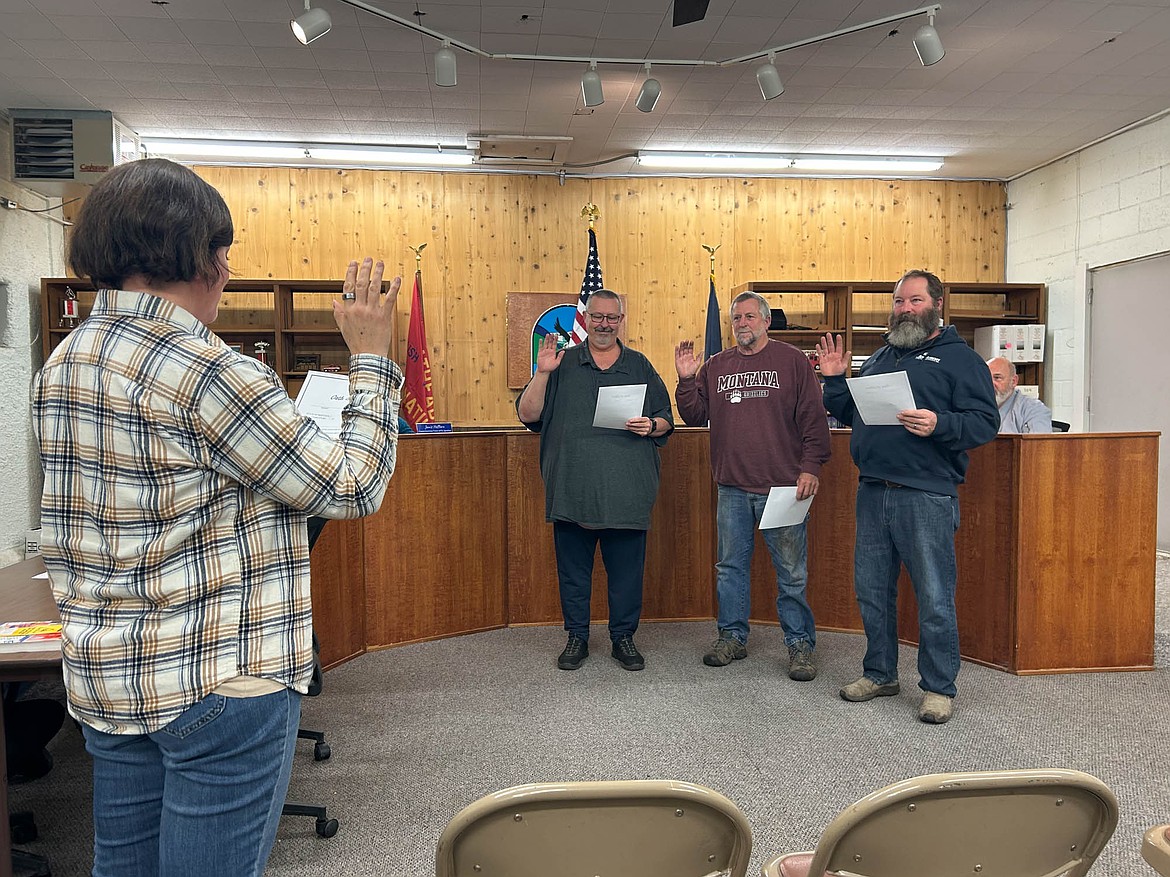
The town clerk/treasurer Amberly Walker swears in elected officials who will take office starting Jan.1. These included Mayor Daren Incasola, whose race was uncontested, and council members Steve McCollum and Chris Heffern. (Emily Messer/Leader)
Emily Heimark (Messer) joined the Lake County Leader in July of 2025 after earning a B.A. degree in Journalism from the University of Montana. Emily grew up in the rolling hills of southeast Missouri. She's lived in Montana since 2022 and honed her reporting craft through the UM J-School newspaper and internships at the RMEF Bugle Magazine and the Missoulian. At the Leader, she covers government, business, education, agriculture and community news. Contact Emily Heimark at [email protected] or 406.883.4343 | December 10, 2025 11:00 PM
The St. Ignatius Town Council passed the first reading of its golf-cart ordinance and swore in the returning council members during last week's meeting on Dec. 2.
The golf-cart ordinance would allow carts to be driven on city streets once again. Due to St. Ignatius citizens requesting the return of this ordinance and improved safety features on these carts, council president Daniel Thompson decided to present it to the council.
The ordinance follows state law, which authorizes carts on city streets as long as they have head lamps, a horn, rear-view mirror and a reflector. The golf cart must go slower than 25 miles per hour, and the driver must have a valid driver’s license.
The golf cart must also be registered through the county and follow any motor vehicle regulations. The second reading of the ordinance will occur during next month’s meeting on Jan. 6 and if passed it will be a town ordinance within the following 30 days.
The town clerk/treasurer Amberly Walker swore in the council members that will take office starting Jan.1. Mayor Daren Incasola was uncontested and councilman Chris Heffern and former mayor Steve McCollum won a four-way race for council.
McCollum was elected mayor in 2017 and previously served on the council for 12 years, according to Lake County Leader reporting.
St. Ignatius Police Chief Jason Acheson also provided an update on department grants. The department was awarded a $5,000 High Visibility Traffic Enforcement Mini Grant from the Montana Department of Transportation Highway Traffic Safety Section.
According to Acheson, this will allow the department to work overtime for holidays, special events, community traffic enforcement needs, or special operations. This is for high traffic visibility presence, which includes DUI shifts or seatbelt-related shifts for citing drivers who are not wearing seat belts.
Acheson also recently applied for a $2,200 Mason Moore Foundation grant to purchase three patrol rifles. He explained that the current rifles he has are 30 years old, two of which he’s had issues with. Acheson said he will know if this grant is approved in February.
Acheson also applied for the Sexual Assault Kit Initiative grant, which would provide his evidence locker with new shelving and a cooler for assault-related evidence. He said he should hear if this is approved or not by Dec. 31.
ARTICLES BY EMILY HEIMARK
Proposed changes to City of Polson government to appear on ballot
The Polson Local Government Review Study Commission completed its report earlier this year, and the proposed changes to the city charter and supplementary report of action to be taken will appear on the November ballot.

Native cowboy from Mission Valley travels to Kyrgyzstan for Nomad World Games
Reaching down from the back of his horse, he grabs the goat carcass, a total of 80 pounds of dead weight, as dust strikes him in the face; the adrenaline rush is never-ending, and the physical demands on his body are unreal.
Rollins Fire completes community-funded addition and remodel
After outgrowing its space, the Rollins Volunteer Fire Department sought support from the community and raised $2.2 million to fund necessary upgrades and a station addition.