
SRS Act would benefit Shoshone County
JOSH McDONALD | Hagadone News Network | UPDATED 3 hours, 26 minutes AGO
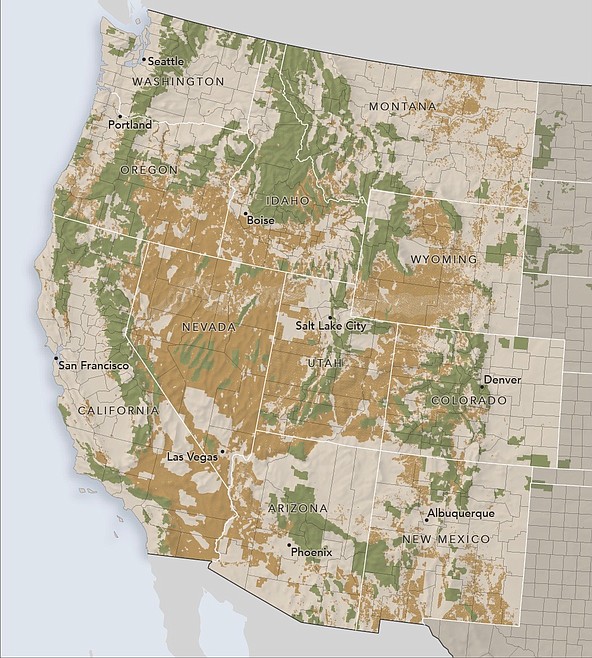
This map shows both lands managed by the United State Forest Service (green) and the Bureau of Land Management (tan), these lands are all accounted for when determining Secure Rural Schools (SRS) funds.
Courtesy image
The U.S. House of Representatives on Tuesday overwhelmingly approved Sen. Mike Crapo’s bipartisan bill to restore funding for rural counties, including those in Idaho, through the Secure Rural Schools program. The measure passed 399-5 and now heads to President Donald Trump’s desk for his signature.
The SRS Reauthorization Act extends funding for the U.S. Forest Service’s program through 2026, providing millions of dollars to counties that rely on federal timber receipts. Locally, Shoshone County uses these funds to support rural schools and maintain county roads.
“The SRS program is vital to maintaining schools, roads and emergency response services in rural, forested counties,” Crapo said. “We have a responsibility to these communities who house large swaths of untaxable federal land."
The passage of the legislation will provide retroactive pay to counties that faced deep cuts since the program’s expiration at the end of Fiscal Year 2023 and restore funding levels for FY 2026, he said.
The SRS program, created by Congress in 2000 under the Secure Rural Schools and Community Self-Determination Act, was designed to stabilize funding for counties that depend on federal forest lands. Today, it provides financial support to roughly 700 counties nationwide for schools, roads, and other essential services.
In 2024, Shoshone County received $2.8 million in SRS funds for Fiscal Year 2023. Sixty percent of that went to the county's roads department, and the remaining 40%, or $1.12 million, was divided up between the three school districts.
The Kellogg School District received the largest portion at $400,000; Wallace and Mullan split the remaining $700,000.
For school districts in the Silver Valley, the funding is essential, although it can be unpredictable.
“We utilize SRS funds for capital projects,” Lance Pearson, Kellogg School District superintendent, said. “Because of the process by which the funds are allocated, they have proven difficult to rely on and are known as ‘one-time funds.’"
He said they typically use SRS funds for maintenance and improvement projects, not wages, because the fluctuation creates significant budgeting issues.
Wallace School District Superintendent Todd Howard echoed those concerns, noting that funding has declined since the original act lapsed.
“The passing of the SRS Reauthorization Act is key to the WSD, the other Silver Valley school districts, and the county,” Howard said. “Our funding amounts have declined each year. The WSD has received less than half of what we received in 2017. Recently, we’ve used SRS funds for curriculum, buses, technology equipment, and facility maintenance. We only use them for one-time expenses because we never know for certain that we will receive those funds.”
The impact extends beyond schools. Shoshone County Public Works Director Jessica Stutzke said the funding is “vital” to her department’s operations.
“We couldn’t be more grateful to see this pass,” Stutzke said. “We had to make the tough decision to cut roughly 40% of our current budget this year due to the absence of these funds and a decrease in projected state revenue.”
Stutzke's department utilizes SRS money to fund road maintenance and repair projects, many of which were on the chopping block after she was forced to slash her annual budget by 40% due to revenue shortfalls.
Stutzke plans to meet with the Board of County Commissioners to discuss how the restored funding will affect the county’s fiscal year budget.
ARTICLES BY JOSH MCDONALD
Floodwaters recede in Shoshone County
Several roads remain closed
Several roads remained closed Saturday, according to the Shoshone County Sheriff’s Office, including Elk Prairie Road into Calder, CCC Road and sections of Old River Road. Ot
Floodwaters recede in Shoshone County

SRS Act would benefit Shoshone County
Shoshone County received $2.8 million in Secure Rural Schools funds for Fiscal Year 2023
The SRS program, created by Congress in 2000 under the Secure Rural Schools and Community Self-Determination Act, was designed to stabilize funding for counties that depend on federal forest lands. Today, it provides financial support to roughly 700 counties nationwide for schools, roads, and other essential services.