
City concerned sewer system could be bottleneck for growth
Hungry Horse News | UPDATED 1 day, 2 hours AGO
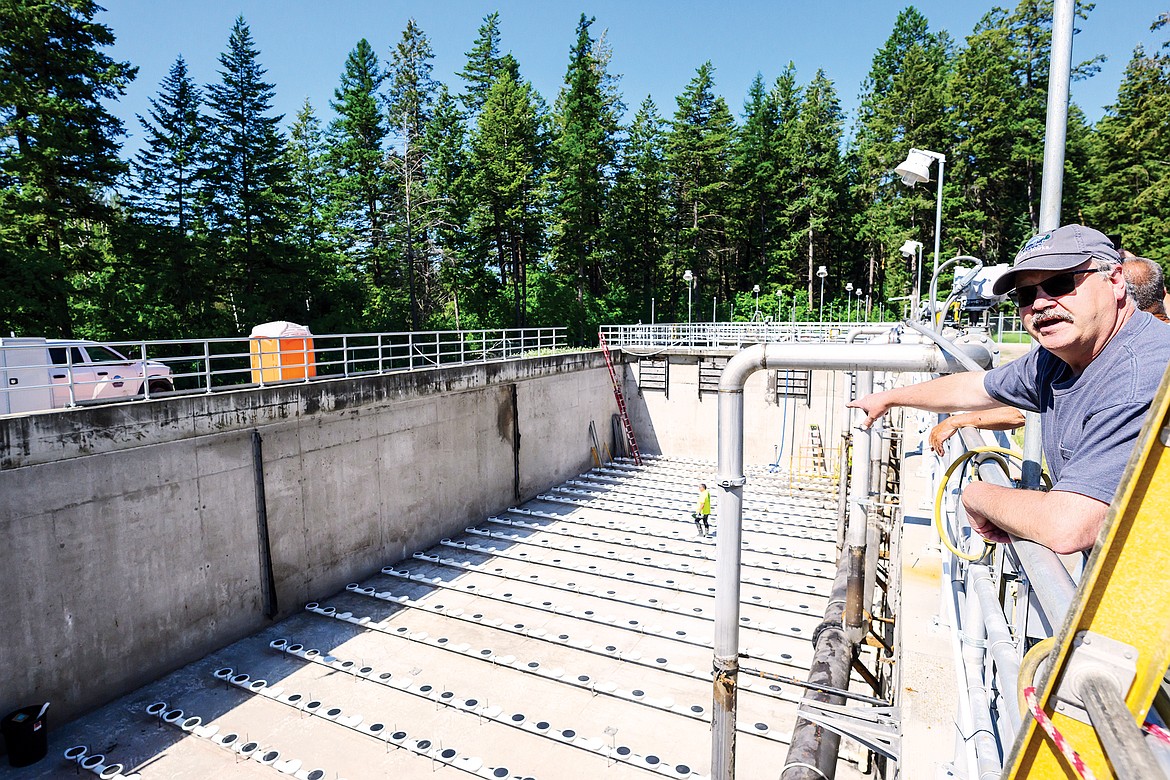
Wastewater treatment plant manager Grady Jenkins points to the plant’s new bioreactor earlier this year. The plant runs well, but may need even more upgrades to accommodate future growth.
The City of Columbia Falls could see a significant bottleneck in future growth due to its sewage treatment plant, depending how the city and the state calculate the sewage treatment plant’s maximum treatment capacity without a major upgrade.
The city currently serves about 6,576 people including its contract with Meadow Lake Resort, which is about 500 people in the winter and about 1,000 in the summer months.
The city has already committed to developments that amount to 540 more people. That includes 32 townhomes, the Garnier Heights subdivision and the Tamarack Heights subdivision.
But in the near term, there are developments currently awaiting city review that could bring 1,560 more people to Columbia Falls. The largest development is Teakettle Heights on the former Columbia Falls Aluminum Co. Plant lands by developer Mick Ruis, which would bring about 844 more people; River Highlands, east of the Flathead River at 438 people; 68 more people from an apartment complex at Meadow Lake Boulevard, and 180 people from a proposed hotel from guests and staff at the former Lazy Day Trailer Court, city manager Eric Hanks said in a report to the city planning commission and city council in the past week.
(The residents of the trailer court were evicted earlier this year and their numbers were reduced from the overall city estimates, since the trailers have been disposed of.)
Add up the committed and near-term future growth and that’s about 2,100 residents.
Now mix in the sewage calculations. The city and its engineers are at a bit of a quandary with how to calculate the plant’s maximum monthly flow.
If they average in a 2022 June rain and flood event, it’s about 630,000 gallons, based on a 2023 study of the plant. The plant’s treatment capacity was lowered in that study, perhaps ironically, because people are using less water, and thus the sewage is more concentrated and is a bit more challenging to treat as a result.
“Assuming a current service population of 6,280, this (June 2022) calculation will reduce the 2023 projected wastewater treatment plant service population of 8,174 to 7,392 (782 person decrease),” Hanks noted in his report.
In other words, the city would be able to serve about 800 less people if it factors in the June 2022 event.
In June 2022, from June 10 to June 15, Glacier Park International Airport recorded 4.5 inches of rain. At Hungry Horse, there was 6.25 inches of rain and one station in West Glacier recorded 6.75 inches of rain from June 10 through June 21.
When asked by the Hungry Horse News whether last week’s high-water event in Columbia Falls would also be calculated in, city staff didn’t have an immediate answer. While it hasn’t been nearly as wet as June of 2022, (which saw localized flooding at Trumble Creek and minor flooding in the mainstem Flathead River) Meadow Lake’s sewage discharge alone surged last week, from about 28,000 gallons to more than 109,000 gallons.
In Columbia Falls, there was about 1.5 inches of rain on top of a foot or so of snow last week. The snow all but melted. In Hungry Horse, it was worse, with 4.55 inches of rain at the Hungry Horse Dam on top of the snow, according to figures provided by the National Weather Service in Missoula. West Glacier also saw 4 inches of rain.
Last week at Meadow Lake, there was 78,000 gallons of what’s known as infiltration and inflow --- rainwater and other water that gets into the sewage system.
By comparison the entire city had 81,000 gallons on inflow and infiltration last week.
The sewage plant itself can easily handle about 2 million gallons of water a day, so it wasn’t close to overflowing. The overall capacity is much higher than its permitted treatment capacity.
The plant itself has been running well, running well below state standards for discharge into the nearly pristine Flathead River, as it has already seen $4 million in upgrades that were finished this year.
Hanks urged the commission to consider prioritizing the sort of housing and development it would like to see in the future.
But the commission was hesitant to make any sort of commitment until it had firmer data to work with and also legal advice from city attorney Justin Breck in the matter.
“At the end of the day it’s a complex discussion and we don’t have all the parts,” noted planning commission chair Darin Fisher.
But Monday, some councilmembers had thoughts. Councilman John Piper, cited the recent housing study, which called for housing, not hotels.
However, the current zoning allows for a hotel at that location, noted city planner Eric Mulcahy. It doesn’t have to go through subdivision review.
City councilwoman Kathy Price wanted to prioritize single family homes.
Mayor Don Barnhart was concerned that the engineering studies, depending on the outcome, could stymie city growth.
But Hanks said the question on how to determine the sewage treatment plant’s treatment capacity was a technical one, not a political one.
The political side was what kind of housing the city wanted to prioritize.
Breck, who was at the city council meeting, weighed in, saying the city should keep housing price point in mind, when pondering the question.
The city council took no formal action, but is anxiously awaiting a final determination by staff and the engineers on the plant and any future upgrades the system might need.