
P&Z recommends STR code change to council
JACK FREEMAN | Hagadone News Network | UPDATED 3 months, 3 weeks AGO
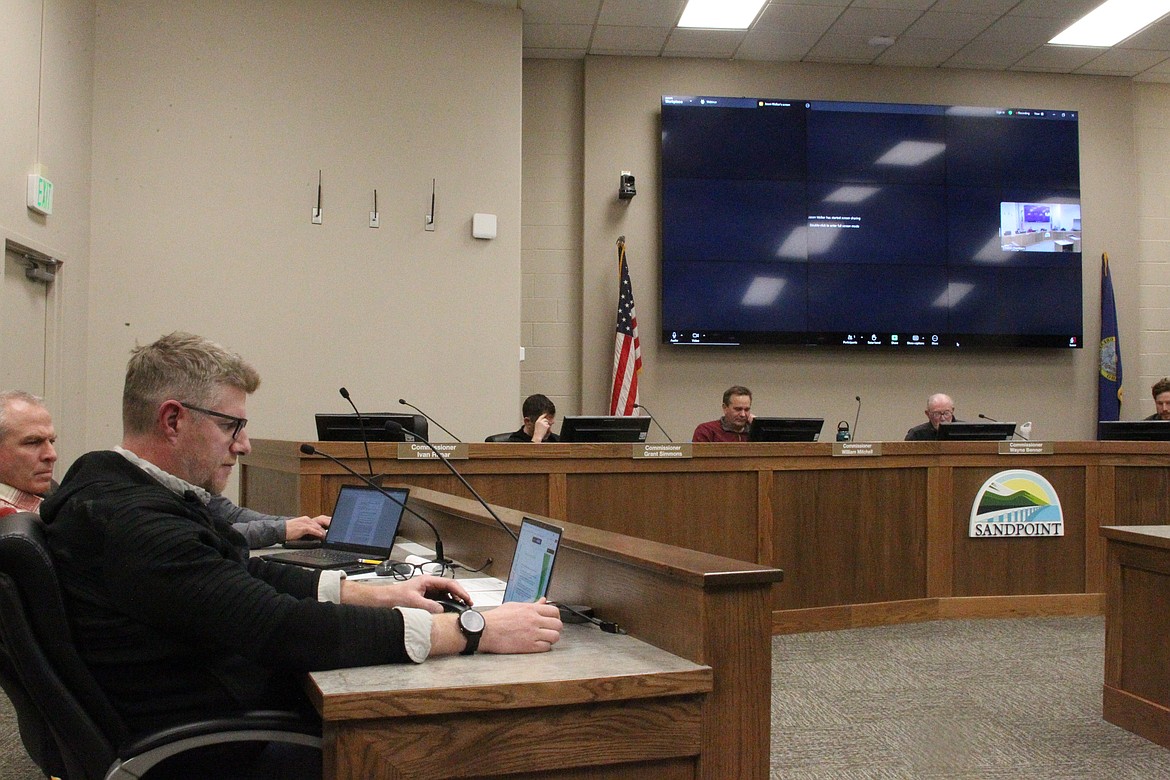
Planning and Zoning commission members before taking a vote on the short-term rental code changes.
Photo by JACK FREEMAN
SANDPOINT — The Planning and Zoning commission recommended the changes to the city’s short-term rental ordinance to the City Council in a reluctant, but unanimous vote.
After over an hour of discussion, public comment and deliberation, the commission sat silent for a full minute waiting for a motion to recommend the change to City Council. Commissioner Reid Weber said the state law seems black and white, and that he felt like the city’s hands were tied.
“It would be hard for me to say, ‘Okay let’s go to battle against the state of Idaho’ as a city of Sandpoint Planning and Zoning commissioner,” Weber said. “That’s where I’m coming from and leaning toward passing this along to the city council.”
The changes to the STR code include removing the citywide 35-unit cap on non-owner occupied STRs in residential zones as well as increasing regulations around parking and occupancy. City Planner Bill Dean said those two aspects where the only two staff could hone in on to strengthen the city's regulations.
Planning and Community Development Director Jason Welker said the city had to remove the cap to bring its ordinance in-line with state law and the Idaho Supreme Court’s ruling in the case of Idaho Association of Realtors v. City of Lava Hot Springs.
In that case, the Supreme Court found that the Lava Hot Springs’ cap of zero STRs in residential zones was in violation of state law 67-6539 or Short-term Rental and Vacation Rental Act. Welker said the city was also warned that its 35-unit cap had them in the crosshairs of a possible legal challenge.
Zachary Jones, the city’s legal counsel, said the Supreme Court's decision allows cities to regulate, but not prohibit STRs in city limits. Jones added that a regulation could not amount to a prohibition by being unreasonable, using the example requiring all STRs to have 10 off-street parking spaces.
"My thought on that is that the 36th applicant is prohibited from having a short-term rental,” Jones said. “Whether you make that number 500, the 501st applicant is prohibited from having a short-term rental. So, the first 500 might not have a cause of action, but as soon as you cross that line, then someone could.”
Additionally, the amended code requires any STR in a residential zone that is advertised for 11 or more people to get a high-occupancy short-term rental permit. Those permits will go through the P&Z commission and public hearing process, if the amended ordinance is adopted.
Commissioner Grant Simmons said he was concerned about the unintended consequences of removing the cap in the future, by making the city a destination for investments. However, Simmons said that the city’s ordinance needed to be lawful.
Welker said there are currently around 200 STRs in Sandpoint, and 18 property owners are currently on the city’s waitlist to acquire a permit for a non-owner-occupied STR. He said the market should respond to an increase in STRs and over time an equilibrium should be found.
“It’s probably not going to be as dramatic as like a sizeable percentage of our housing market is converted to short-term rental lodging,” Welker said.
Public testimony was limited with only three people signing up to speak, two of whom were opposed to getting rid of the cap. Both, Rebecca Holland and Tari Pardini, said they’d like to see Sandpoint attempt to fight a legal challenge and that they believed the 35-unit cap was regulation and not a prohibition.
The lone speaker in favor, Pat Green, a real estate agent who lives in Sagle, said he sold a home he owned in Sandpoint because the cap didn’t allow him to run a STR there. He said he believes removing the cap will allow for more families in Sandpoint to keep property in the city.
Welker said despite removing the cap, he believes Sandpoint’s STR ordinance will remain the strongest in the state of Idaho. Dean said he and Welker put a lot of time into researching other city’s ordinances to find anyway to tighten restrictions.
In his presentation, Welker warned of a bill backed by Airbnb lobbyists that is headed to the Idaho Legislature during its next session. According to his summary of the bill, Welker said it would mean STRs do not have to register with cities for permits, and STRs would be treated like any other residential building.
"There is no end to their greed and their desire to deregulate, Idaho is being used as a test case right now,” Welker said of the lobby group backed by Airbnb. “They are seeing if they can get total annihilation of short-term rental regulations in Idaho and then they’ll move on to other states.”
After the recommendation, the amended ordinance will now move to the Sandpoint City Council for a final decision at a meeting next year.
The red-lined ordinance can be found in full in the meeting’s agenda packet at sandpointidaho.gov/meetings/recent. The entire commission meeting is available to watch on the city’s YouTube channel at youtube.com/@cityofsandpoint.
ARTICLES BY JACK FREEMAN

Outgoing POP executive director wins statewide award
That effort combined with the construction of nearly 20 miles of new trail and a new trail management plan has earned her the 2026 Professional Award for Parks, Trails, or Conservation from the Idaho Recreation and Parks Association.

APRIL NIBJ: Nonprofits help people follow their life’s compass
Kanning’s story isn’t unique, ask any worker at one of the 500 nonprofits in Bonner County are you’ll likely hear the same reason for working: it feels right.

Ponderay to begin Black Rock clean-up project
With the approval of a memorandum of agreement with Sandpoint on Wednesday evening, the city of Ponderay is now able to begin its Black Rock clean-up project next week.