
ITD: Idaho crashes on rise
Coeur d'Alene Press | UPDATED 10 hours, 46 minutes AGO
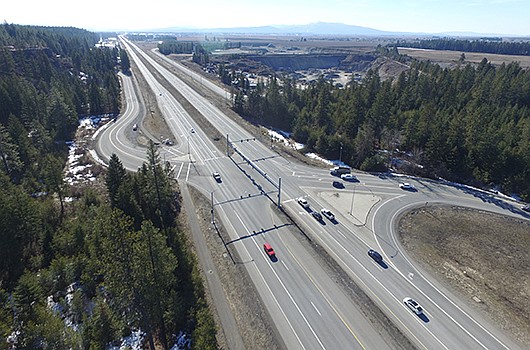
According to the Idaho Transportation Department, trafic accidents in the state are increasing. Shown here is the U.S. 95, Highway 53 interchange.
As federal officials estimate that more than 39,000 people died in U.S. traffic crashes last year alone, new AAA research shows strong public support for improved safety countermeasures, a press release said.
Two-thirds of survey respondents say that there should be laws requiring all new vehicles to feature alcohol-impairment prevention technology as standard equipment.
Last year, nearly 1,700 crashes in Idaho involved an impaired driver, with 86 fatalities.
“Every year, drivers voice strong opinions that we should address and eliminate risky behavior on the roads,” said AAA Idaho public affairs director Matthew Conde. “However, we need everyone on board to make meaningful progress.”
According to the Idaho Transportation Department’s 2024 Idaho Traffic Crashes report, the total number of crashes increased by nearly 2% to 28,158 crashes, while the number of traffic deaths decreased by nearly 10% to 219 people. Still, there is more work to be done.
“Until we get every single person home safely, there are opportunities to improve, whether it be through education, better infrastructure, enforcement, or other mechanisms,” Conde said. “There’s a lot we can learn from the data.”
Key AAA findings
Impaired driving
• 93% of American drivers say it’s very or extremely dangerous to drink and drive, yet 7% admitted driving when they believed they were impaired by alcohol.
• 60% believe that they will be caught after drinking enough to be over the legal limit.
• 51% support reducing the legal limit from 0.08 to 0.05 blood-alcohol content.
The impairing effects of prescription medications are less understood — just 85% perceived their use as very or extremely dangerous. Remember — impaired is impaired!
Last year, nearly 1,700 crashes in Idaho involved an impaired driver, with 86 fatalities.
Distracted driving
• Nearly all drivers see scrolling (97%), texting (94%), and reading on a phone (90%) as very dangerous, yet 28% reported texting and 37% read messages in the previous 30 days.
ITD reports a nearly 7% drop in distracted driving crashes (4,435) and a 6% increase in distracted driving fatalities (51 deaths) last year.
Aggressive driving and speeding
• 90% of survey respondents said that aggressive driving is extremely dangerous, and 80% felt the same about deliberately running red lights when they could have stopped.
• 58% think they’d be caught speeding 15 MPH over the limit, yet half had done so recently.
ITD reports a slight drop in aggressive driving crashes (including speeding) of 0.4% to 13,899 crashes. While there was also a 27% drop in aggressive and speeding-related deaths, 75 people still lost their lives on Idaho roads in these crashes.
“Please consider that while 75% of all aggressive driving crashes happen in urban areas, 76% of the fatal aggressive driving crashes happen in rural areas,” Conde said. “Rural roads can be windy, there may be trees, ditches, and other hazards, and you’ll certainly encounter more wildlife."
Drowsy driving
• 93% of drivers believe being sleepy behind the wheel is very or extremely dangerous, while 97% say that family members would disapprove of drowsy driving. However, 19% admitted to doing so at least once in the previous 30 days.
Perceptions about roadway safety
• 93% of drivers believe that local government shows at least some concern about roadway safety. 17% felt these efforts had improved in recent years, while 71% felt they had stayed the same.
• 96% of all respondents expressed concerns about roadway safety, with 41% thinking more about it in recent years.
• Most concerns focused on unsafe driving behaviors, such as distraction (24%), speeding (16%), impairment (14%) and aggressive driving (11%).
• Half of drivers reported changing their behaviors in recent years to reduce the risk of being in a crash, with 40% saying they drive more defensively, 30% trying to not exceed the speed limit, and 10% further reducing phone use or increasing following distance.
For this year’s research, AAA has learned that the prevalence of drivers in the Distracted and Aggressive categories has increased, with a slight dip in Speeding Drivers.
“The vast majority of drivers believe that dangerous driving behaviors are not only wrong, but also socially unacceptable,” Conde said. “There may be a temptation to rely on personal experience or to justify risky behavior, but don’t fall into that trap.":