
Judge says Montana wolf hunting and trapping season quota can continue
MICAH DREW Daily Montanan | Daily Inter-Lake | UPDATED 4 hours, 6 minutes AGO
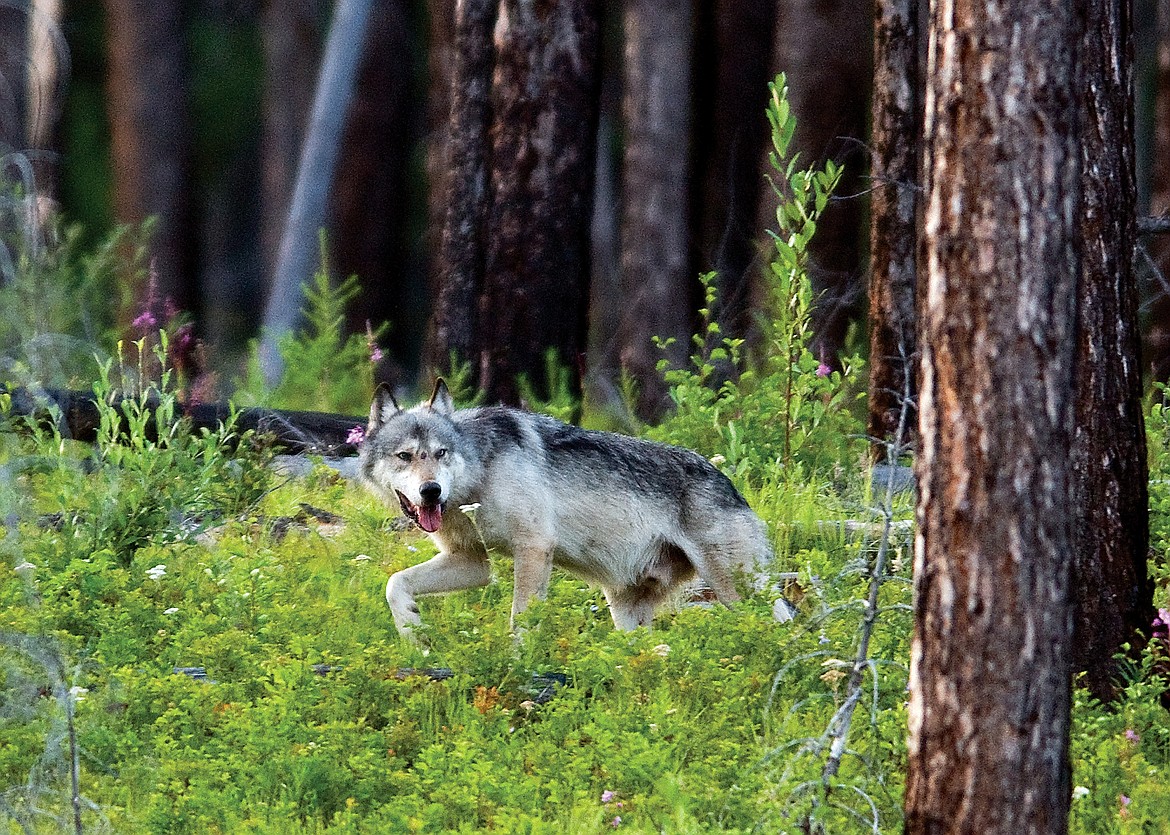
A gray wolf walks through the woods in Glacier National Park up the North Fork in this file photo. (Chris Peterson/Hungry Horse News)
A Lewis and Clark District Court judge has ruled that Montana’s current wolf hunting and trapping season can continue, despite several conservation organizations submitting a petition to halt the season they allege could spell disaster for the state’s wolf population.
The decision on Friday by Judge Christopher Abbott came down against the conservation organizations that had sought an injunction against the state, arguing that the statewide harvest quota of 458 wolves is too high, threatens the survival of gray wolves in Montana and violates the state constitution.
“We are deeply disappointed that Montana’s wolf eradication agenda will continue,” Lizzy Pennock, carnivore coexistence attorney at WildEarth Guardians, said in a statement. “Wolves, and anyone who values them and the ecosystems they support, will pay the price. While we lost this battle, our lawsuit is far from over, and we will not stop fighting to protect this essential, intelligent wildlife.”
The emergency petition seeking an injunction was filed this fall against Montana Fish, Wildlife and Parks, and the Fish and Wildlife Commission, which sets department policies and regulations. Conservation groups WildEarth Guardians, Project Coyote, Footloose Montana, and the Gallatin Wildlife Association argued against the increased wolf quota as the latest part of a larger ongoing lawsuit about the state’s management of the species.
A spokesperson for FWP said that the department does not comment on ongoing litigation.
Also this fall, a pair of Republican lawmakers and two sportsmen’s organizations filed an opposing lawsuit in Sanders County arguing that the state was not complying with laws intended to reduce the wolf population and should raise the quota. The sportsmen’s organizations filed as intervenors in the petition over hunting quotas Abbott ruled on last week, but their other suit is still pending.
The latest court action is a continuation of arguments that played out during the 2025 legislative session — and statewide for more than three years — pitting legislators and advocates for reducing the state’s population of roughly 1,100 wolves against those seeking to preserve and protect the species.
At the heart of the most recent legal action are the 2025 wolf hunting and trapping regulations, adopted by the Commission in August, which set a statewide harvest quota of 452 wolves, plus two additional three-wolf quotas for hunting areas outside Yellowstone National Park. An additional 100 wolves are authorized for removal by the department for cases of conflict with livestock or humans.
Hunters and trappers killed 297 wolves last season, while the most killed in a season was 326 during 2020. The quota for wolf harvest has not been met by hunters and trappers in recent years. A total 348 wolves were killed through hunting and trapping or management removals in 2024.
According to FWP’s latest population survey, there are an estimated 1,091 wolves in Montana, a dozen fewer than the 2023 population estimate and slightly lower than the 10-year average of 1,138 wolves.
The state population of wolves is a major point of contention in the lawsuit filed by the conservation groups.
State wildlife managers use an “integrated patch occupancy model,” or iPOM, methodology to determine wolf abundance. The method has drawn criticism from some researchers who say it is an inexact count based heavily on wolf sightings by hunters, as well as from traditional field work.
Conservation groups have often said relying on iPOM greatly overestimates population numbers, and therefore a high mortality rate due to hunting and trapping could have a greater impact on wolf numbers than anticipated.
Although the judge said the quota could stand, he also raised questions about the state’s methods for determining wolf numbers.
“The court decision also underscored that serious and valid questions exist about the reliability of how the Department of Fish, Wildlife & Parks (FWP) estimates wolf populations, and that these problems could potentially result in inadequate protection of Montana’s wolves over time,” according to a press release by the plaintiffs.
The conservation organizations have been battling the state through the court system since 2022 over the state’s management of wolves and the hunting and trapping regulations.
In seeking an injunction against the latest iteration of regulations — with the increased wolf quota — the plaintiffs used a claim that increased wolf killing infringed on the state’s constitutional right to a clean and healthful environment.
But the state, and sportsmen’s groups that intervened in the suit, argued that a clean and healthful environment “does not reach wildlife regulation.”
Abbott agreed with the conservation organizations, saying that it is likely “wolves are sufficiently integral to the ecosystem that their continued existence at a level sufficient to sustain their population in perpetuity and positively contribute to the ecosystem forms part of the ‘environmental life support system’ of the state as contemplated by the Constitution.”
However, he also wrote that the plaintiffs had not successfully argued that wolves “are on the verge of irreparable injury based on current estimated numbers,” and halting the current hunting and trapping regulations could cause harm to individuals and businesses that have made plans for the season.
The conservation organizations, in a press release, said that denying the emergency petition will “allow the state to kill over half the estimated wolf population.”
“Although this ruling is a severe setback for Montana’s magnificent wolves, the resulting slaughter will only strengthen our ongoing case for the protection of this vital species,” said Connie Poten, board chair of Footloose Montana. “The fight for wolves is deep and broad, based in science, connection, humaneness and necessity. Wolves will not die in vain.”
While the request for an injunction was denied, Abbott did allow the conservation groups to amend a previous complaint to allege the state’s 2021 wolf statues and regulations also infringe on the right to a clean and healthful environment, calling it “not untimely,” and opening the door for further arguments under that claim.
“The proposed amended causes of action are but a riff on the themes that have already run throughout this litigation,” Abbott wrote, adding that “little would be accomplished by denying amendment.”
The overarching lawsuit is expected to go to trial in 2027.