
THE DIRT: Historic pollution study of the Coeur d’Alene Basin
Shoshone News-Press | UPDATED 11 hours, 7 minutes AGO
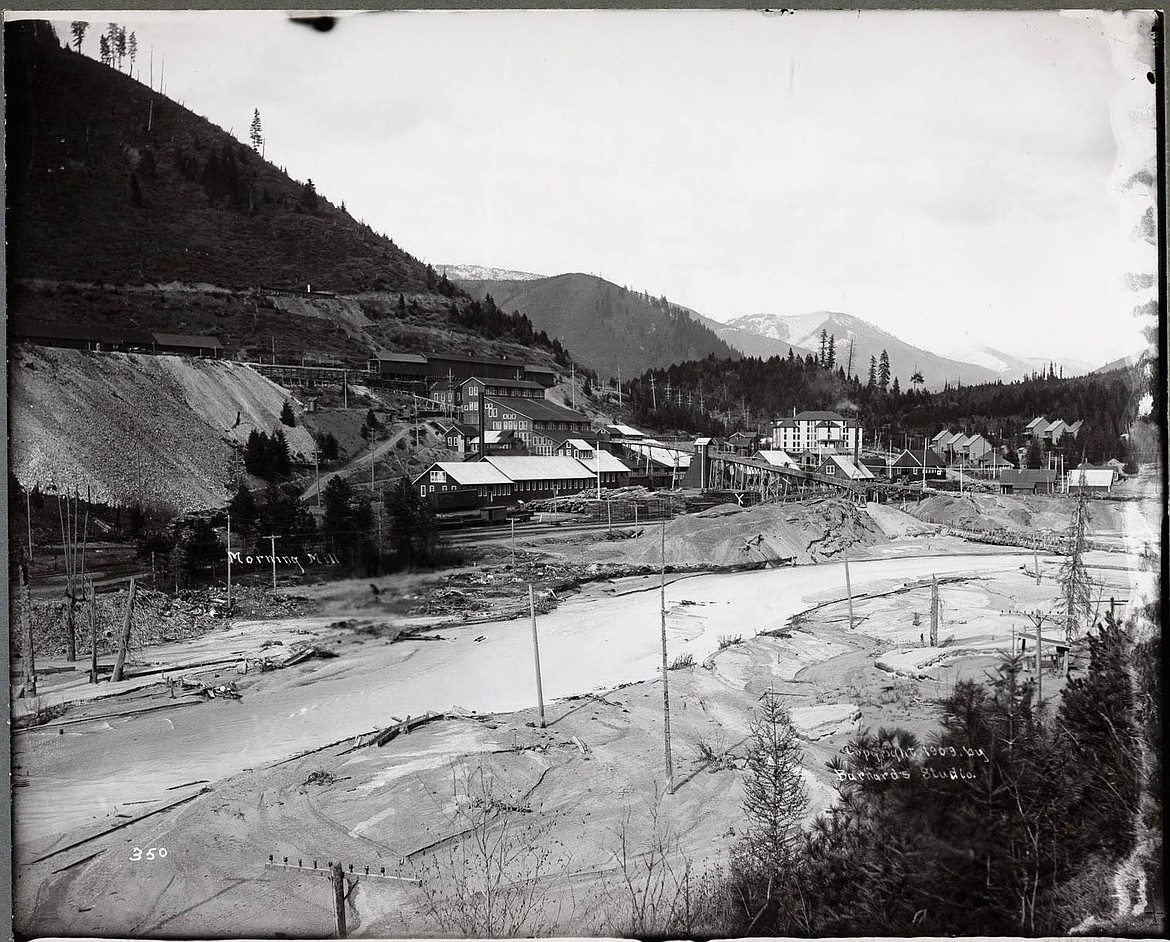
This photo shows the Morning Mill in Mullan circa 1909. You can see the direct discharge flume from the mill going into South Fork Coeur d'Alene River.
Courtesy photo
Today, the waters of the South Fork and the main Coeur d’Alene Rivers run clear as they meander across the lush landscape of the Idaho Panhandle, but in the not-so-distant past those waters ran cloudy gray with the discarded tailings and byproducts of mining in the Silver Valley.
As one of the most productive mining regions in the country, the Coeur d’Alene District produced record amounts of lead, zinc, and silver ore, but also created vast quantities of waste. Most mine sites were in the deep, narrow gulches of the mountains, making waste storage and disposal difficult.
With limited space and minimal flat ground, it became common practice to dispose of the waste rock and mill tailings directly into nearby creeks, which washed much of the waste away. Smaller creeks carried waste to the South Fork, where materials settled and continued to travel downstream, billowing out into the main Coeur d’Alene River channel. Waste began building up and collecting along riverbanks and the bottom of the river, creating sizeable deposits and manmade sandbars down its length. While common and legally permitted, disposing of waste into area water bodies was not welcomed by all, especially those living downstream in the region known as the Lower Basin.
An area of rich fertile land, the Lower Basin had been homesteaded by ranchers and farmers to grow crops, rear livestock, and raise their families. These early settlers began seeing dramatic changes to the landscape as mining waste began to infiltrate the area.
Waste material from area mines first reached Lower Basin farms and communities as visible pollution in the 1890s. By 1900 the farmers began to complain that these sediments were causing illness and poisoning crops and livestock.
In 1904, sixty-five Kootenai County farmers filed suit against several mining companies seeking more than $1.2 million in damages. In a separate action, they sought a permanent injunction against waste discharged into the river by these companies. The mining companies, represented by the Mine Owners Association (MOA), successfully defended the preferential status of miners’ water rights in the mining district, claiming that the waste was harmless, and offered the economic importance of mining as a justification for their dumping policies.
The damage suit ended two years later when the jury was directed to award the farmers one dollar, a far cry from the $1.2 million they originally sought. In anticipation of additional cases, the MOA started a program to indemnify all property owners along the South Fork and the main Coeur d’Alene River against possible future damages. The MOA shared the cost of purchasing overflow and pollution easements, which released companies from all past and future pollution claims.
In 1929, Harrison banker and Kootenai County Commissioner E. O. Cathcart took John Knox Coe, the city editor of the Coeur d'Alene Press, on a boat tour of the Lower Basin to show him the devasted waterways, landscapes, and abandoned farms dotting the banks of the river. After seeing the damage firsthand, Coe began a new campaign effort to abolish the practice of direct discharge disposal in the Silver Valley.
Coe published an eight-part series in the Coeur d’Alene Press called “The Valley of Desolation”, documenting the conditions of the Lower Basin and telling stories of ranchers and farmers whose lives were left in ruin following the destruction of their crops and livestock by mine waste. Coe solicited support for his campaign from local civic and outdoor groups as well as local politicians, including Congressmen Burton L. French of the First Idaho District.
By March of 1931, this extra attention and mounting political pressure led the state legislature to authorize and finance a study by the Idaho Pollution Commission.
Learn more about how this study influenced past and current cleanup efforts in the Coeur d’Alene Basin in part two of this series.
The Dirt is a series of informative articles focused on all aspects of cleanup efforts associated with the Bunker Hill Superfund Site. Our goal is to promote community awareness of contamination issues, to provide tools for protecting public health, and to keep the community informed of current and future cleanup projects. The Dirt is a group of committed and local experts from multiple agencies, including the Basin Environmental Improvement Project Commission, Panhandle Health District, Shoshone County, Silver Valley Economic Development Corporation, and the Idaho Department of Environmental Quality.