
For Mitchell, it’s been a rewarding career leading the Glacier National Park Conservancy
Chris Peterson | Hungry Horse News | UPDATED 17 hours, 45 minutes AGO
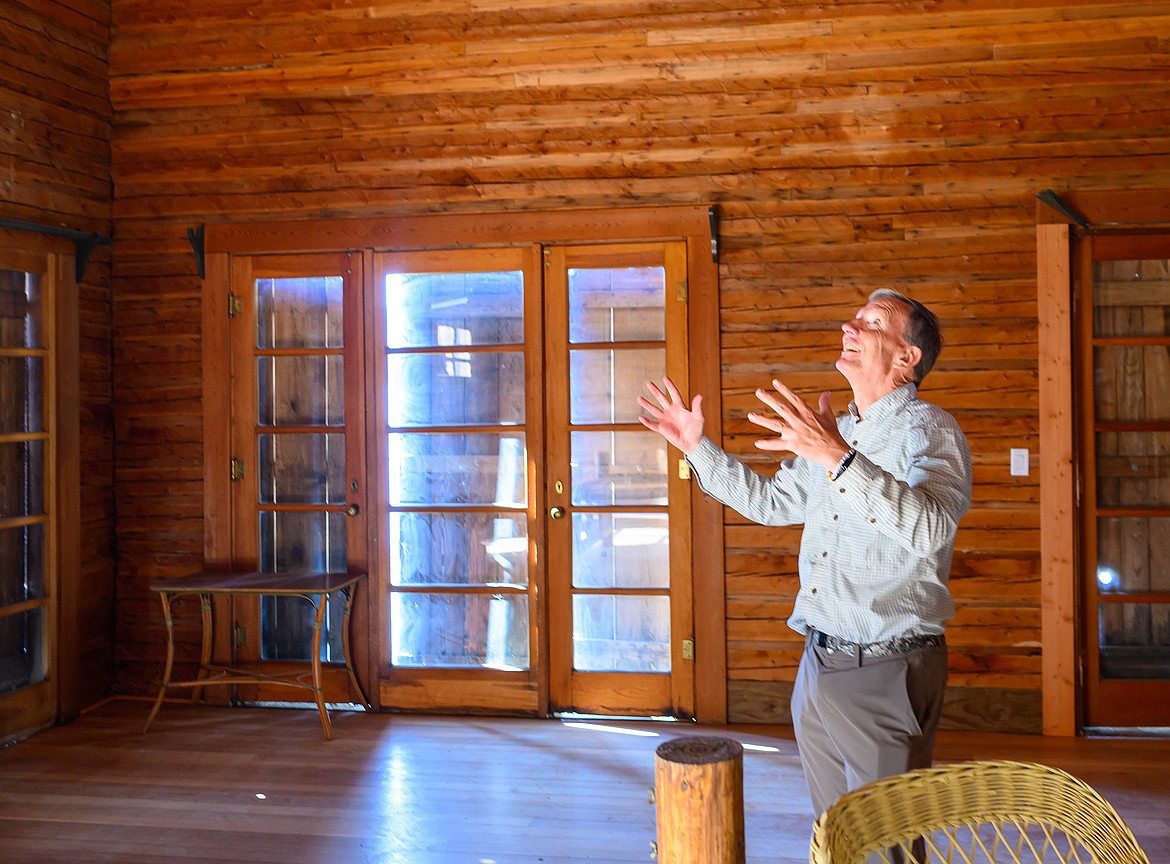
Doug Mitchell marvels at the restored Wheeler cabin during a tour in September.
Glacier National Park Conservancy Executive Director Doug Mitchell will soon retire, having more than doubled the nonprofit’s giving to Glacier over his 10-year tenure at the helm of the Columbia Falls-based operation.
When Mitchell first took the job in 2017 the board of directors told him he’d have to “just soak” in the experience for a few months.
“But then we had the Sprague Creek Fire and it burned Sperry Chalet,” Mitchell said in a recent interview. “My soak turned into a very steep learning curve.”
Mitchell immediately went to work raising funds to rebuild the chalet, high in Glacier’s backcountry, more than 6 miles from the road and nearly straight uphill at that.
The Conservancy played a key role in getting emergency funding to stabilize the structure through the winter of 2018 and continued to support the project through the reconstruction phase, most notably paying to have the kitchen crew work through the summer months so construction workers could live on site.
It was a remarkable partnership between the Conservancy, the Park Service and private donors and became a defining moment for the Conservancy, proving that the organization could execute and accomplish emergency help for Glacier in just a few weeks.
For Mitchell, it was literally a trial by fire and a rather successful one at that. Today, Sperry welcomes hundreds of guests each summer and thousands more day hikers.
Mitchell was no stranger to getting things done however. Prior to joining the Conservancy he was deputy Secretary of State under Mike Cooney and Sen. Max Baucus’s Montana Chief of Staff for five years. He was also deputy director of the state Department of Commerce under then Gov. Steve Bullock.
He grew up in Marin County, California and met his wife Julie while in college. They moved to Montana and raised their two sons here while Mitchell worked in Helena, where they still have a home today.
He said he joined the Conservancy at the age of 57 to “give back to the place that gave (my family) so much over the years.”
Mitchell is an avid hiker and runner and said he always has enjoyed the “hands on” approach to leadership and to work.
For the Conservancy that might mean spending a day folding T-shirts or more recently, he dug holes to help the telephone company bring lines to the Wheeler Cabin.
The Wheeler Cabin, at the head of Lake McDonald, is the former summer home of Montana Sen. Burton K. Wheeler and his family. The Conservancy spearheaded an effort in partnership with the family and Park Service to restore the structure with the hopes of someday making it a retreat and gathering place.
Since Mitchell took the helm of the Conservancy, support to Glacier has more than doubled to over $4.39 million, or about 25% of Glacier’s overall budget.
That support funds a host of critical science, research and popular interpretative programs in Glacier, such as the Native American Speaks program and the dark skies astronomy programs to name a couple. Almost every science project in Glacier has received some degree of Conservancy funding.
It’s been rewarding work.
“The job has done more for me than I have for the job,” Mitchell said. “I’m really proud of the work here.”
For longtime board member Mo Stein, Mitchell’s work was greatly appreciated.
“Doug was great,” he said. “He was absolutely the right person at the right time.”
Mitchell’s experience in commerce, business and government made him successful, Stein noted.
“It was a great match,” Stein, who was board president when Mitchell was hired, said. “It felt so comfortable for everybody.”
Mitchell was great at building partnerships with the Park Service, which, in turn, led to growth in the organization.
Stein sees that growth continuing into the future, with challenges ahead. The Conservancy would like to help the Park Service with a world-class shuttle system. In addition, Glacier has a treasure-trove of history, but no home to display it. It’s largely squirreled away in various buildings in headquarters, hidden from public view.
A proper archive is, perhaps, another future goal.
Stein said through Mitchell’s leadership, which often ran the nonprofit as a business, the Conservancy has grown into one of the finest examples of philanthropy in the National Park Service.
There are concerns, Stein noted. Currently Glacier has several key leadership positions that are not filled and federal funding has been stagnant.
“Get off the tracks at Belton Station and in a few minutes you will find yourself in the midst of what you are sure to say is the best care-killing scenery on the continent,” famed naturalist and author John Muir wrote of Glacier National Park in his 1901 book “Our National Parks.”
Stein said the Conservancy’s charge is to maintain that standard today.
“That’s what we have an obligation to think about,” Stein said.
For Mitchell, his leaving is a simpler analogy. He said he has had an incredible staff and board with fantastic ideas.
He likened it to a soda that’s been shaken, full of potential energy.
“And I’m the bottle cap,” he said.
So it’s time to leave. As for his favorite hike in Glacier, it has to be Dawson-Pitamakan, a hike he and Julie do on their wedding anniversary.
“I don’t think there’s a finer hike in the park,” he said.