
Legislation provides “a clear path forward” for struggling police departments
HAILEY SMALLEY | Hagadone News Network | UPDATED 1 year, 8 months AGO
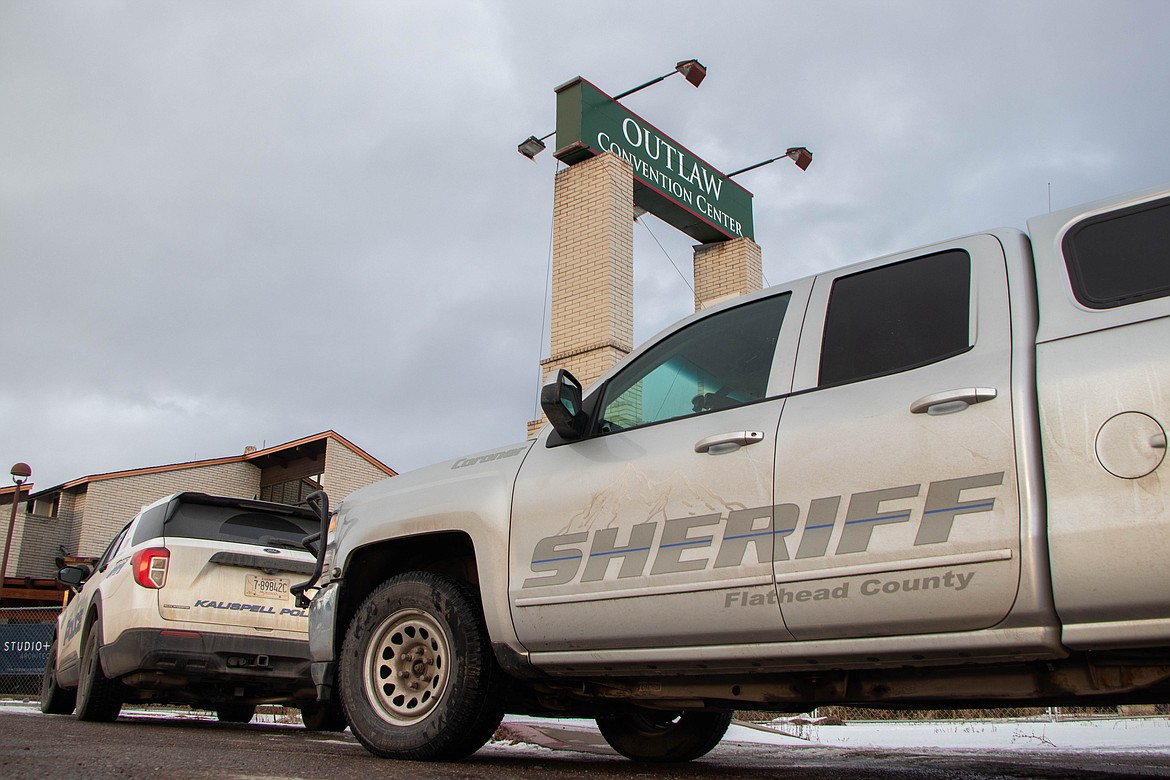
The Kalispell Police Department and Flathead County Sheriff's Department respond to a report of a suspected dead person inside of a building at the area of 18th St. E. and 3rd Ave. E. The investigation is ongoing. (Kate Heston/DailyInterLake)
As police departments across the nation report staff shortages, many Montana cities and towns are exploring new ways to provide law enforcement services. One common solution is to contract with the county sheriff’s department.
In 2023, when a rash of unexpected resignations reduced the Libby Police Department from six employees to one, the Lincoln County Sheriff’s Office stepped in to fill the gaps. Other interlocal law enforcement agreements stretch back decades, but new legislation from Rep. Courtenay Sprunger, R-Kalispell, aims to formalize this process, making it more accessible to small cities and towns throughout the state.
“This is for my neighbors in more rural communities,” said Sprunger.
She introduced House Bill 333 to the House Local Government Committee on Tuesday as “a clear path forward” for municipalities struggling to financially maintain a police force, which is required by state law.
Under Sprunger’s proposed legislation, cities and towns with less than 5,000 residents would be able to circumnavigate this requirement by entering into law enforcement agreements with nearby cities or counties. The bill stipulates that the law enforcement agency must be paid for its services, though a spokesperson for the Montana Sheriffs and Peace Officers Assocation, Brian Thompson, said specific criteria for compensation was initially left out.
“The price for these agreements is incredibly wide and incredibly broad,” said Thompson. “What works for some places, wouldn’t work in others.”
If the parties cannot agree on fair compensation, the bill stipulates that a third party from Montana State University's Local Government Center will facilitate negotiations.
Legal services director for the Montana League of Cities and Towns Thomas Jodoin said the specific negotiation process laid out in the bill is a valuable addition to an already common practice.
“It creates the opportunity for communities to discuss how to achieve proper law enforcement services based on the needs of the community at that local level,” said Jodoin.
House Bill 333 did face opposition from the Montana Association of Counties, though a spokesperson at the hearing clarified that the organization did not oppose the idea of interlocal agreements. Rather, the association advocated for specific changes to the negotiation process, including the requirement that a county commission sign off on the final agreement.
Sprunger said she is actively working with the Montana Association of Counties and plans to incorporate its feedback into an upcoming amendment.
Reporter Hailey Smalley can be reached at [email protected].
ARTICLES BY HAILEY SMALLEY

Trump stumps for Flint in Kalispell as Election Day nears
President Donald Trump, wearing a dark suit, red tie and red USA cap, ambled into the Majestic Valley Arena to the raucous roar of a crowd.

Flathead National Forest greenlights Swan Valley timber project
A 2,307-acre timber project is now under way in the Swan Valley.
Flathead National Forest greenlights Swan Valley timber project
A 2,307-acre timber project is now under way in the Swan Valley.